

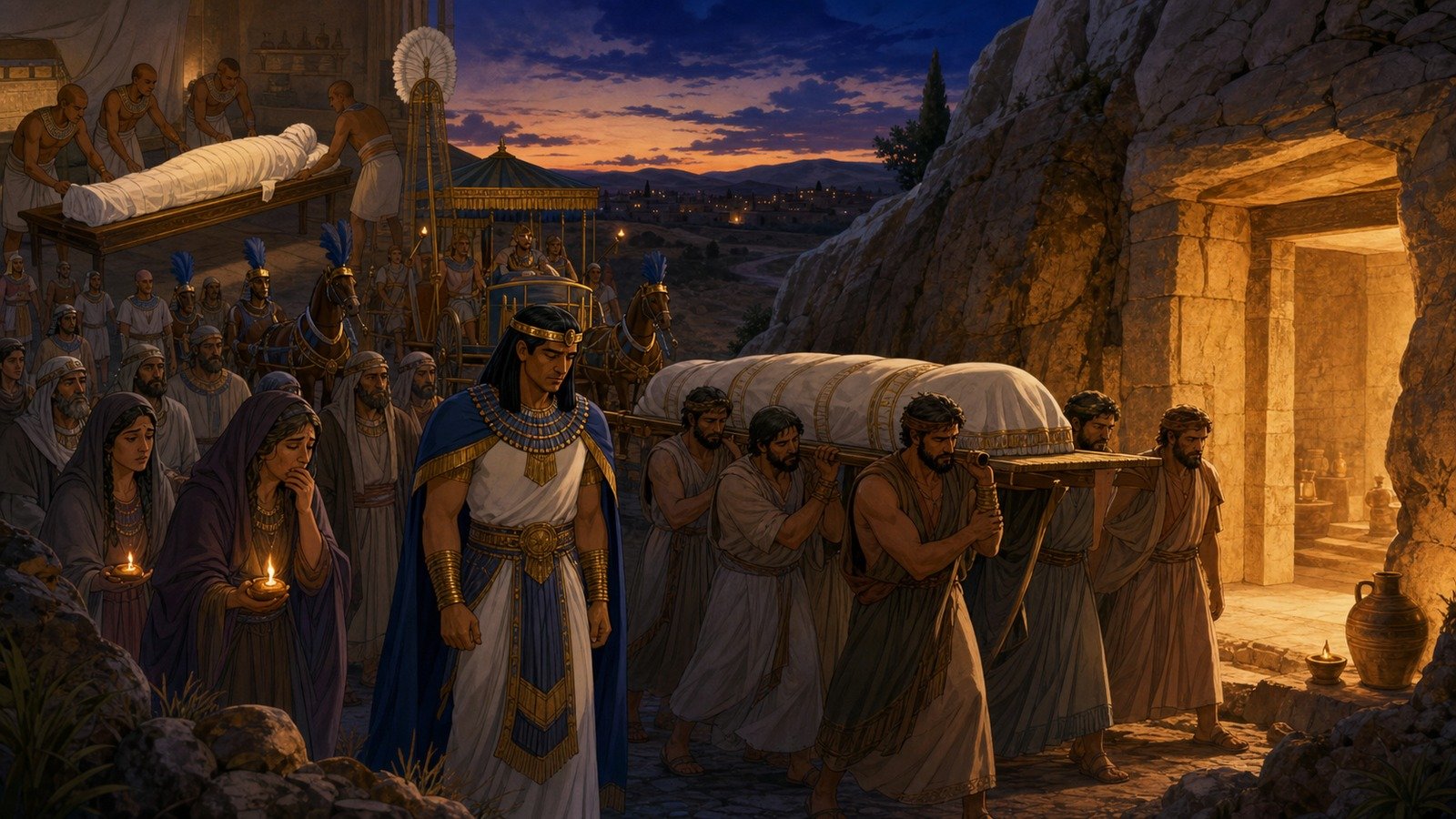
Jacob dies at 147; Joseph has him embalmed and, with Pharaoh's permission, buries him at Machpelah in Canaan alongside Abraham, Sarah, Isaac, Rebekah and Leah.
Further context
2 min readJoseph throws himself on his father, weeps over him and kisses him, and then the scene moves straight into Egyptian administrative procedure.
He orders the physicians in his service to embalm his father, and two figures are given. The embalming took forty days, and the Egyptians mourned for seventy. Both correspond to what is known of Egyptian practice: the full process ran to about seventy days from death to burial, with the body treated with natron for a substantial part of it, and Herodotus, writing much later, gives the same total. Jacob is the only one of the patriarchs to be mummified, and the detail shows how completely the family has entered Egyptian life within a single generation.
The request to leave the country is made through intermediaries rather than in person. Joseph speaks to Pharaoh's court and asks them to put the matter to the king. A man in mourning, unshaven and unwashed, could not appear before the throne under Egyptian convention, which is the usual explanation and fits the circumstances.
Permission is granted and the funeral party is described in terms that make it a state occasion. All Pharaoh's officials go, the dignitaries of his court and the dignitaries of Egypt, together with Joseph's household and his brothers, with chariots and horsemen. Only the children and the flocks and herds stay in Goshen, which is both practical and a guarantee that the party will come back.
They stop at the threshing floor of Atad, described as beyond the Jordan, and hold seven days of mourning there. The Canaanites who see it name the place the mourning of the Egyptians. The route is puzzling, since a party travelling from the Delta to Hebron would normally take the coastal road, and going round to the east side of the Jordan adds a great deal of distance. Explanations offered include avoiding Egyptian frontier garrisons, avoiding the Philistine coast, and following a route suitable for a large procession with wagons. None of them is stated.
The burial itself takes one sentence that lists the deed again: his sons carried him to the land of Canaan and buried him in the cave in the field of Machpelah, near Mamre, which Abraham had bought along with the field as a burial place from Ephron the Hittite. That purchase has now been described at length twice and referred to twice more, which is the emphasis of a family that owns exactly one thing in the country it was promised.
They all go back to Egypt afterwards, and the brothers immediately become frightened that Joseph will finally take his revenge now that their father is gone. They send him a message claiming the old man left instructions that he should forgive them, which reads like an invention, and then throw themselves down in front of him offering to be his slaves. His answer holds two things together without collapsing either: you intended to harm me, but God intended it for good, to accomplish what is now being done, the saving of many lives.