

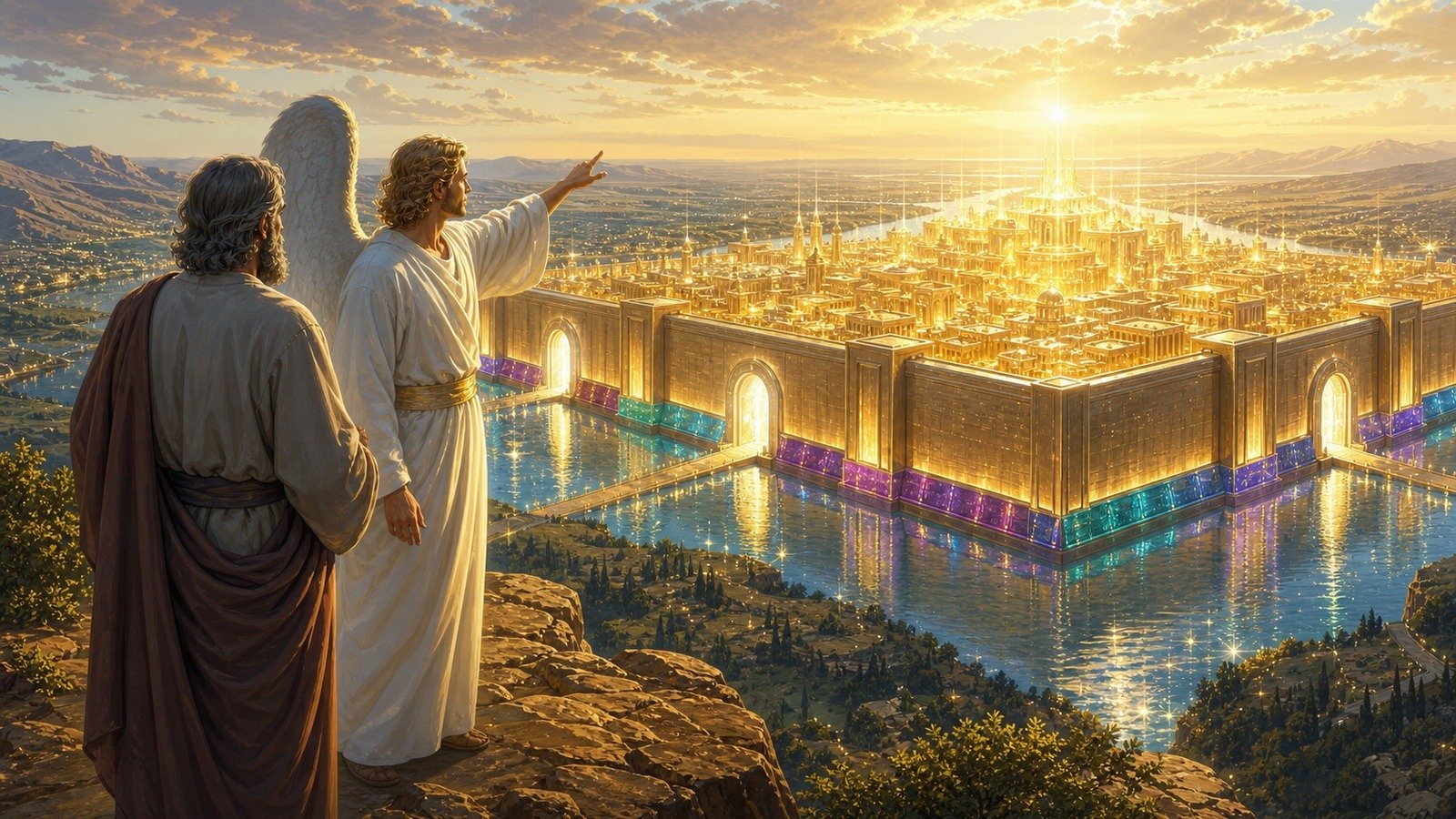
An angel gives John a detailed tour of the New Jerusalem's dimensions, gates and foundations, built of gold and precious stones, noting it has no temple, "because the Lord God Almighty and the Lamb are its temple," and needs no sun, since God's glory is its light.
Further context
3 min readOne of the seven angels who had the bowls carries John away in the Spirit to a mountain great and high, and shows him the Holy City coming down out of heaven from God.
What follows is a survey with measurements, and the figures are all built out of twelve.
It has a great high wall with twelve gates, three on each of the four sides, with twelve angels at the gates, and on the gates are written the names of the twelve tribes of Israel. The wall has twelve foundations, and on them are the names of the twelve apostles of the Lamb.
Israel at the entrances and the apostles in the foundations, in one structure.
The angel measures it with a rod of gold. The city is laid out as a square, and its length, width and height are equal: twelve thousand stadia, which is about two thousand two hundred kilometres in each direction.
A cube that size is roughly the distance from London to the Black Sea, and it is high as well as wide, which is the point at which measurement stops being architecture and becomes something else. Cubes have one obvious precedent in Jewish thought: the innermost room of the temple, where God was said to dwell, which was a perfect cube. What is being described is a holy of holies the size of an empire, with everybody inside it.
The wall is a hundred and forty-four cubits thick, which is sixty-five metres, and made of jasper, while the city itself is of pure gold, as pure as glass.
The twelve foundations are decorated with twelve kinds of precious stone, and the list overlaps substantially with the twelve stones on the breastpiece worn by the high priest, each engraved with the name of a tribe. The twelve gates are twelve pearls, each gate made of a single pearl. The great street is of gold, as pure as transparent glass.
Then the sentence that changes everything: I did not see a temple in the city, because the Lord God Almighty and the Lamb are its temple.
Every previous vision of a restored Jerusalem, including Ezekiel's long one, has a temple at the centre. This one does not, and the reason given is that the building existed to house a presence which is now everywhere in it.
The city does not need the sun or the moon, for the glory of God gives it light, and the Lamb is its lamp. Its gates will never be shut, because there will be no night there.
Twelve thousand stadia is twelve multiplied by a thousand, and the wall of a hundred and forty-four cubits is twelve squared. Every measurement in the survey is built from the number of the tribes and the apostles.
That the wall is measured at all, and that the gates are never shut, is a combination worth noticing. A walled city with permanently open gates is a contradiction in ordinary military terms and an exact description of what is being claimed.
The kings of the earth will bring their splendour into it, and the glory and honour of the nations will be brought into it. The nations that spent the middle of the book following the beast are described at the end walking through the gates carrying things.