

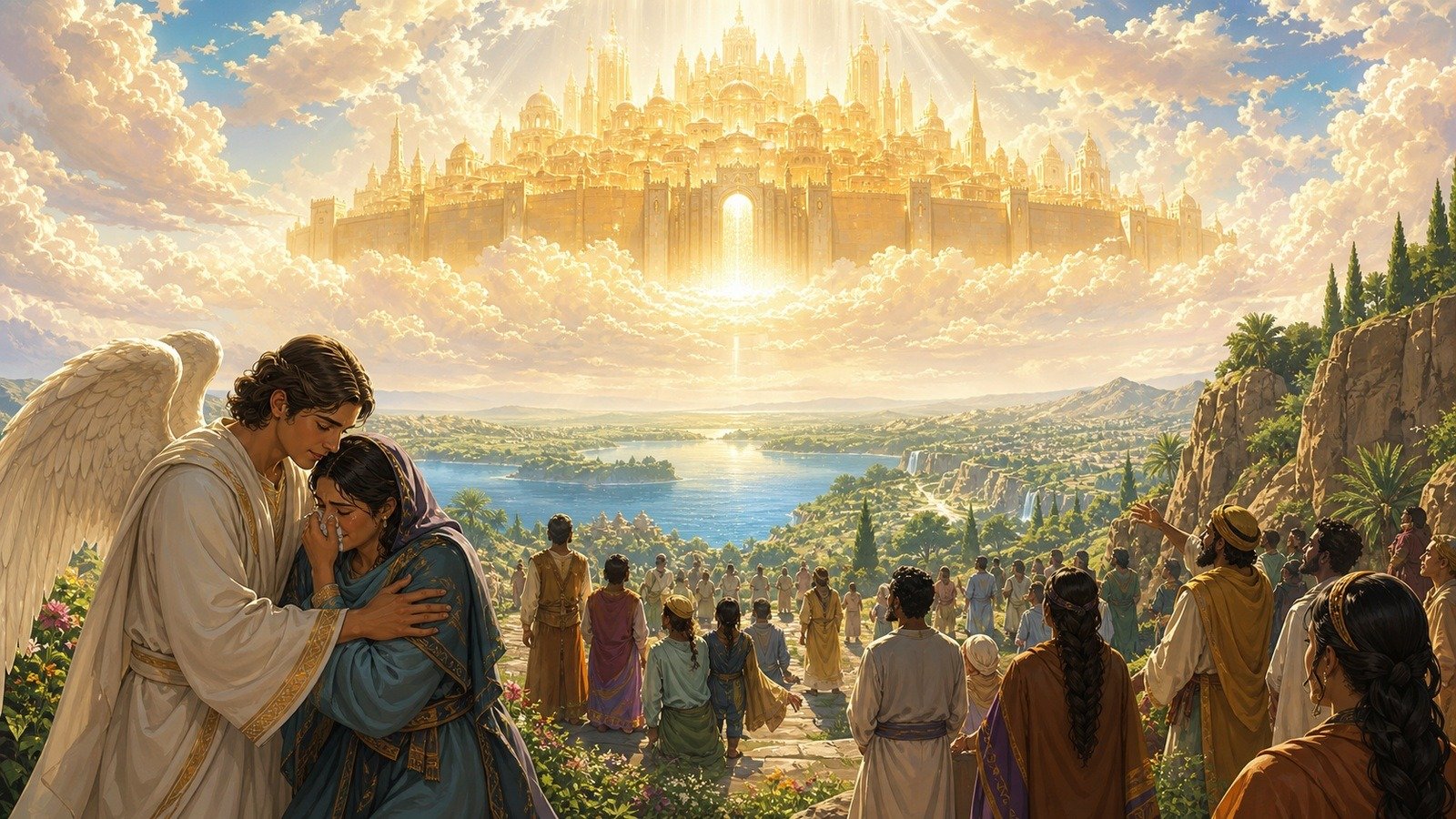
John sees "a new heaven and a new earth," with the old order passed away, and a holy city, the New Jerusalem, descending from heaven "as a bride beautifully dressed for her husband," accompanied by the promise that God will wipe every tear from their eyes.
Further context
3 min readThen I saw a new heaven and a new earth, for the first heaven and the first earth had passed away, and there was no longer any sea.
The absence of the sea is the first thing that strikes a modern reader as a loss and would not have struck a first-century one that way. In the imagery running through the whole Bible the sea is chaos, the place the beast came from, the barrier that separated an exiled writer on Patmos from everyone he was writing to. What is being said is that the thing which divides and threatens is gone.
The word used for new is the one meaning new in kind rather than new in time, so what is described is renewal rather than replacement, and that distinction has carried a great deal of weight in Christian thinking about the material world.
And I saw the Holy City, the new Jerusalem, coming down out of heaven from God, prepared as a bride beautifully dressed for her husband.
The direction of travel is the point. Nobody goes up. The city comes down, and God comes with it.
Then a loud voice from the throne: look! God's dwelling place is now among the people, and he will dwell with them. They will be his people, and God himself will be with them and be their God.
The word for dwelling place is the one for a tent, and its verb is the same one used when the Word became flesh and pitched his tent among us. It reaches back to the tabernacle carried through the wilderness, which was the whole point of that structure: a God who moves in with people.
He will wipe every tear from their eyes. There will be no more death or mourning or crying or pain, for the old order of things has passed away.
Those words are read at more funerals than almost anything else in the Bible, and their force is in the specificity. Not comfort in general, but the removal of four named things, and a hand doing it.
He who was seated on the throne said: I am making everything new! Then he said: write this down, for these words are trustworthy and true.
The passing away of the first heaven and earth has been read as annihilation and replacement, and as transformation of what exists. The vocabulary supports the second more naturally, and Paul's language about creation itself being liberated from its bondage to decay points the same way.
Nothing in the picture is disembodied. There is a city with streets, gates and a river, and people living in it.
The promise about tears is a quotation from Isaiah, who says God will swallow up death for ever and wipe away the tears from all faces. The book quotes it at the point where the older promise is described as arriving.
No longer any sea is the third of four things removed in this section, alongside death, mourning and pain, and grouping it with those is what settles how it is meant.
The city coming down rather than the people going up is the detail most often reversed in popular Christian imagination, and it is stated twice in the space of a few lines.
Everything promised here has been promised to the seven congregations individually in the opening messages: the tree of life to Ephesus, escape from the second death to Smyrna, a name to Pergamum, the morning star to Thyatira, white clothes to Sardis, a pillar to Philadelphia and a place on the throne to Laodicea. The end of the book pays out what the beginning of it offered.