

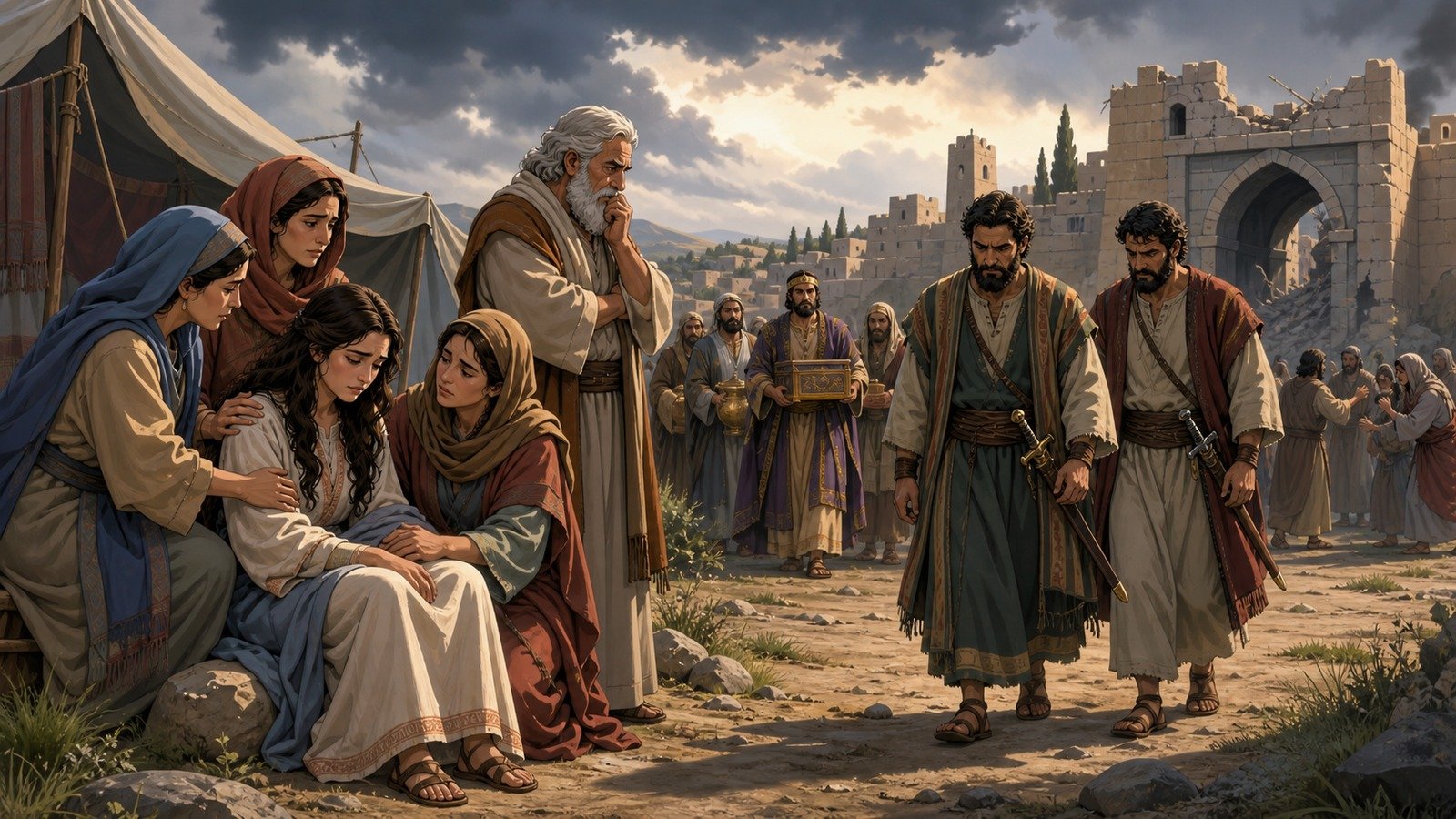
Shechem, son of the local ruler Hamor, rapes Jacob's daughter Dinah and then seeks to marry her. Simeon and Levi deceive the Shechemites into circumcision, then massacre them while incapacitated, an act Jacob later condemns on his deathbed.
Further context
2 min readDinah never speaks. She goes out to visit the women of the land, and Shechem, son of Hamor the Hivite and ruler of the city that carries his name, sees her, takes her and violates her. The Hebrew verbs describe force and humiliation, and translations that soften them are not supported by the vocabulary. From that point everything said about her is said by somebody else, and she is not heard from again anywhere.
What follows is stranger than the assault. His heart is drawn to her, he loves her, he speaks tenderly to her, and he asks his father to get her for him as a wife. Hamor comes to Jacob with a proposal that goes far beyond one marriage: general intermarriage between the two communities, freedom to trade, and land to settle in. Shechem adds that he will pay any bride price demanded, however great.
Jacob has heard what happened and says nothing until his sons come in from the fields. That silence is noted twice.
The brothers arrive filled with grief and fury, because a disgraceful thing has been done. Their answer is delivered deceitfully, and it is described as deceitful before it is quoted. They cannot give their sister to an uncircumcised man; if every male in the city is circumcised, the two peoples can become one. Hamor and Shechem take the proposal to the men at the city gate and sell it on frankly commercial grounds: will not their livestock, their property and all their other animals become ours? Every male in the city agrees.
On the third day, while they are still in pain, Simeon and Levi take their swords, walk into the city unopposed and kill every male including Hamor and Shechem, and take Dinah out of Shechem's house. The other brothers then plunder the place, seizing flocks, herds, donkeys, wealth, women and children.
Jacob's response is the only thing he says, and it is about consequences rather than about right and wrong. You have brought trouble on me by making me obnoxious to the Canaanites and Perizzites. We are few in number, and if they join forces against me I and my household will be destroyed.
The brothers' reply is the last line, and their father is given no answer to it: should he have treated our sister like a prostitute?
The argument is left unresolved where it stands and settled much later. In his final words over his sons, Jacob curses the anger of Simeon and Levi, calls their fury cruel, and declares that he will scatter them in Jacob and disperse them in Israel. Both tribes lose a continuous territory: Simeon's allotment ends up absorbed inside Judah, and Levi receives no tribal land at all, only towns scattered among the others. The verdict falls on the method and the deceit, not on the grievance behind them.
Nobody in the episode comes out of it with credit except possibly the brothers' anger itself. A city is wiped out over an offence committed by one man, its population is enslaved, and a father's objection is that it was bad for business.