

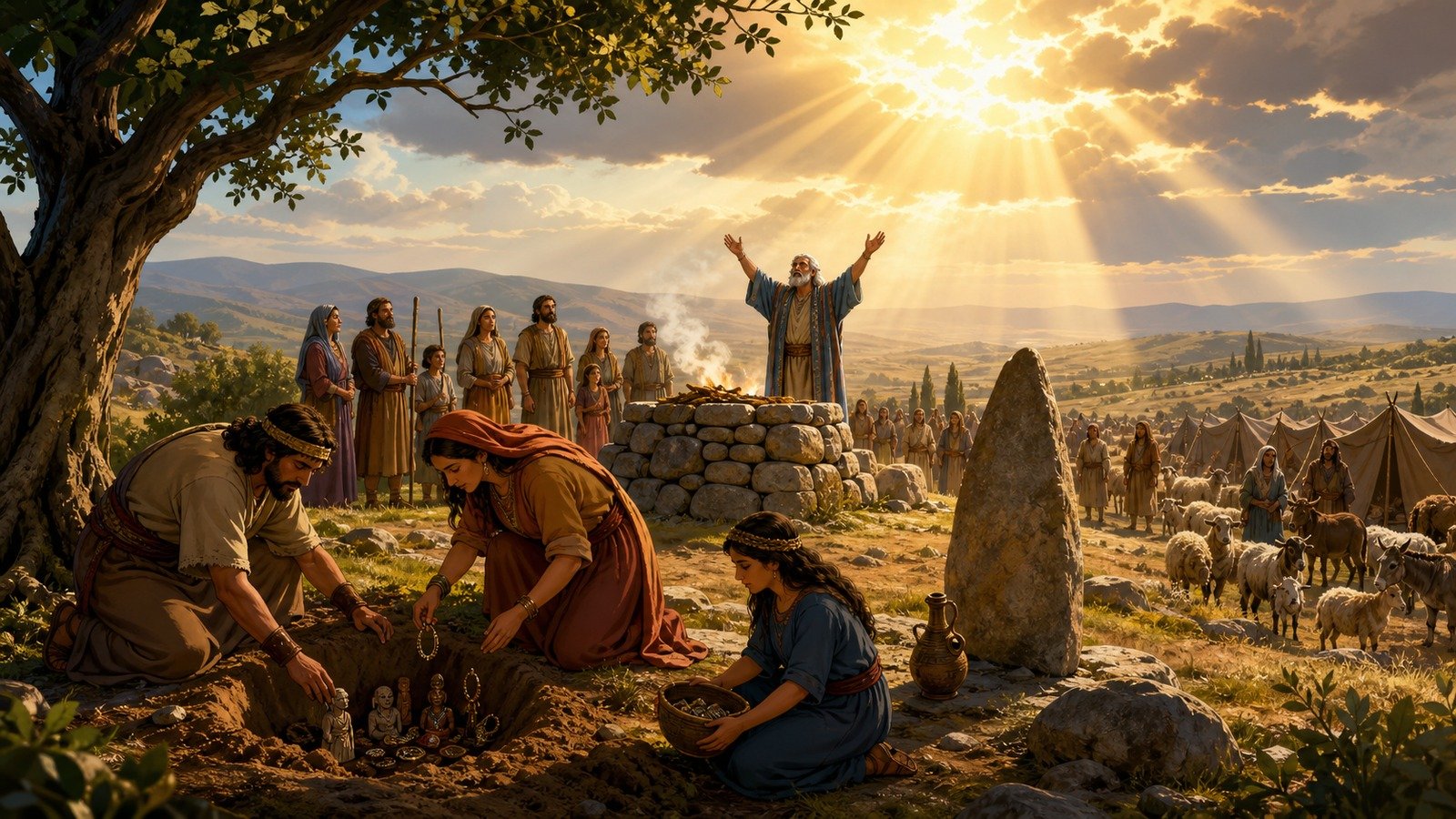
God calls Jacob back to Bethel to renew his vow; Jacob has his household rid itself of foreign gods first, and God reaffirms both his new name, Israel, and the covenant promise.
Further context
2 min readThe instruction comes immediately after a massacre. Go up to Bethel and settle there, and build an altar there to God, who appeared to you when you were fleeing from your brother Esau. He is being sent back to the hillside where he slept on a stone as a fugitive thirty years earlier, with two sons who have just emptied a town.
His first act is a purge of his own household. He tells everyone with him to get rid of the foreign gods they have, to purify themselves and to change their clothes. They hand over their gods and the rings in their ears, and he buries the lot under the oak at Shechem. A household carrying the promise had been keeping other gods in it for years, including whatever Rachel took from her father, and nobody had raised it until now.
They travel, and one sentence explains why a caravan with two hundred armed enemies behind it was not attacked: the terror of God fell on the towns around them, and no one pursued them.
At Bethel he builds the altar and names the place God of Bethel, because it was there that God revealed himself when he was running away. One incidental death is recorded, and it is the only trace preserved of a whole household. Deborah, Rebekah's nurse, dies and is buried under an oak below Bethel, and the tree is named the oak of weeping. Rebekah's nurse is in Canaan, so her mistress's household did travel south, and Rebekah herself is never mentioned alive again after she sent her son away.
God appears once more and does two things. The renaming at the river is confirmed formally: your name is Jacob, but you will no longer be called Jacob; your name will be Israel. And the promise given to Abraham and Isaac is restated to him in his own right, with an addition. A nation and a community of nations will come from you, and kings will be among your descendants, and the land given to Abraham and Isaac is given to him and to those who follow him.
The mention of kings is new. Nothing said to Abraham or Isaac spoke of a monarchy, and the addition points forward across the whole of the later histories.
He sets up a stone pillar at the spot, pours out a drink offering on it and pours oil over it, and names the place Bethel a second time. The vow he made there as a young man was conditional: if God will be with me and watch over me and bring me back safely, then the LORD will be my God. He has come back with eleven sons, four women, flocks, servants and a limp, and the pillar he once anointed alone is anointed again in front of his whole household.
The burial of the foreign gods under that oak has a long afterlife. Joshua ends his career at the same place, telling the assembled tribes to throw away the foreign gods among them and setting up a stone as a witness. Two covenant renewals separated by centuries happen on the same ground and turn on the same instruction.