

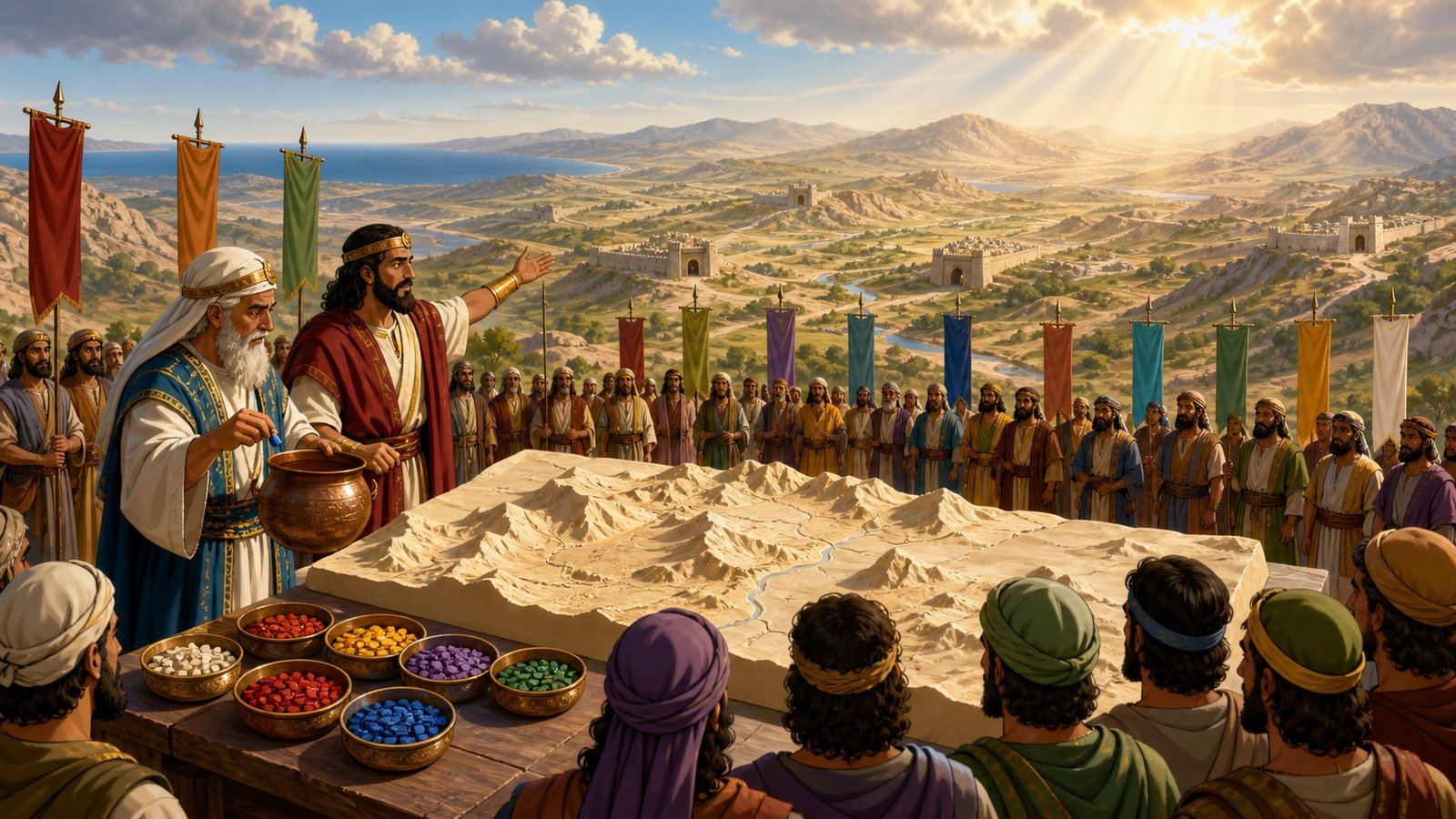
Joshua and Eleazar oversee the allotment of Canaan by tribe and by lot, including forty-eight Levitical towns and six cities of refuge for those guilty of accidental killing, fulfilling the land promise first made to Abraham.
Further context
2 min readNine and a half tribes still need territory, since Reuben, Gad and half of Manasseh already have theirs east of the Jordan. What follows is a land registry: boundary descriptions running from landmark to landmark, town lists, and disputes settled by name.
The method is the lot, cast in front of the tent at Shiloh, which removes human preference and prevents the strongest tribes taking the best ground. Judah receives the southern hill country, Ephraim and Manasseh the centre, and the remaining seven are surveyed and divided into seven portions before lots are cast for them, because they had been slow to go and take possession.
Levi receives no territory at all, and this is stated repeatedly. The tribe that handles the sanctuary is given forty-eight towns scattered among the others, with pasture around them, so that the priests and Levites live distributed through the whole country rather than concentrated in one place. The stated reason is that the offerings made to the LORD are their inheritance. A professional religious class with no land base cannot become a regional power and cannot be bought out by one, and the arrangement is deliberate.
Six of those forty-eight are designated as cities of refuge, three on each side of the Jordan, spaced so that no part of the country is far from one. Anyone who kills another person accidentally may run to one and stay there safely until a trial, which prevents the blood feud from starting before anyone has established what happened. The distinction drawn is between killing without intent and killing with malice aforethought, and the second gets no protection.
Caleb's claim is handled separately and is the one piece of human detail in the whole registry. He is eighty-five, and he asks for the hill country he scouted forty-five years earlier, where the descendants of Anak had their fortified towns and where his ten colleagues lost their nerve. Give me this hill country, he says, and points out that he is as strong now as he was then. He takes Hebron.
The daughters of Zelophehad also appear, presenting themselves to Eleazar and Joshua and reminding them of the ruling made in Moses' lifetime, and they receive an inheritance among their father's relatives. A legal decision taken on the plains of Moab is enforced in the field a decade later by the women who won it.
The boundary descriptions themselves are worth a moment. They run from wadi to ridge to spring to named tree, in the manner of every land survey in the region before maps existed, and a great many of the places in them can no longer be located. What survives is a document that behaves like a registry rather than like a story, listing towns in groups with totals at the end of each group, and it is one of the reasons this material is generally thought to preserve very old administrative records.
Shiloh, in the hill country of Ephraim, becomes the site of the tent and the centre of national worship for the next three centuries, until the Philistines destroy it. The site has been excavated and shows a substantial destruction layer in the eleventh century BC, which fits the period when the ark was captured in battle and never came back there.