

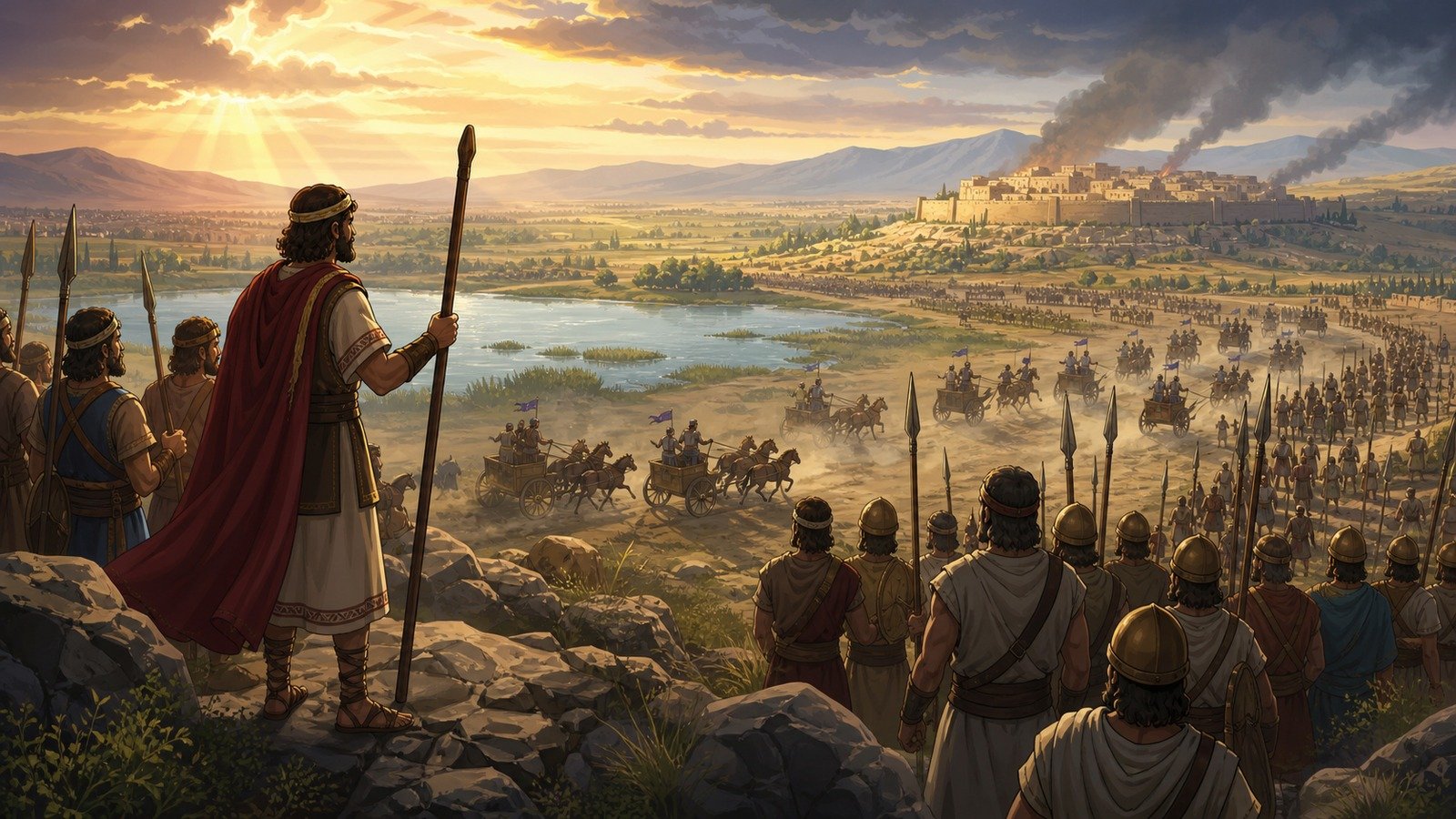
Joshua defeats a northern coalition led by Jabin of Hazor, burning the city, and Joshua 12 summarises the full list of kings defeated on both sides of the Jordan. The text notes land still remained to be taken even after the main campaigns ended.
Further context
2 min readJabin king of Hazor forms the northern coalition, and the force described is different in kind from anything in the south: a huge army, as numerous as the sand on the seashore, with a great number of horses and chariots. Chariots on the plains of Galilee are a serious problem for infantry, and the northern valleys are exactly where they can be used.
The attack comes at the Waters of Merom, and the instruction given afterwards is unusual: hamstring their horses and burn their chariots. The captured equipment is destroyed rather than used. An army that has just acquired the most valuable military technology in the region is told to make it unusable, and Israel fields no chariot force for another three centuries, until Solomon.
Hazor is singled out and burned, and the reason given is that it had been the head of all these kingdoms. That description is accurate in a way nobody could have guessed before the site was excavated. Hazor covers about eighty hectares, roughly ten times the size of Jerusalem in the same period, and it is the largest Bronze Age site in the country. It appears in the archives at Mari on the Euphrates and in Egyptian records, which confirms it was a power in its own right. Yigael Yadin's excavations in the 1950s found a violent destruction layer in the Late Bronze city, with burning, smashed statues and decapitated images, and Amnon Ben-Tor's later work confirmed it. Who did it remains argued over, with Israelites, Egyptians, Sea Peoples and rival Canaanites all proposed.
Hazor is also the only town in the northern campaign that Joshua is said to have burned. The others were taken but left standing, which is a practical policy for a population intending to live in them.
The closing summary lists thirty-one defeated kings by name, and states that Joshua took the entire land and gave it as an inheritance, and that the land had rest from war.
Alongside that stands a sentence a few paragraphs later saying that very much land remains to be taken, and then a whole book describing Canaanite towns still holding out. The tension is not a slip. What is being claimed is a decisive break in organised resistance, not the removal of every population, and the difference between defeating a coalition and occupying a country is the subject of everything that follows.
How long the campaigning took is never stated precisely. Caleb says later that forty-five years passed between the scouting mission and his claiming of Hebron, which places the fighting at roughly five to seven years.
The destruction of the chariots deserves one more sentence. Hamstringing a horse severs the tendon above the hock and permanently disables it, and it was a standard way of denying captured animals to an enemy. Doing it to your own captured stock, and burning the vehicles, is different: it forecloses an option. A generation later Israel is still fighting infantry battles in hill country and losing the plains, and the reason given for the original instruction is that this army was not to become the thing it had just defeated.