

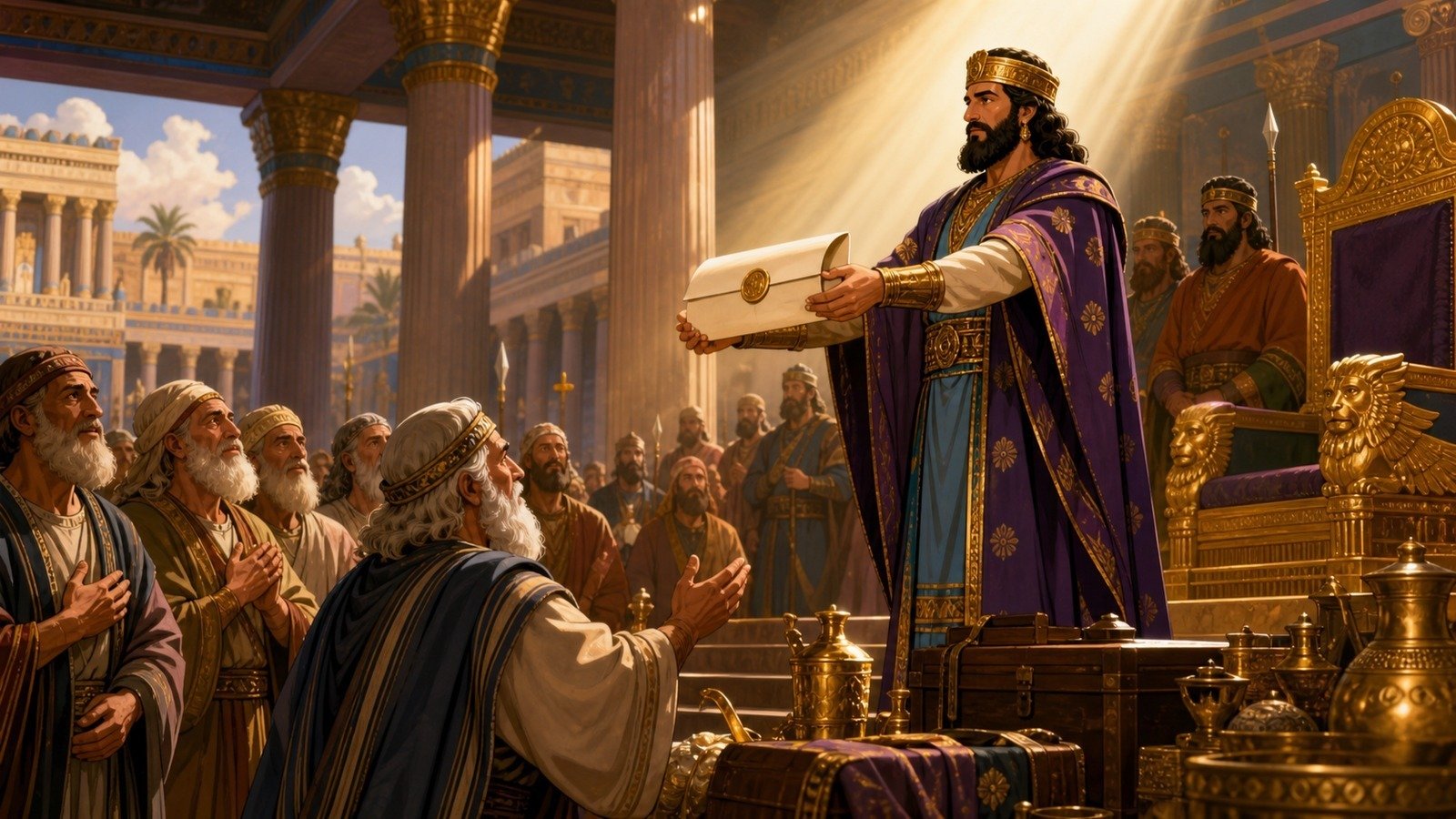
Cyrus issues a decree permitting exiled peoples to return home and rebuild their temples, framed in Ezra as a direct act of God stirring the Persian king's spirit.
Further context
3 min readIn the first year of his reign over Babylon, a proclamation is issued throughout the empire and put in writing, and its terms are specific. Anyone from the exiled people of Judah who wishes to may go up to Jerusalem and rebuild the house of the LORD there, and their neighbours are to provide them with silver and gold, goods and livestock, and freewill offerings for the building.
A second version of the decree, quoted later as an administrative memorandum found in the archives at Ecbatana, adds detail of a kind that is hard to invent: the height and width of the building are specified, the costs are to be paid from the royal treasury, and the gold and silver articles taken from the temple by Nebuchadnezzar are to be returned. That version is written in Aramaic, which was the administrative language of the empire, while the surrounding narrative is in Hebrew, which is the pattern a genuine filed document would produce.
The number of vessels returned is itemised: thirty gold dishes, a thousand silver dishes, twenty-nine silver pans, thirty gold bowls, four hundred and ten matching silver bowls, and a thousand other articles, five thousand four hundred in total, handed over to Sheshbazzar, prince of Judah, when the exiles came up from Babylon.
The policy behind it is not sentiment. Persia governed a very large territory by conciliating local religions rather than suppressing them, and restoring a temple in a small province on the Egyptian frontier bought loyalty on a route the empire needed. The Cyrus Cylinder describes the same approach elsewhere. What is unusual about Judah is that its people had no image to bring home, only vessels and a memory of a building.
The exiles who go are not the ones who left. Nearly fifty years have passed since the destruction, and most of those returning were born in Babylonia and had never seen Jerusalem. Many others do not go at all. The Jewish community in Mesopotamia stays, prospers, and remains the intellectual centre of Judaism for well over a thousand years, producing the Babylonian Talmud.
Sheshbazzar's title in the decree, and the instruction that the costs be met from the royal treasury, both indicate that this was handled as a provincial infrastructure project rather than as an act of piety. Imperial subsidy for a rebuilt temple was normal Persian practice and appears in other cases, including a well-documented instance in Egypt.
The proclamation is framed in the record as an answer to something rather than as a policy decision: in order to fulfil the word of the LORD spoken by Jeremiah, the LORD moved the heart of Cyrus king of Persia to make a proclamation. An imperial decree issued for reasons of state is described from the other end as the closing of a seventy-year sentence.
The decree is preserved twice, once in Hebrew as a proclamation and once in Aramaic as an administrative memorandum found later in the archives at Ecbatana, and the two versions differ in exactly the way an announcement and a filed order would.
The Aramaic version contains the details a bureaucracy would record: the dimensions of the building, the specification that three courses of large stones should alternate with one of timber, and the instruction that the costs are to be paid from the royal treasury.
The vessels taken from the temple by Nebuchadnezzar are handed back and counted, and the inventory is given: thirty gold dishes, a thousand silver dishes, twenty-nine silver pans, thirty gold bowls, four hundred and ten matching silver bowls and a thousand other articles.
Somebody had kept them, catalogued, for half a century, which says something about how Babylonian administration worked.