

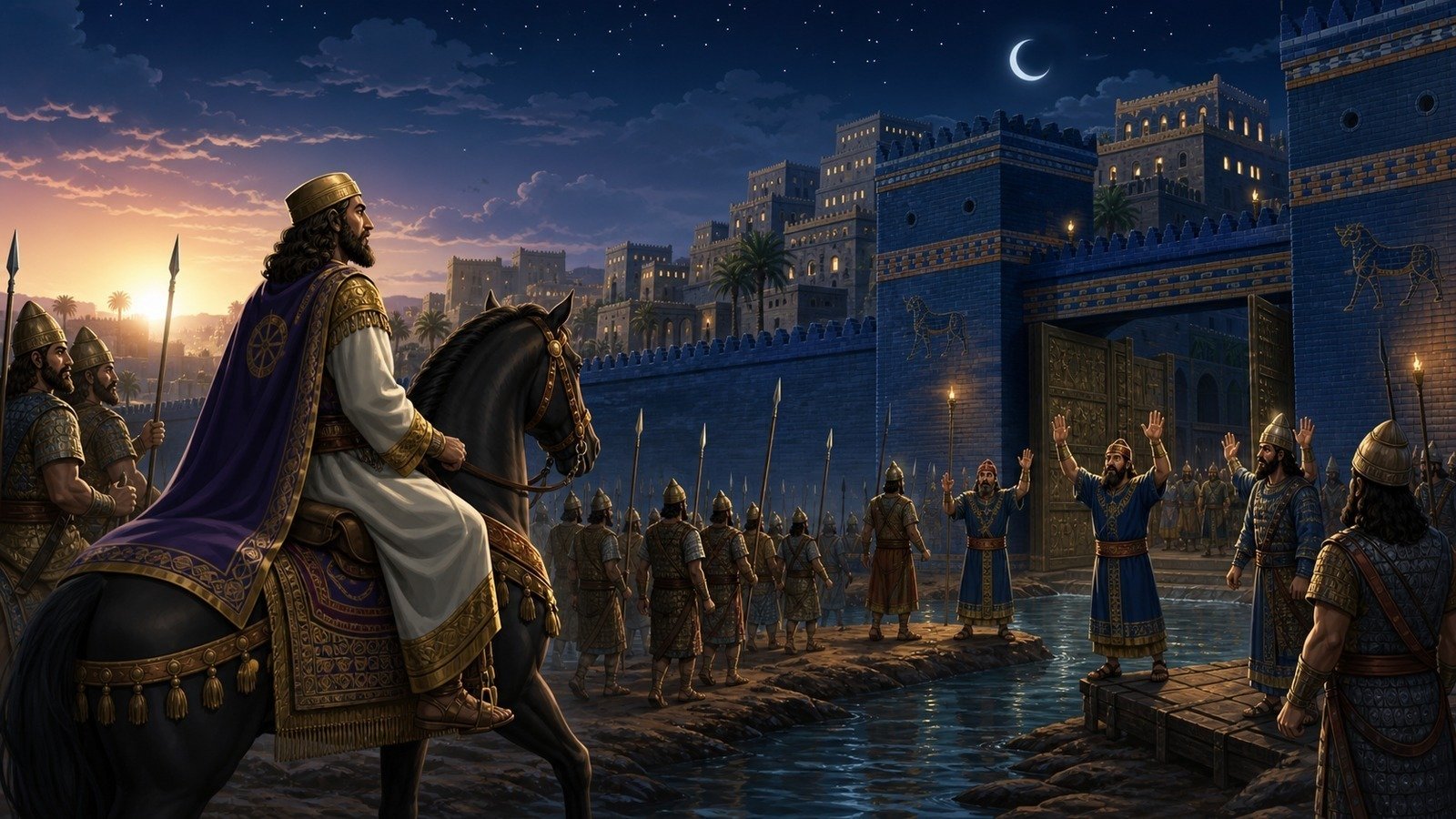
Cyrus the Great of Persia takes Babylon, ending the Babylonian empire and, within the Biblical narrative, fulfilling Isaiah's much earlier prophecy naming Cyrus by name as God's chosen instrument to release Judah from exile.
Further context
3 min readThe city falls in October 539 BC and the manner of it is unusual: there is no siege and no destruction. The Babylonian army is defeated at Opis, Sippar surrenders, and Babylon itself is entered without a battle. Nabonidus is captured. Cyrus enters the city about two weeks later and is received without resistance.
Two contemporary documents describe it. The Nabonidus Chronicle, a Babylonian record, reports the army entering without fighting. The Cyrus Cylinder, a foundation deposit written in Akkadian in Cyrus's own name and now in the British Museum, presents the conquest as the local god Marduk choosing him because the previous king had neglected the proper worship, and describes him restoring sanctuaries and returning displaced peoples and their gods to their own cities.
That policy is the reason Cyrus matters here. Assyria and Babylon had governed by deportation, breaking populations away from their land to prevent rebellion. Persia reversed it, and the cylinder describes gathering inhabitants and returning them to their settlements as a deliberate imperial programme. Judah is not mentioned in it, which is worth saying plainly, but the policy it describes is exactly the one the return from exile happens under.
The extraordinary thing in the Hebrew scriptures is that Cyrus is named. Isaiah calls him by name twice, describes him as the LORD's anointed, and says that God will take hold of his right hand to subdue nations before him and to open doors so that gates will not be shut. Anointed, in Hebrew mashiach, is the word used of Israelite kings and priests, and it is applied here to a Persian who does not know the God who is using him: I summon you by name and bestow on you a title of honour, though you do not acknowledge me.
Whether that naming is prediction given a century and a half in advance, or a later writer describing a contemporary, is exactly the question that divides the argument about the authorship of the second half of that book, and it has no agreed answer.
The fall of Babylon also closes a promise. Jeremiah had said the desolation would last seventy years, and the interval from the first deportation in 605 BC to the decree of Cyrus in 538 BC is sixty-seven years, or seventy from 605 to the completion of the second temple in 516, or seventy from the destruction of the temple in 586 to that same rebuilding. Several countings work and none is exact to the year, which is characteristic of round numbers in that world.
One consequence of the manner of the conquest is worth stating. Because Babylon was taken intact rather than sacked, its archives, temples and administration continued to function, and the Judaean community living there was not displaced by the change of regime. The people who eventually went home did so as a matter of choice under a new policy, not as refugees from a second catastrophe.
The empire that had burned the temple lasted less than fifty years after doing it.
Cyrus took Babylon in October 539 BC, and the Babylonian sources say it fell without a battle. The Nabonidus Chronicle records that the army entered the city without fighting and that Cyrus arrived later to general rejoicing, and Greek historians preserve an account of the Euphrates being diverted so that troops could enter along the riverbed.
The Cyrus Cylinder, a clay barrel found at Babylon in 1879 and now in the British Museum, is his own version. It presents him as chosen by Marduk to restore order, describes the return of gods to their sanctuaries and of displaced peoples to their homes, and is the standard statement of a Persian policy quite different from the Assyrian and Babylonian one.
That policy is what makes the return possible. Deportation had been the instrument of empire for two centuries, and Cyrus reversed it as a matter of administration.