

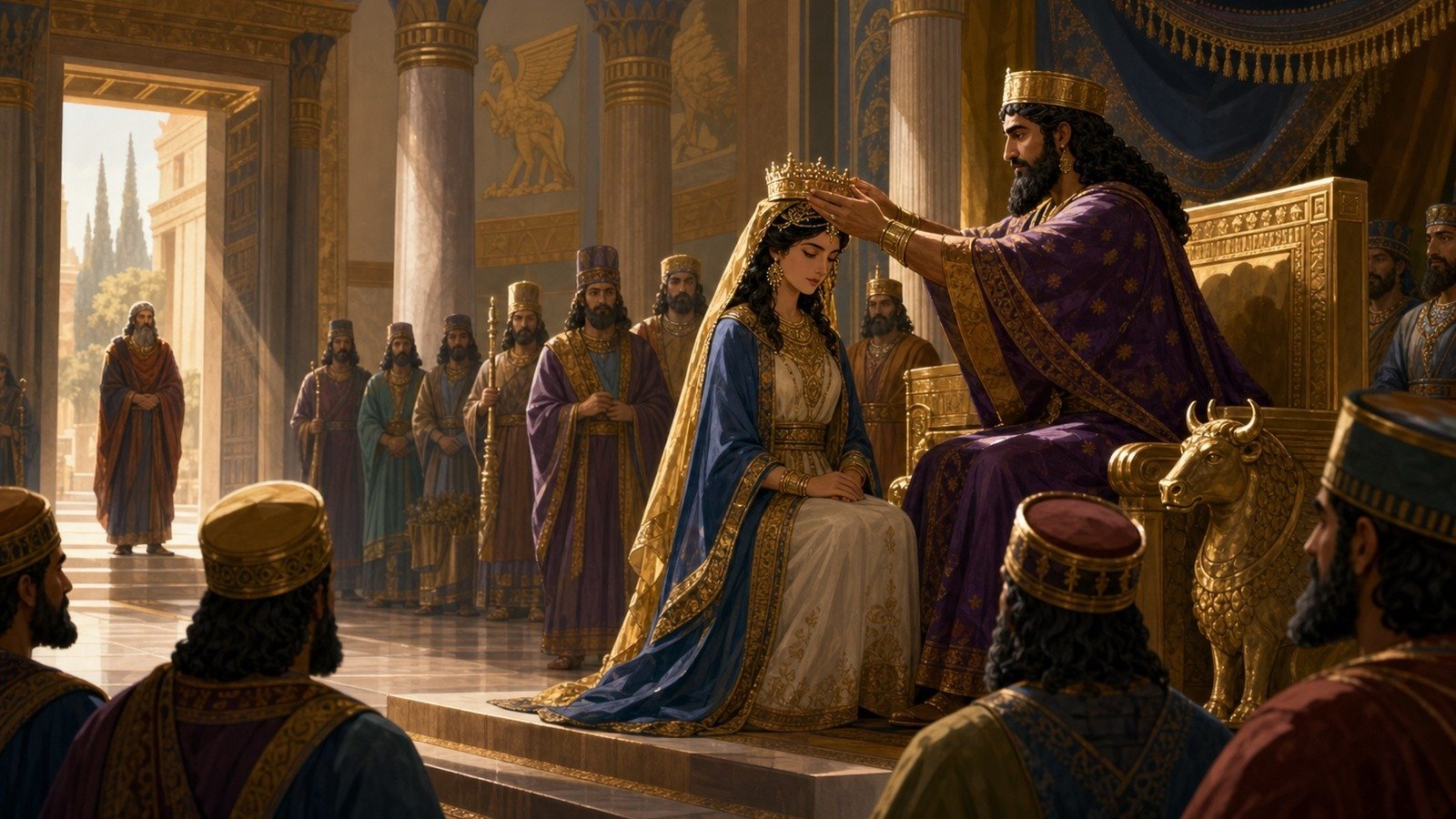
After Queen Vashti's removal for refusing a public summons, a kingdom-wide search brings the Jewish orphan Esther, raised by her cousin Mordecai, into King Xerxes' court, where she is chosen queen without revealing her Jewish identity.
Further context
3 min readThe setting is the winter capital at Susa in the reign of Xerxes I, who is called Ahasuerus in Hebrew and who is very well documented in Greek and Persian sources. He ruled from India to Cush over a hundred and twenty-seven provinces, and the banquet that opens the story lasts a hundred and eighty days followed by a further seven, which is consistent with Greek accounts of Persian court display.
Queen Vashti is summoned to appear before the guests wearing her royal crown, in order to display her beauty, and she refuses. Nothing explains why, and the refusal is the hinge of everything. The king consults his legal experts, who advise that the matter is constitutional rather than domestic: the queen's conduct will become known to all the women, and they will despise their husbands. A decree is issued and written into the irrevocable laws of Persia and Media, and she is deposed.
The search for a replacement is described with unsettling clarity. Beautiful young virgins are gathered from every province into the harem under the care of a eunuch, given beauty treatments for twelve months, six with oil of myrrh and six with perfumes and cosmetics, and each goes to the king in turn and afterwards moves to a second harem for concubines and does not return unless he is pleased with her and summons her by name.
Esther is a Jewish orphan raised by her cousin Mordecai, and he tells her not to reveal her nationality. She is taken into the palace under those conditions and she pleases the king more than any of the others, and he sets a royal crown on her head and makes her queen.
The name Esther is Persian or Babylonian, most plausibly connected with the goddess Ishtar, and her Hebrew name is given separately as Hadassah, meaning myrtle. Mordecai's name contains the element Marduk, the chief god of Babylon. Two Jews in the Persian civil service carrying names built out of Mesopotamian deities is an accurate picture of what four generations in exile had done to a community's naming habits.
Two features of the book are worth stating because they shape everything in it. God is never mentioned, not once, in the whole of it, and neither is prayer, the law, the temple or Jerusalem. And nothing supernatural happens anywhere. What the story consists of is timing: a refusal at a banquet, an overheard assassination plot, a king unable to sleep on the right night, a request made at the right moment.
Mordecai's overhearing of the plot against the king is recorded in the annals and then forgotten, which is the detail that saves everyone five years later.
The two contemporary lots and edicts are the machinery the whole book runs on, and both are Persian. The lot chosen to fix a date, the irrevocability of a sealed decree, the mounted courier service and the written record of daily events are all attested features of that administration, and the story could not be told about any other empire.
Xerxes was assassinated in 465 BC, which is the end of the reign this all happens inside.
The book opens with a banquet lasting a hundred and eighty days followed by a seven-day feast for everyone in the citadel of Susa, and the description of the setting is unusually detailed: white and blue linen hangings fastened with cords of white linen and purple material to silver rings on marble pillars, couches of gold and silver on a mosaic pavement.
Excavations at Susa have uncovered the palace complex, including a great columned hall, and the physical layout matches the movements in the story closely enough that the writer knew the building.
Queen Vashti is deposed for refusing to appear before the guests, and the reason given by the king's advisers is a general one: the queen's conduct will become known to all the women, and they will despise their husbands.
Esther conceals her nationality on Mordecai's instruction, and why he thought it necessary is never explained.