

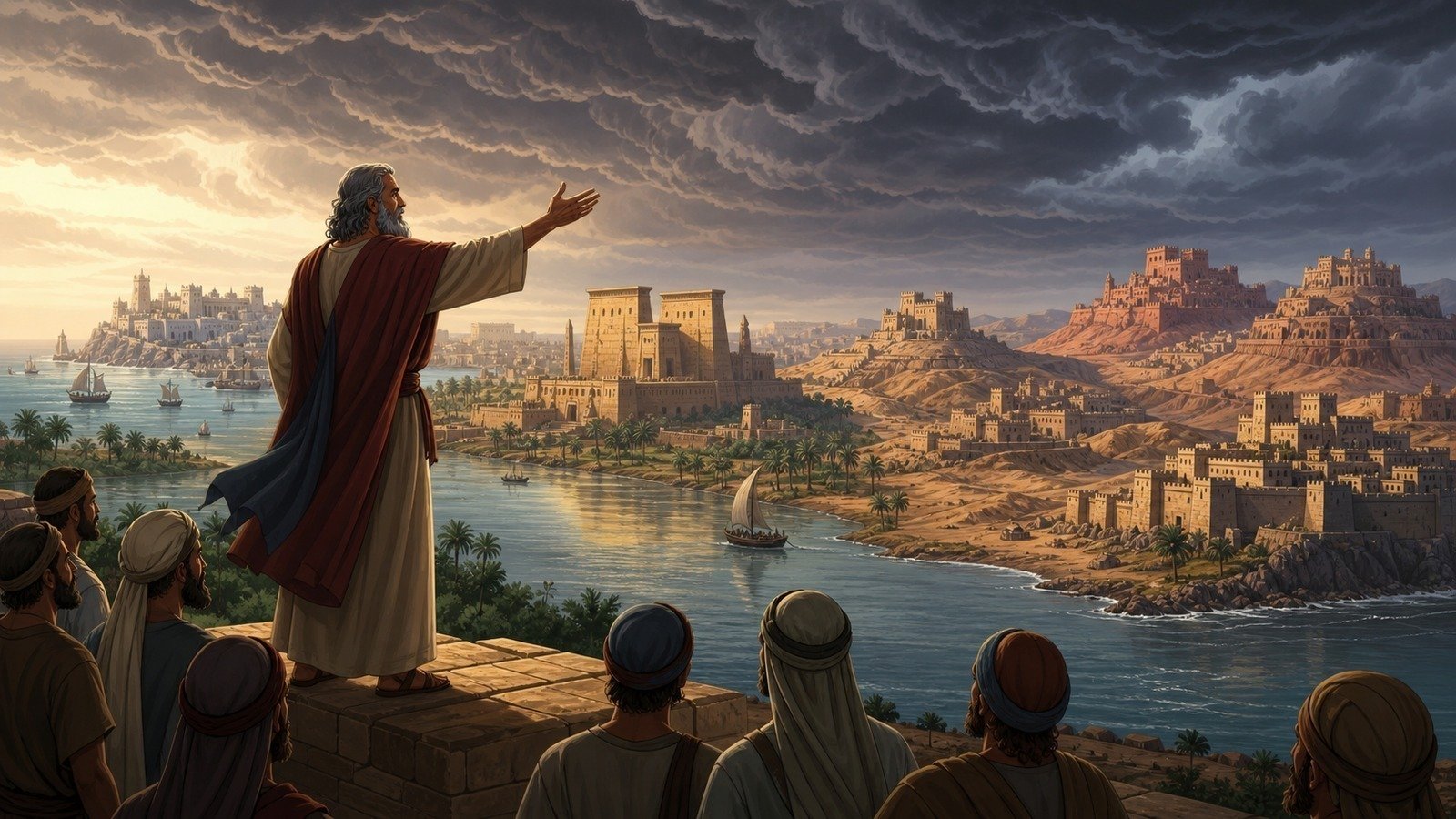
Ezekiel pronounces judgement on Judah's neighbours, including Ammon, Moab, Edom, Philistia, Tyre and Egypt, for their hostility toward Judah or their own arrogance, extending the scope of his ministry beyond Israel itself.
Further context
3 min readBetween the material about Jerusalem's fall and the material about restoration sits a long block addressed to seven foreign peoples, and the arrangement is deliberate. Judgement on Judah comes first, then judgement on everyone else, then the promises. A God who punishes only his own people would be a tribal deity with unusually high standards; the middle section is there to say that the same standard applies everywhere.
Ammon, Moab, Edom and Philistia are dealt with briefly, and the charge against each is what they did while Jerusalem was falling. Ammon clapped its hands and rejoiced. Edom took revenge and is condemned at length in several other books for the same thing: standing at the crossroads to cut down the fugitives and handing over survivors.
Tyre gets three chapters, and they are among the most detailed descriptions of ancient commerce that survive from any source. The city is portrayed as a merchant ship built of the best materials from everywhere: pine from Senir, cedar from Lebanon, oaks from Bashan, sails of Egyptian linen, awnings of blue and purple from Cyprus. Then the trading partners are listed with what each supplied: silver, iron, tin and lead from Tarshish; slaves and bronze from Greece and Anatolia; horses and mules from Beth Togarmah; ivory and ebony; turquoise, purple fabric, embroidered work, fine linen, coral and rubies; wheat, honey, olive oil and balm from Judah; wine and wool; cassia and calamus; lambs, rams and goats from Arabia; spices, precious stones and gold. It is a functioning inventory of Iron Age Mediterranean trade, and historians use it as one.
The charge against Tyre is what it said when Jerusalem fell: aha, the gate to the nations is broken, and now that she lies in ruins I will prosper. A commercial rival celebrating a competitor's destruction.
Egypt gets four chapters and the longest single oracle. The image used is a great monster lying among its streams saying, the Nile is mine; I made it for myself, and the judgement is that it will become the lowliest of kingdoms and never again exalt itself above the nations. The dating attached to one of those oracles, the twenty-seventh year of the exile, is the latest internal date anywhere in the book, which means he was still working around 571 BC, more than twenty years after his call.
Two passages inside the Tyre material describe a figure of extraordinary beauty and wisdom, adorned with precious stones, in Eden, on the holy mount of God, who became proud and was cast down. Christian tradition from the early centuries onwards has read those lines as describing the fall of Satan behind the figure of the king, and other readers take them as royal hyperbole aimed squarely at a Phoenician monarch.
Seven nations are addressed: Ammon, Moab, Edom, Philistia, Tyre, Sidon and Egypt, and the Tyre material runs to three chapters, more than any other.
Tyre was a Phoenician island city with two harbours, immensely wealthy from trade and dyeing, and the oracle against it is written as a shipwreck. The city is a ship built of the finest materials from everywhere, with a crew and merchants from a list of two dozen places, and it goes down at sea with all its cargo.
The historical outcome is unusual. Nebuchadnezzar besieged Tyre for thirteen years and did not take the island, and Ezekiel says so afterwards in plain terms: he got no wages for the campaign. Alexander took it two and a half centuries later by building a causeway out to it, which is still there and has silted up into an isthmus.
The oracles against Egypt are dated by year and month, and one of them is the last dated word in the book.