

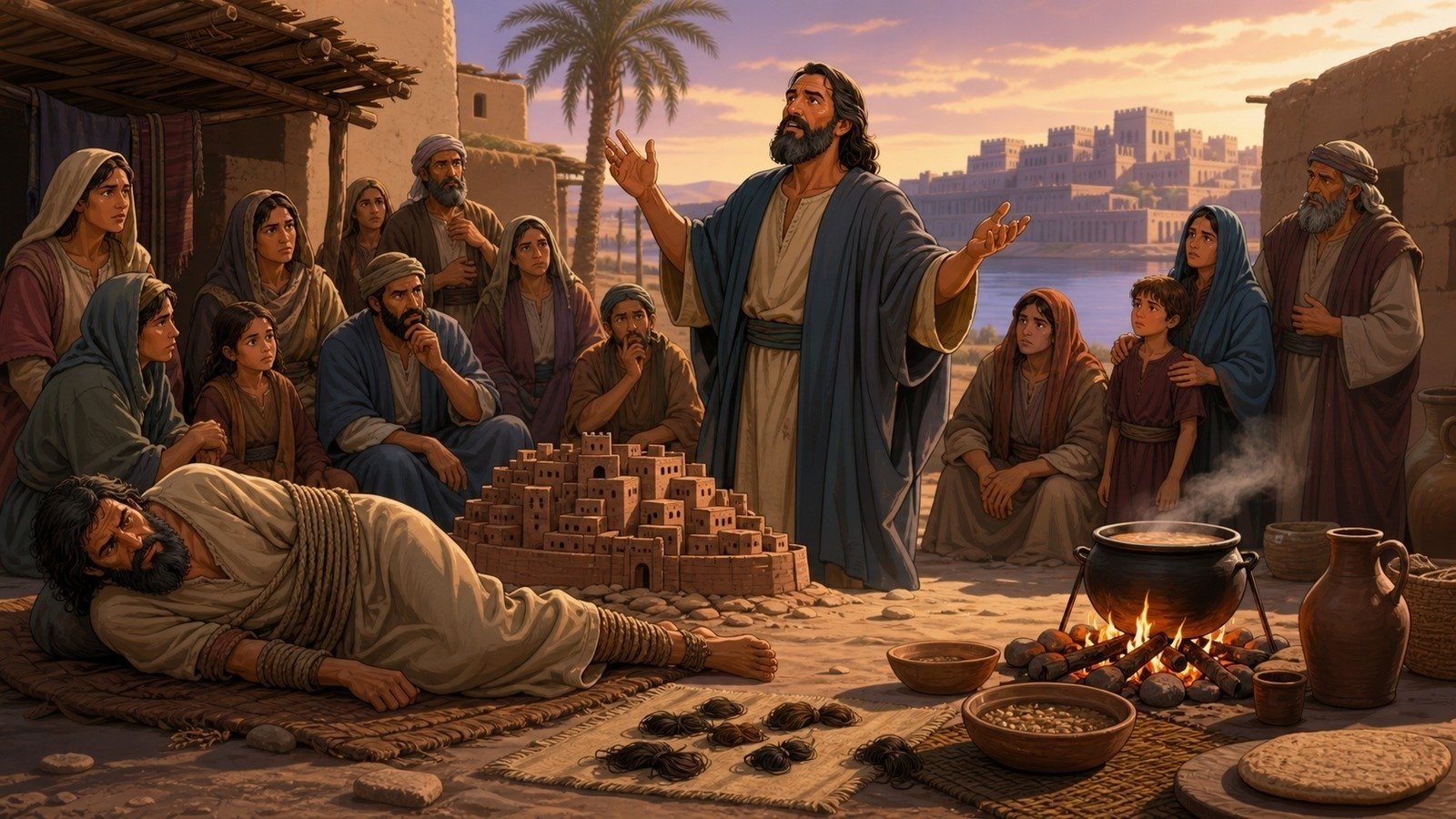
Ezekiel performs a series of striking symbolic acts, lying bound for over a year, shaving and dividing his hair, cooking over dung, to dramatise the coming siege, while also insisting each individual bears responsibility for their own sin rather than inherited guilt alone.
Further context
3 min readFor the six years between Ezekiel's call and the fall of Jerusalem, most of what he does is performed rather than spoken, and the performances are extraordinary even by prophetic standards.
He takes a clay tablet, draws the city of Jerusalem on it, and lays siege to it in miniature with ramps, camps and battering rams, with an iron pan set up as a wall between himself and it. Then he lies on his left side for three hundred and ninety days and on his right for forty, one day for each year of the sin of Israel and Judah. He eats a measured ration of bread made from a mixture of wheat, barley, beans, lentils, millet and spelt, twenty shekels a day, with water rationed by measure, cooked over dung. When he objects to the fuel on grounds of ritual purity, that detail is conceded and he is permitted cow dung instead of human. Everything about it is a siege diet, measured out in front of an audience who could work out what it meant.
He shaves his head and beard with a sword, weighs the hair and divides it into three: a third burned inside the city on the tablet, a third struck with the sword around it, a third scattered to the wind, with a few strands tucked into the folds of his garment.
The vision of the temple is the theological centre of the period. He is taken in vision to Jerusalem and shown what is happening in the building: an idol at the north gate, seventy elders in a hidden room burning incense to figures of creeping things and animals carved on the walls, women mourning for the god Tammuz at the north gate, and twenty-five men between the porch and the altar with their backs to the temple and their faces east, bowing to the sun. Then the glory of God is shown leaving, in stages, from the sanctuary to the threshold to the east gate to the mountain east of the city.
The hardest sign is his wife's death. He is told that the delight of his eyes will be taken from him with one blow, and that he must not mourn, weep, or shed tears, or follow any of the customs. I spoke to the people in the morning, and in the evening my wife died. The next morning I did as I had been commanded. When the exiles ask what it means, they are told that the sanctuary they take pride in will fall and their sons and daughters will die, and that they too will not mourn.
He is also the source of one of the clearest statements of individual responsibility anywhere: the one who sins is the one who will die. The child will not share the guilt of the parent, nor the parent the guilt of the child.
The performances run for years and they are physically punishing. He lies on his left side for three hundred and ninety days and on his right for forty, cooks his food over dung, shaves his head and beard with a sword and divides the hair into three parts to be burned, cut and scattered, and digs through a wall at night with his belongings on his shoulder like a man going into exile.
The hardest of them is not an action. His wife dies suddenly, described as the delight of his eyes, and he is forbidden to mourn her publicly: groan quietly, do not mourn for the dead, keep your turban on and your sandals on your feet.
When the people ask what it means, he tells them: the sanctuary is going to be desecrated, and their sons and daughters left behind will fall by the sword, and they will not mourn either.
The message and the man's own life had stopped being separable.