

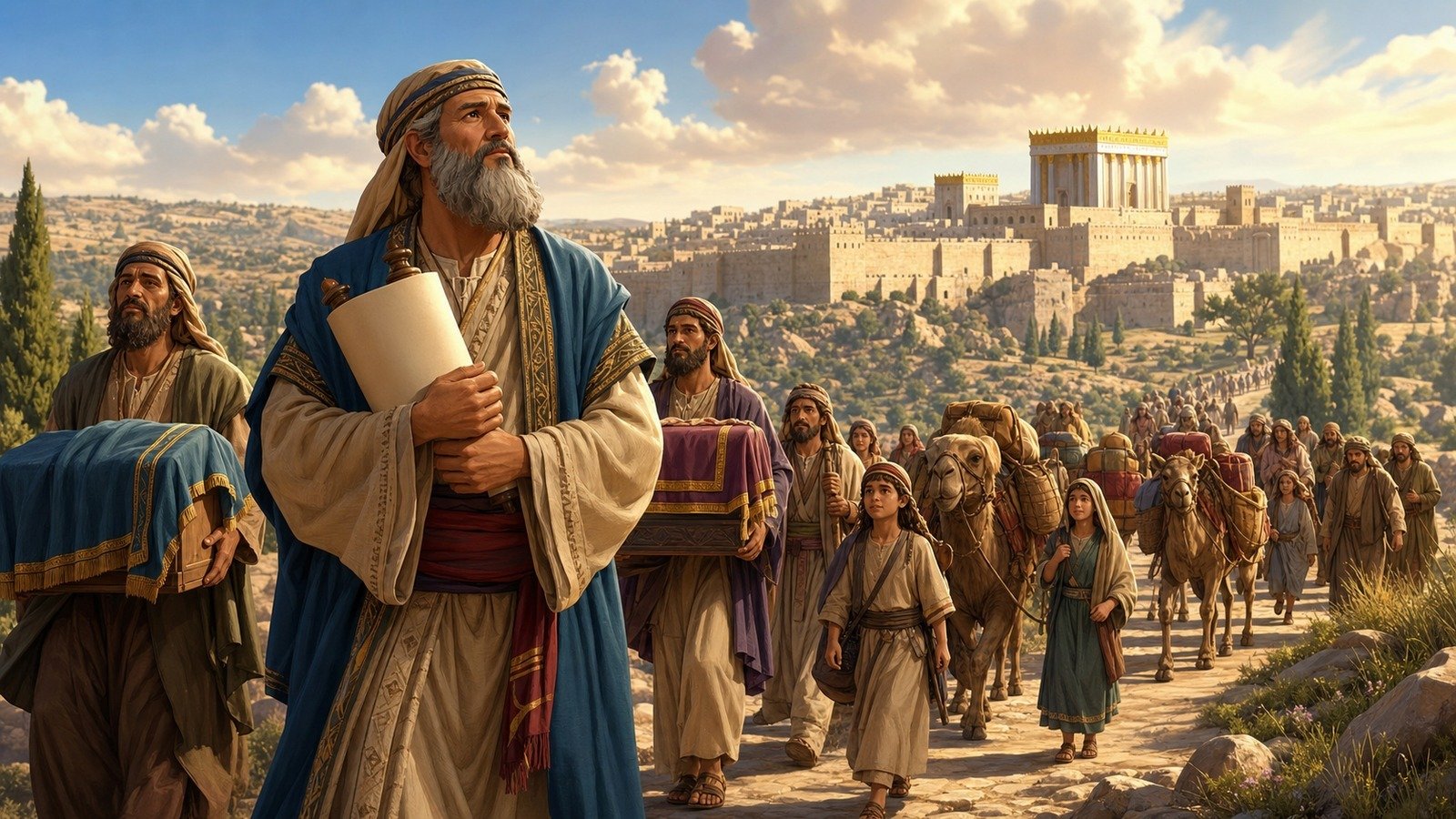
The priest and scribe Ezra leads a second group of returnees, carrying further Temple articles and royal authority to teach and enforce the Law across the province.
Further context
3 min readEzra arrives in the seventh year of Artaxerxes I, which is 458 BC, roughly sixty years after the temple was finished and eighty after the first return. His genealogy is traced back to Aaron, so he is a priest, and he is described with a phrase that becomes a job title in later Judaism: a teacher well versed in the Law of Moses.
The summary given of him is one sentence and it is the shape of a career: he had devoted himself to the study and observance of the Law of the LORD, and to teaching its decrees and laws in Israel. Study, then practice, then teaching, in that order.
The imperial letter he carries is quoted in Aramaic and its terms are extraordinary. He may take with him anyone who volunteers. He carries silver and gold from the king and his counsellors and from the province of Babylon, and freewill offerings, to buy bulls, rams, lambs, grain offerings and drink offerings. The treasurers of the province west of the Euphrates are instructed to supply him with up to a hundred talents of silver, a hundred cors of wheat, a hundred baths of wine and a hundred baths of olive oil, and salt without limit. Priests, Levites, singers, gatekeepers and temple servants are exempted from taxes, tribute and duty.
And then the clause that matters most: he is authorised to appoint magistrates and judges to administer justice to all the people west of the Euphrates who know the laws of his God, and to teach anyone who does not know them. The empire is granting a returning exile the power to establish Jewish law as the enforceable civil law of a province.
The party is around fifteen hundred men with their families. Before setting out he notices there are no Levites among them and sends a delegation to recruit some, which produces thirty-eight.
Then a detail that shows the man. He is ashamed to ask the king for soldiers and horsemen to protect them from bandits on the road, because he had told the king that the gracious hand of our God is on everyone who looks to him. So they fast and pray at the river instead, and travel fifteen hundred kilometres carrying twenty-five tonnes of silver and gold with no escort. He weighs the treasure out to twelve priests before leaving and has it weighed back in on arrival.
The list of who came with him is preserved by family, and the tally of the treasure is given by weight: six hundred and fifty talents of silver, silver articles weighing a hundred talents, a hundred talents of gold, twenty gold bowls valued at a thousand darics and two fine bronze objects as precious as gold. Weighing it out to twelve named priests and weighing it back in at the other end is standard treasury practice and it is recorded as such.
The journey takes four months. Nothing happens on the road.
Ezra is described as a teacher well versed in the Law of Moses, and the phrase used of his purpose is the sentence the whole book turns on: he had devoted himself to the study and observance of the Law of the LORD, and to teaching its decrees and laws in Israel.
The letter of authorisation from Artaxerxes is preserved in Aramaic and it is remarkably generous. He may take with him anyone who wishes to go, he carries silver and gold from the king and his advisers, he may draw on the treasury of the province, and priests and Levites are exempted from tax, tribute and duty.
He is also empowered to appoint magistrates and judges and to teach the law to anyone who does not know it.
Before setting out he proclaims a fast at the Ahava canal, and the reason he gives is that he had been ashamed to ask the king for soldiers and horsemen to protect them, having told him that God's hand is on everyone who looks to him.