

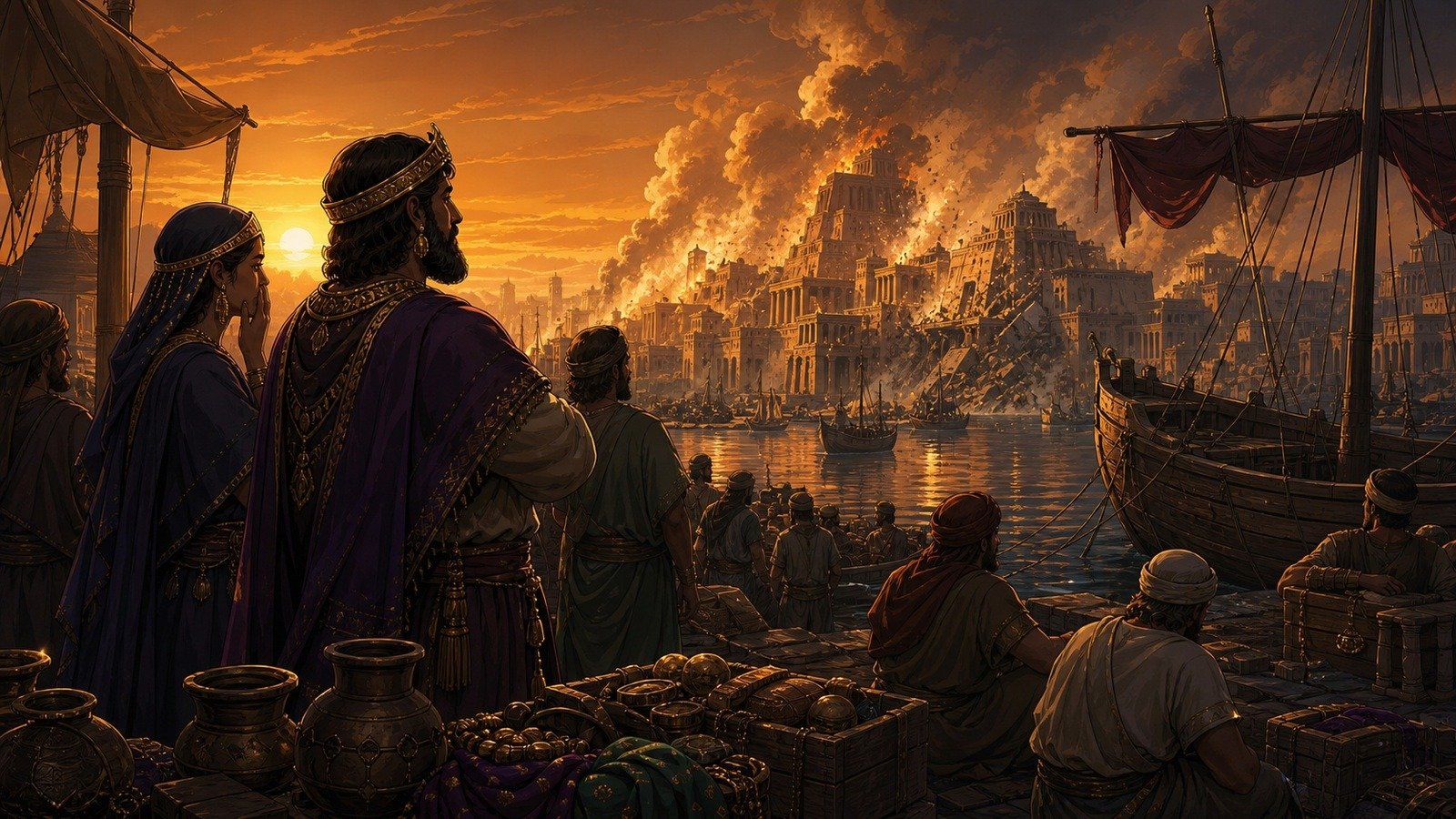
An angel announces Babylon's sudden downfall in a single hour, while merchants, sailors and kings who profited from her mourn her destruction from a safe distance, and heaven is called to rejoice over her judgement.
Further context
2 min readAn angel comes down from heaven with great authority, and the earth is illuminated by his splendour. He shouts: fallen! Fallen is Babylon the Great!
Then another voice calls: come out of her, my people, so that you will not share in her sins.
That instruction is the practical heart of the chapter, and it is not an instruction to leave a city. The people addressed lived in the cities of Asia Minor and worked in their trades and markets. What they are being told to withdraw from is a way of living, and what follows explains exactly which way.
What comes next is a funeral lament in three parts, sung by the people who lose money.
The kings of the earth weep and mourn over her when they see the smoke of her burning, standing far off in terror.
The merchants weep because no one buys their cargoes any more, and the cargo list is the most concrete thing in the book: gold, silver, precious stones and pearls; fine linen, purple, silk and scarlet cloth; citron wood, ivory, costly wood, bronze, iron and marble; cinnamon, spice, incense, myrrh and frankincense; wine, olive oil, fine flour and wheat; cattle and sheep; horses and carriages.
Every one of those items appears in Roman writers describing the trade that fed the capital. Citron wood came from north Africa and was used for table tops that cost more than a house; Pliny writes about the mania for it. Silk came overland from China. Marble came from Greece, Egypt and Asia.
And then the last two items on the list, in the same sentence and the same grammatical form as the marble and the wheat: and bodies and souls of men.
The slave trade is listed as freight, at the end, and the phrasing is what makes it land.
The sea captains and sailors join in, throwing dust on their heads and crying: woe! Woe to you, great city, where all who had ships on the sea became rich through her wealth! In one hour she has been brought to ruin!
Then a mighty angel picks up a boulder the size of a large millstone and throws it into the sea: with such violence the great city of Babylon will be thrown down, never to be found again.
And the sound of harpists, musicians, pipers and trumpeters will never be heard in you again. The sound of a millstone will never be heard in you again. The voice of a bridegroom and bride will never be heard in you again.
Come out of her, my people is a quotation from Jeremiah's instruction to the exiles about the historical Babylon, and it is applied here to people who had never been anywhere near Mesopotamia.
The lament follows the shape of the prophetic laments over Tyre and Babylon closely enough that the borrowing is deliberate, including the ships, the merchants and the sudden silence.
What none of the three groups says is that the city was unjust. The kings mourn their loss of power, the merchants their loss of trade and the sailors their loss of freight, and every speech is about what the mourners are no longer getting.