

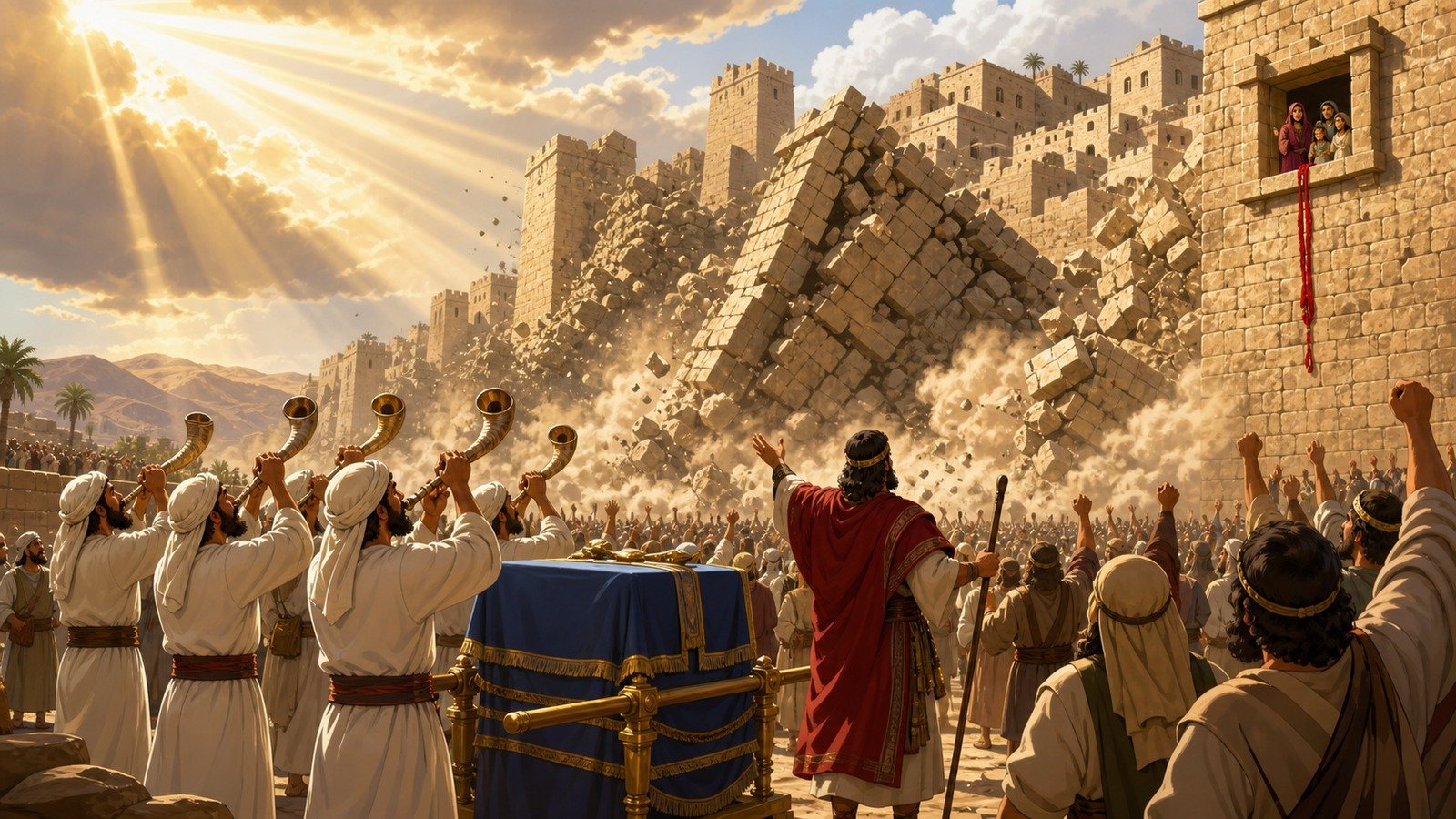
Following God's unconventional battle plan, Israel marches around Jericho for seven days; on the seventh day the walls collapse after a shout and trumpet blast, and the city is destroyed, sparing only Rahab and her family for hiding the Israelite spies.
Further context
2 min readThe instructions Joshua is given for taking Jericho are militarily absurd, and that is the point of them. March around the city once a day for six days with the armed men in front, seven priests carrying trumpets of rams' horns ahead of the ark, and the rear guard behind. Say nothing. On the seventh day march around seven times, and when the horns sound a long blast, everyone shouts.
For six days an army walks in silence around a walled town and goes back to camp. Whatever is happening psychologically inside the walls by the fifth or sixth morning is not described, and it is not hard to imagine.
The wall collapses and the city is taken. Rahab and her family are spared because of the scarlet cord, and she is described afterwards as living among the Israelites, which is where the story of a Canaanite prostitute joins the ancestry of David and, through him, the genealogy at the head of Matthew's Gospel.
Everything else is destroyed and nothing is taken. Jericho is placed under a ban, meaning the whole of it is devoted to God and no plunder may be kept, and the silver, gold, bronze and iron go into the treasury of the sanctuary. That prohibition is what the next episode turns on.
The archaeology of Jericho is genuinely contested and the state of the argument is worth having straight. Kathleen Kenyon's excavations in the 1950s found substantial Middle Bronze Age fortifications with collapsed mudbrick walls and a destruction layer, and dated that destruction to around 1550 BC, which is too early for either proposed date of the conquest. She concluded that the Late Bronze Age settlement was tiny or absent, which would mean there was no walled city there to fall. Her dating rested largely on the absence of imported Cypriot pottery, and Bryant Wood challenged it in 1990 on the basis of the local pottery, arguing for a date around 1400 BC, which would fit the earlier framework. That argument has been contested in turn and no consensus exists.
Two things can be said without taking a side. The site is small, roughly four hectares, so the town was a fortified strongpoint controlling a spring and a crossing rather than a city in the modern sense. And erosion at Tell es-Sultan has removed much of the Late Bronze material, which is why the argument turns on scraps.
The ban placed on the town is the hardest element and it should be named rather than skirted. Everything living in Jericho is destroyed, and the reason given elsewhere is that the population of Canaan had reached a point of moral collapse specified centuries earlier, when Abraham was told his descendants would return only when the sin of the Amorites had reached its full measure. Christians have argued about that for as long as there have been Christians, and the argument is not resolved by anything in the taking of the town.
Nothing here is interested in walls. Nobody undermines them, no ram is brought up and no siege is laid, and the whole operation is arranged so that the one thing the army does is walk and shout. The letter to the Hebrews lists it among acts of faith, and puts Rahab's name immediately after it.