

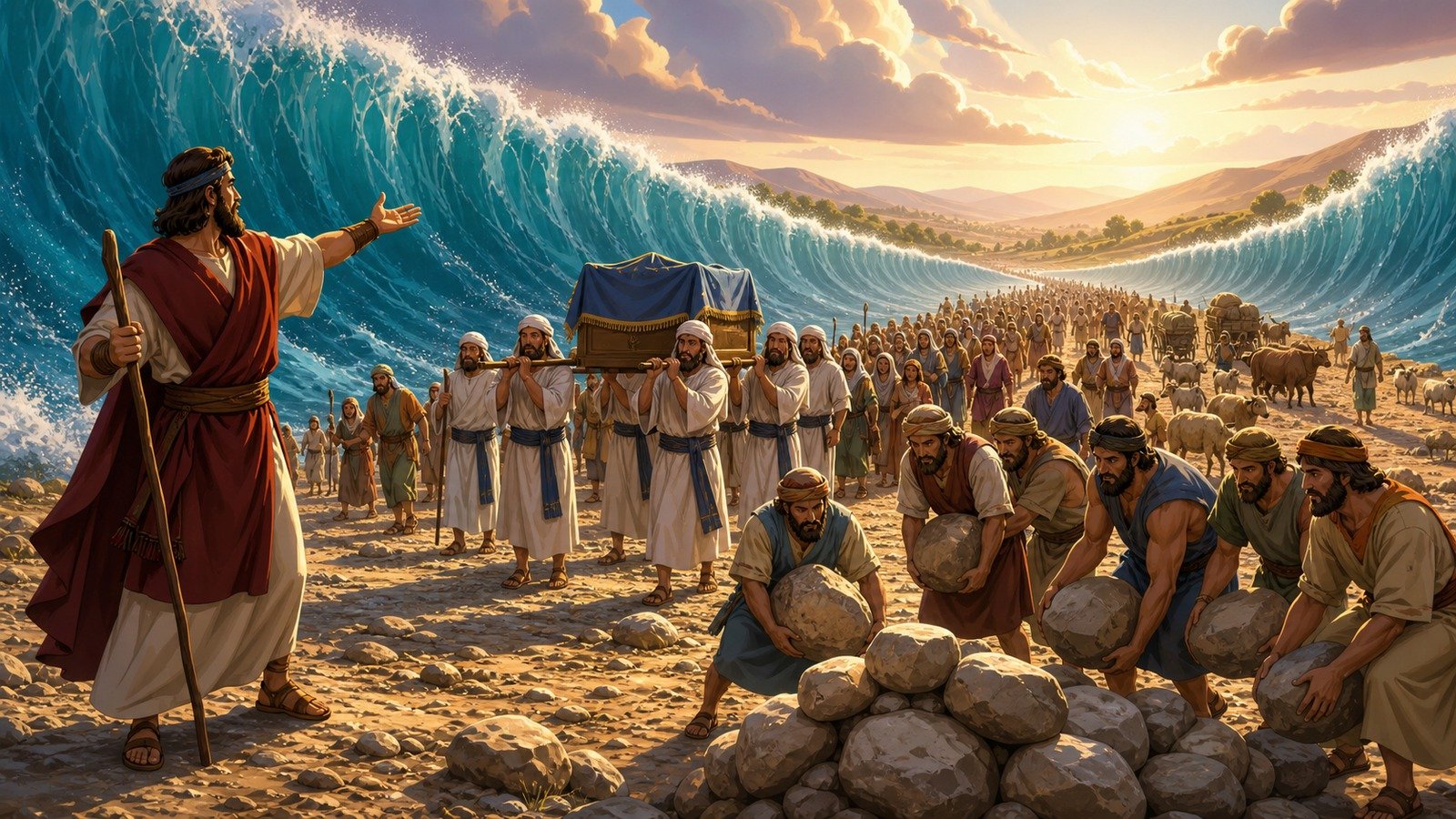
God commissions Joshua to lead the conquest, and Israel crosses the Jordan on dry ground when the priests carrying the ark step into the river, echoing the Red Sea crossing forty years earlier. Twelve memorial stones mark the crossing point.
Further context
2 min readThe commission opens with a repeated instruction: be strong and courageous. It is said three times in a few sentences, which is not a compliment. A man told that often is a man whose nerve is in question, and he is being handed a campaign that his predecessor's entire generation refused to begin.
What he is told to do with his time is unexpected for a general. Keep this Book of the Law always on your lips; meditate on it day and night, so that you may be careful to do everything written in it. Then you will be prosperous and successful. The first military order of the conquest is about reading.
Two spies are sent to Jericho and end up in the house of a prostitute named Rahab, which is a sensible place for strangers to lodge without attracting questions. She hides them under stalks of flax drying on the roof, sends the king's men off in the wrong direction, and then tells the two men why. We have heard how the LORD dried up the water of the Red Sea for you, and what you did to Sihon and Og. Our hearts melted and everyone's courage failed. Forty years after the sea, the news has reached a walled town in Canaan and is still frightening people. She asks for her family to be spared and hangs a scarlet cord from her window.
The crossing itself is staged. The priests carry the ark into the water first and stand still in the riverbed while the whole nation walks across, and the water is described as piling up in a heap a great distance upstream at a town called Adam. The Jordan cuts through soft marl terraces, and landslips damming the river have been recorded several times in the historical period, including in 1927 when a collapse near that area stopped the flow for over twenty hours. Whether that is the mechanism is unknown, and what is emphasised is the timing rather than the geology.
It happens at harvest, when the river is at flood stage, which is stated explicitly and is the least convenient moment of the year.
Rahab's position needs one more sentence, because it is easy to reduce her to a plot device. She takes a decision, on the strength of news forty years old, to betray her own city to an army camped on the other side of the river, on the calculation that its God is real. She negotiates terms, insists on an oath, and secures her whole extended family. She then appears in the New Testament twice, once among examples of faith and once among examples of faith proved by action, and in the ancestry of David.
Twelve stones are taken from the riverbed and set up at Gilgal, and the stated purpose is a question children will ask later: when your children ask what these stones mean, tell them the waters were cut off before the ark of the covenant. A generation that crossed on dry ground is arranging in advance for the next one to be told why.