

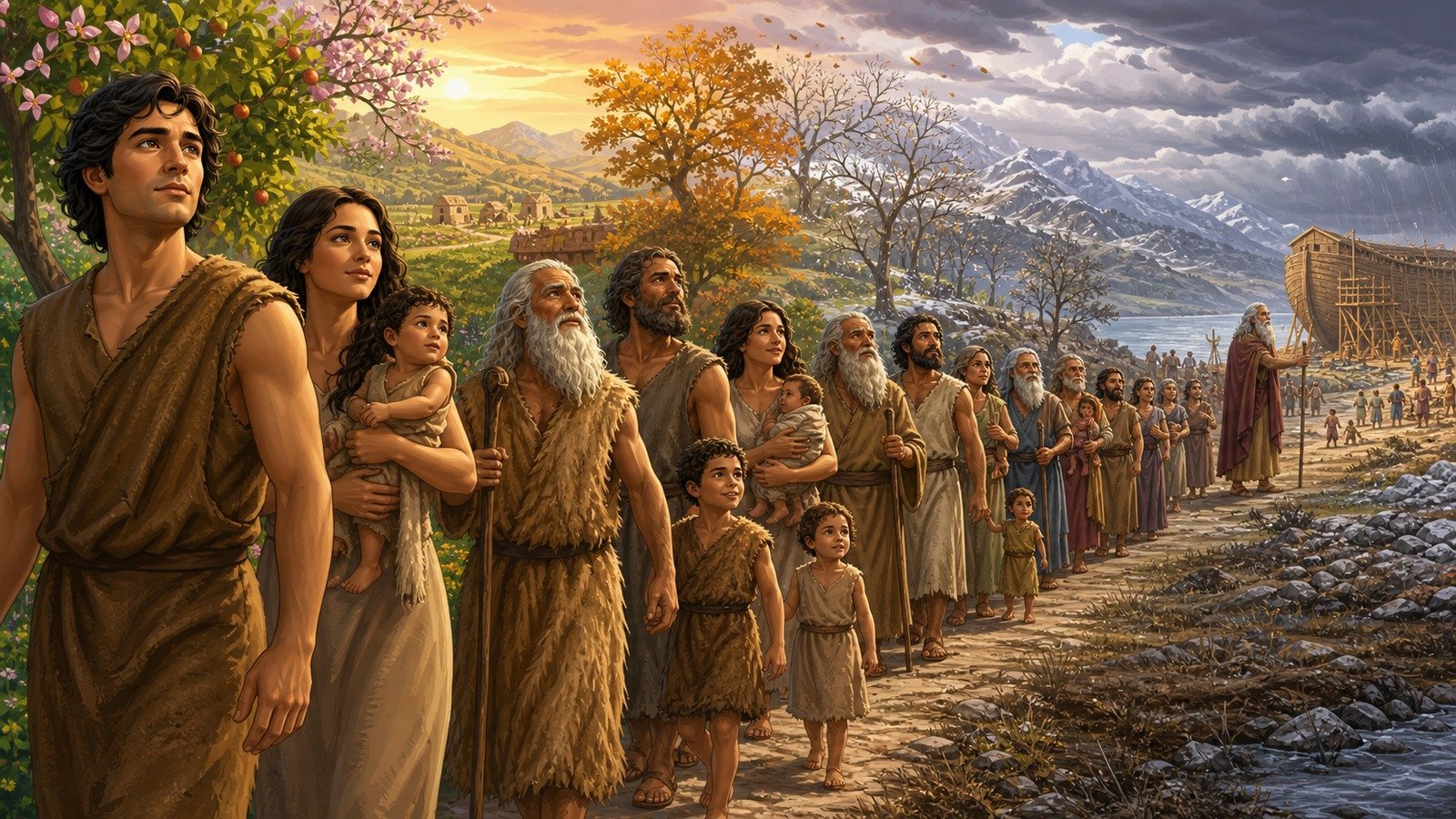
Ten generations are traced from Adam to Noah, recording each patriarch's lifespan; this list supplies the raw data later chronologists used to construct calendar dates for the primeval period.
Further context
3 min readTen names, ten lifespans, and one sentence repeated eight times: and then he died. Each man in the list lives a stated number of years, fathers a named son, lives a further stated number, has other sons and daughters, and dies. The refrain is doing something rather than filling space. The judgement in the garden ended with a return to dust, and this list counts out the fulfilment eight times over.
The lifespans are what everyone notices. Methuselah reaches nine hundred and sixty-nine, Jared nine hundred and sixty-two, Noah nine hundred and fifty, and only Enoch falls anywhere near an ordinary human span. Three explanations circulate and each rests on a specific argument.
The first takes the figures literally and treats the sharp fall in lifespans after the Flood as a change in conditions.
The second treats them as schematic. The Sumerian King List, which survives in copies from the early second millennium BC, assigns its kings before the flood reigns of twenty-eight thousand and thirty-six thousand years. Set beside that, the Hebrew figures look like the same conventional framework with the numbers cut to a fraction, which would make them a deliberate statement rather than a measurement.
The third holds that the list is selective, giving representative heads of families rather than consecutive fathers and sons. That is not a device invented to protect a conclusion. Hebrew genealogies demonstrably skip generations when a list is being shaped, and the Hebrew word for father covers an ancestor as readily as an immediate parent. What weakens it here is that this particular list states the father's age at each birth, which is precisely what makes the arithmetic possible in the first place.
The numbers are also unstable across manuscripts, and the consequences are measurable rather than theoretical. The Hebrew, the Samaritan and the Greek traditions disagree about the ages at fatherhood for most of the ten. On Hebrew figures Methuselah dies in the year of the Flood. On Samaritan figures he dies fourteen years before it. On Greek figures the arithmetic puts his death after it, which is a long-recognised problem, since he is not on the ark. The totals from Adam to Abraham differ between the Hebrew and the Greek by roughly fourteen hundred years.
This list, together with the one that runs from Noah to Abraham, is the entire evidential basis for every traditional date given to the earliest period. Nothing outside the Bible corroborates any of it, and nothing inside it connects these men to a datable city, king or record. A figure such as 4004 BC is the product of adding these numbers in one manuscript tradition and assuming the list is complete.
One name in the list is worth holding on to for what comes next. Lamech, the ninth, names his son Noah and explains the name by saying that this one will bring comfort from the labour and painful toil of hands working ground the LORD has cursed. It is the first indication anywhere that the curse laid on the soil was felt as an ongoing grievance rather than a settled fact, and it is spoken by a man who dies five years before the Flood arrives.
Later writers reproduce the same ten names as a bare list with no numbers at all, and Luke runs the sequence backwards at the head of the ancestry of Jesus, ending with Seth and Adam.