

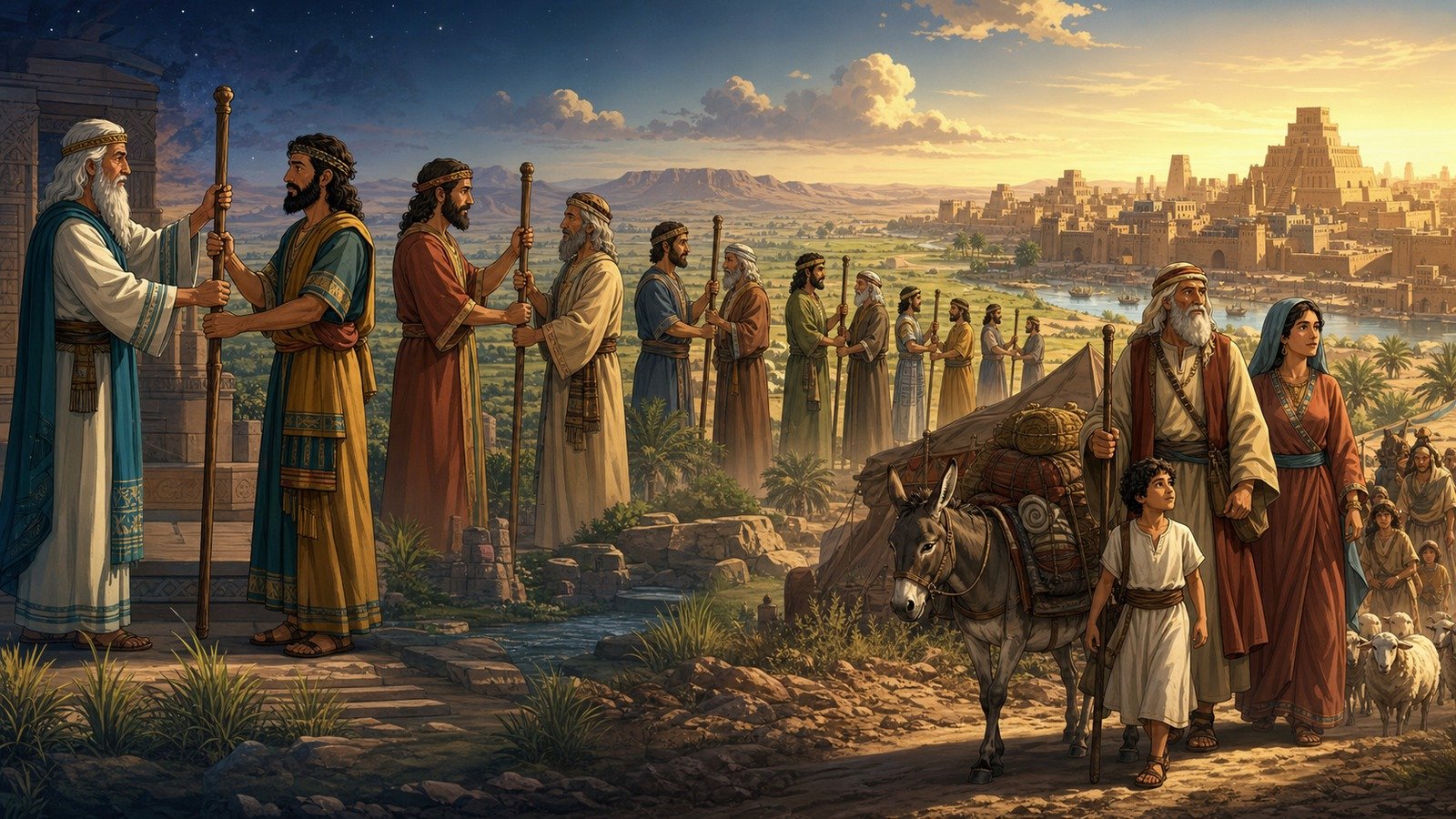
A second genealogy bridges the Flood to Abram, tracing ten generations through Shem's line and noting the family's move from Ur of the Chaldeans to Harran under Terah, Abram's father.
Further context
2 min readTen generations run from Shem to Terah, matching the ten from Adam to Noah and giving the earliest section of the story a symmetry of two sets of ten on either side of the Flood.
The formula shifts slightly. Each man's age at the birth of his named son is given, along with the years he lived afterwards, but the totals are missing and the refrain about dying is gone. What appears instead is a decline. Shem lives six hundred years, Arphaxad four hundred and thirty-eight, Peleg two hundred and thirty-nine, Nahor a hundred and forty-eight, Terah two hundred and five. The fall is steep across the early generations and then levels out, bringing the figures down towards the range the patriarchs will occupy.
One name carries a note the others do not. Peleg is explained on the grounds that in his time the earth was divided, and the Hebrew root behind his name means to divide. What was divided is unknown. Readers who connect it to the scattering at Babel have proximity on their side. Others point out that the same verb is used of dividing water into channels, and that the irrigation canal systems of southern Mesopotamia would suit a note about the earth being divided in a particular generation.
The manuscript problem that affects the earlier list bites harder here, and it has a visible consequence in the New Testament. The Greek version inserts an additional generation, Cainan, between Arphaxad and Shelah, which the Hebrew does not have. Luke includes Cainan in the ancestry of Jesus, following the Greek. Anyone adding these figures to produce a date is therefore choosing between traditions that differ both in the numbers and in how many names there are.
The list ends with a short piece of narrative rather than another entry. Terah takes his son Abram, his grandson Lot and his daughter-in-law Sarai out of Ur of the Chaldeans to go to Canaan, and the family stops at Harran and settles there, and Terah dies in Harran.
Both places can be located, and one of the names carries a difficulty. Ur is generally identified with Tell el-Muqayyar in southern Iraq, a major Sumerian city excavated by Leonard Woolley between 1922 and 1934, where a large stepped platform and a set of royal tombs were found. The description "of the Chaldeans" is anachronistic, since the Chaldeans are attested in Babylonia only from the ninth century BC, long after any plausible date for Abram, and the phrase is best explained as a later clarification added so that readers would know which Ur was meant. Some scholars prefer a northern site called Ura near Harran, which removes the distance problem and has less support behind it.
The two cities have something specific in common. Both were principal centres of moon worship, called Nanna at Ur and Sin at Harran, each with a major temple. Joshua, addressing Israel centuries later, says plainly that Terah and his family worshipped other gods beyond the River. The man who is about to be told to leave everything is leaving a household that already had its own religion, in a city built around a shrine.