

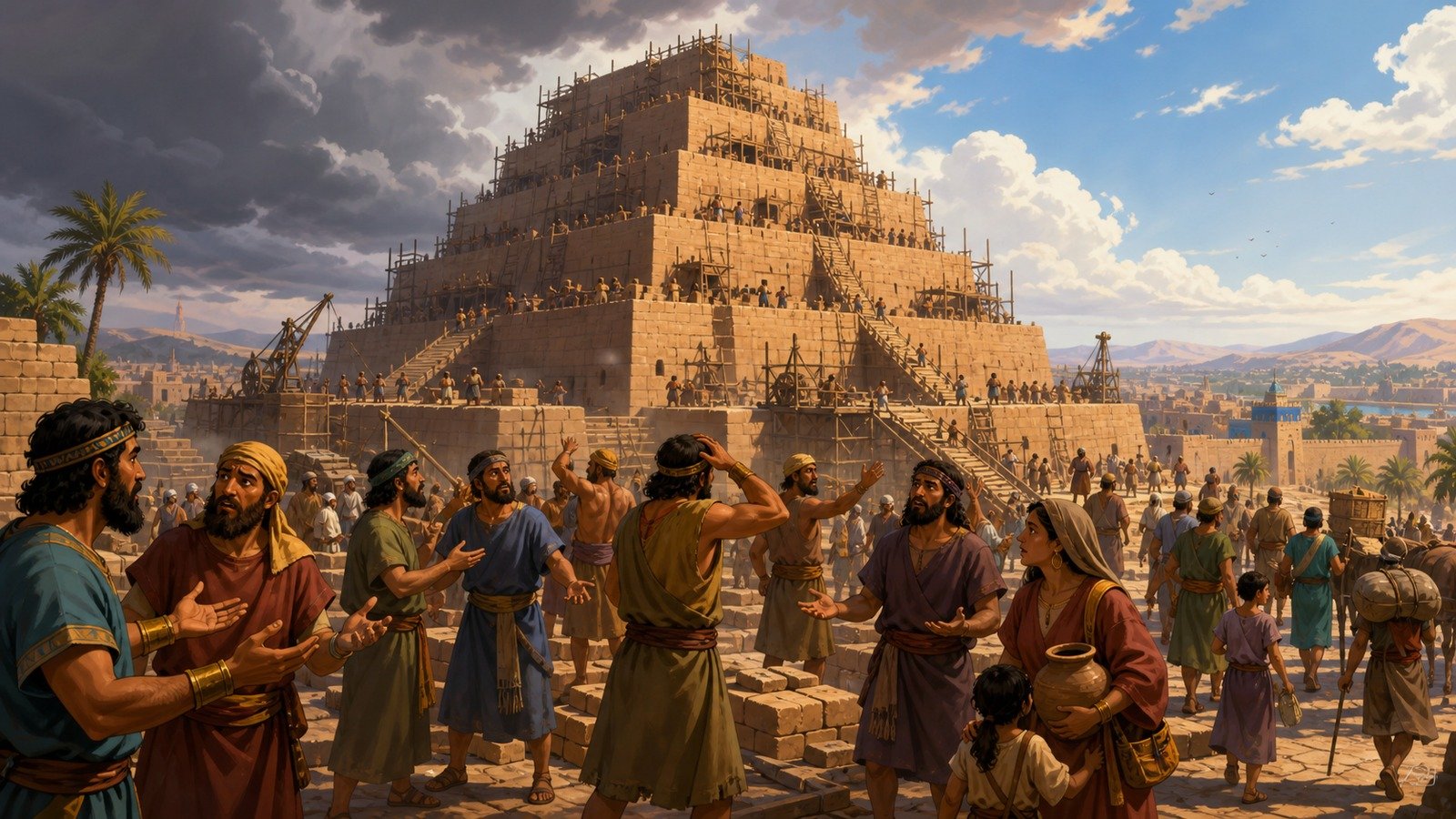
Humanity, still speaking one language, attempts to build a city and tower "that reaches to the heavens" to make a name for itself. God confuses their language and scatters them across the earth, explaining the origin of linguistic diversity within the narrative's own logic.
Further context
3 min readBrick instead of stone, and bitumen for mortar. That one line is technically exact and would not have occurred to anyone inventing the scene from inside Canaan. Southern Mesopotamia has no building stone and no useful timber. What it has, in unlimited quantity, is alluvial clay and natural bitumen seeping to the surface, and its monumental architecture was built accordingly, of fired and mud brick set in bitumen. A writer surrounded by limestone would have had no reason to specify the material, still less to explain it.
People moving eastward settle on a plain in Shinar, which is southern Mesopotamia, and decide to build a city with a tower reaching to the heavens.
The building they describe corresponds to a known type. Mesopotamian cities were dominated by stepped temple platforms, and the one at Babylon was called Etemenanki, a Sumerian name meaning the house of the foundation of heaven and earth. A cuneiform tablet giving its dimensions puts the square base at about ninety metres a side. The phrase about a top in the heavens matches how such buildings were routinely described.
The builders state their own motive: to make a name for themselves, so that they will not be scattered over the face of the whole earth. The thing they are trying to prevent is precisely what they were told to do after the Flood, when the instruction was to fill the earth. Their fear and their orders point in opposite directions.
Then something quietly ironic happens. The tower reaches the heavens and God comes down to look at it. The verb is used twice: he comes down to see it, and then comes down to confuse their language.
The name of the city carries the point. Babylon in Akkadian is Bab-ili, the gate of the god, a prestigious name the city used of itself. Hebrew connects it instead with a verb meaning to confuse or mix (balal), so that the gate of heaven becomes Babble. The pun works only in Hebrew, and it is the last move made before the whole section closes.
One chronological oddity is worth flagging. The list of nations that comes immediately before this already describes peoples divided by their languages, in their own territories, which places the dispersion before the episode that causes it. Hebrew narrative regularly summarises and then doubles back to relate the episode behind the summary, and that is the usual explanation. Anyone preferring to treat the two as independent traditions has to account for why they were placed in an order that produces the difficulty.
Traditional chronologies put this somewhere in the third or early second millennium BC, and the figure comes from counting genealogies backwards rather than from any external verification. Babylon itself is attested from the late third millennium and rose to prominence under Hammurabi in the eighteenth century BC, and Etemenanki in the form archaeologists have recovered belongs to the seventh and sixth centuries. None of that can be tied to this episode.
The scattering is where the earliest section of the story stops. From the next paragraph the focus narrows from all the nations of the earth to one family from Ur, and the promise given to that family is that all peoples on earth will be blessed through it, which is an answer aimed squarely at the situation this scene creates.