

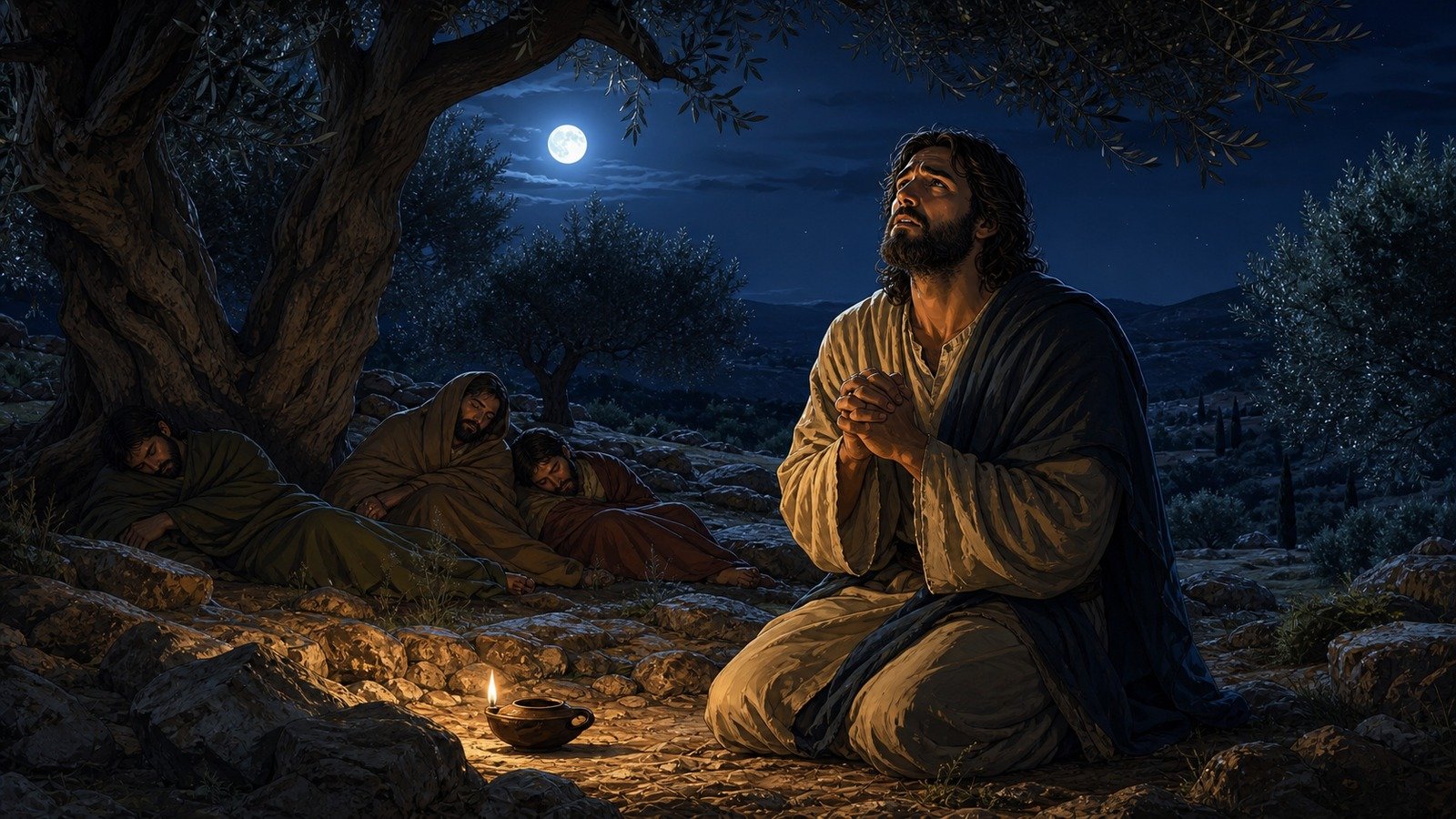
In an olive grove called Gethsemane, Jesus prays in visible anguish, asking that "this cup" be taken from him while submitting to the Father's will; his closest disciples repeatedly fall asleep instead of keeping watch with him as he had asked.
Further context
2 min readGethsemane, where Jesus goes after the supper, means oil press, and the name describes what the place was: an enclosed grove on the lower slope of the Mount of Olives, across the Kidron valley from the city, with a press for crushing olives. Ancient olive trees still stand on the site, though none of them is old enough to have been there.
He takes Peter, James and John further in with him, the same three taken up the mountain and into the room where a dead girl was raised, and tells them what is happening to him: my soul is overwhelmed with sorrow to the point of death. Stay here and keep watch with me.
The verbs used to describe his state are the strongest available. He began to be deeply distressed and troubled, and the first of those words describes shocked alarm. Luke, alone, adds that his sweat was like drops of blood falling to the ground, along with a mention of an angel strengthening him; both details are missing from some early manuscripts, and whether they were original has been argued for a long time.
He falls to the ground and prays that if possible the hour might pass from him. Abba, Father, everything is possible for you. Take this cup from me. Yet not what I will, but what you will.
The word abba is Aramaic and domestic, the word a child used for his own father, and it is preserved untranslated here and twice in Paul's letters.
The cup is the image he had used with James and John, and in the prophets it is regularly the cup of God's wrath handed to a nation to drink.
What is on display is not resignation. Christian writers have found this scene difficult from the earliest centuries, because a man asking to be let off is harder to explain than a martyr walking calmly to his death, and several early accounts of executed Christians describe far more composure than this. That difficulty is itself the reason most historians regard the episode as unlikely to have been invented.
Three times he prays, and three times he comes back to find them asleep. The watch is your spirit is willing, but the flesh is weak, and the second time he does not even have an answer from them, because they did not know what to say to him.
Then: are you still sleeping and resting? Enough! The hour has come. Rise! Let us go! Here comes my betrayer.
The three who go furthest in with him are the three who had seen him transfigured, and they fall asleep in both places, which is the sort of detail nobody inventing a story about heroic followers would include.
How anyone knew what he prayed, when the witnesses were asleep a short distance away, is a fair question. He prayed aloud, as people did, and came back to them three times; a man repeating the same short prayer within earshot of men drifting in and out of sleep is not hard to reconstruct.