

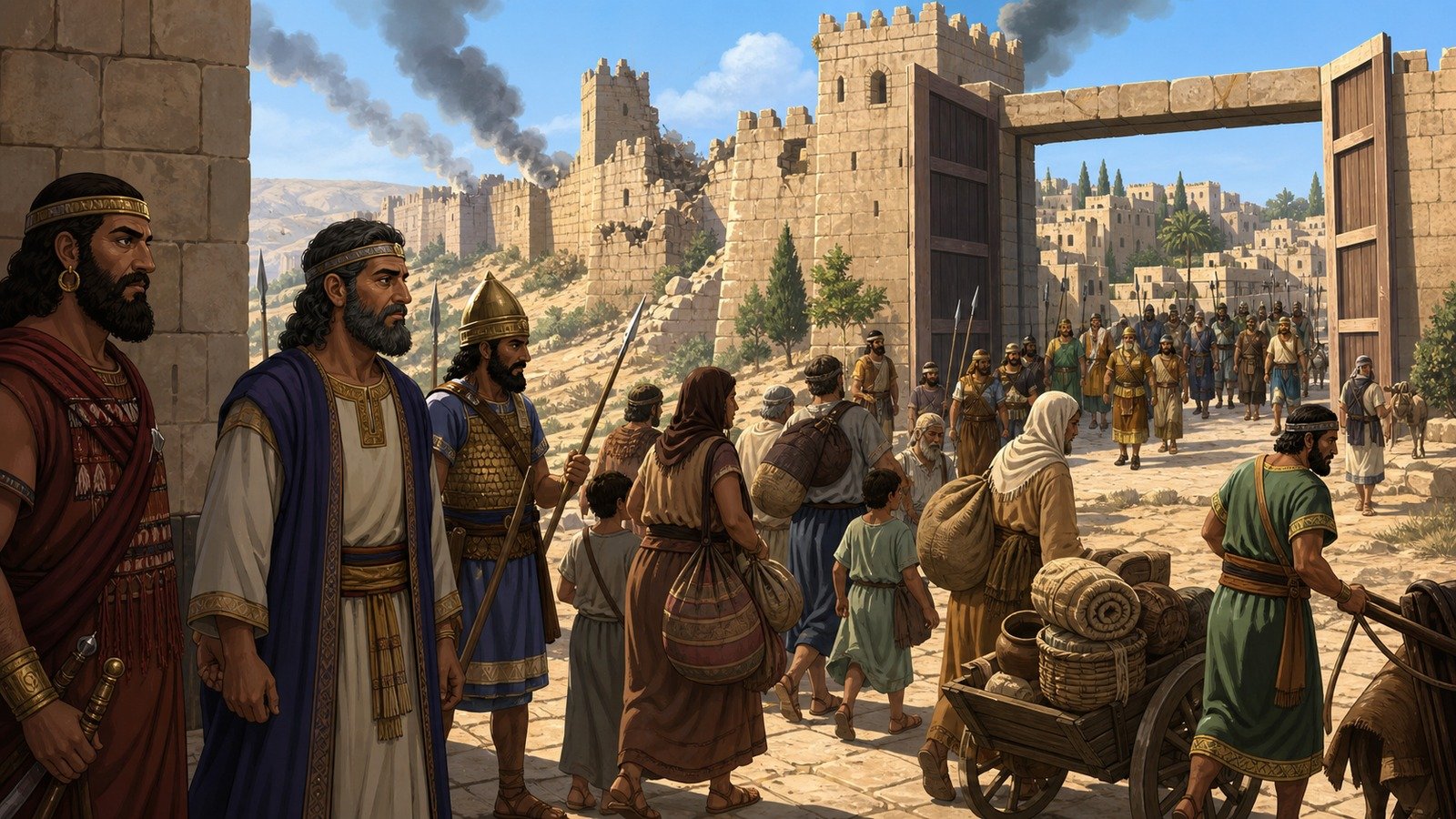
Israel's last king, Hoshea, rebels against Assyria after paying tribute; Shalmaneser V besieges Samaria, and Sargon II completes its capture, deporting the northern population and resettling the land with foreign peoples, permanently ending the northern kingdom of Israel.
Further context
3 min readNine years, and a verdict slightly softer than the formula: he did evil in the eyes of the LORD, but not like the kings of Israel who preceded him.
He is installed with Assyrian approval after assassinating Pekah, and he pays tribute to Shalmaneser V for several years. Then he stops, and sends envoys to So king of Egypt, and the Assyrians find out.
Every small state on that frontier tried the same manoeuvre and it never worked once. Egypt in this period was fragmented and militarily weak, and Isaiah's description of it as a splintered reed of a staff, which pierces the hand of anyone who leans on it, is an accurate assessment of what Egyptian promises were worth.
Hoshea is seized and imprisoned. Samaria is besieged for three years and falls in 722 BC.
Which Assyrian king took it is disputed and both candidates have a claim. The siege began under Shalmaneser V, who died during or shortly after it. Sargon II, who took the throne that year, claims the capture in his own inscriptions and gives a figure of 27,290 deportees, along with a note that he took fifty chariots for his royal corps. The biblical account credits the king of Assyria without resolving the question, which is what a contemporary would have said.
The deportations run in both directions. The Israelites are settled in Halah, on the Habor river in Gozan, and in the towns of the Medes, which is northern Mesopotamia and western Iran. People from Babylon, Kuthah, Avva, Hamath and Sepharvaim are brought in and settled in the towns of Samaria in their place. Both movements are standard Assyrian policy, and both are attested in Assyrian records.
The mixed population that results keeps the local shrines running and adds its own gods, and a priest is eventually sent back from exile to teach them how the God of the land should be worshipped. The result is described bluntly: they worshipped the LORD, but they also served their own gods. That community is the ancestor of the Samaritans, and the hostility between them and the Judaeans that appears in the New Testament starts here.
The ten tribes deported from the northern kingdom do not reappear. Later speculation about lost tribes has produced a great deal of literature and no evidence, and the plainest account of what happened is the one the policy was designed to achieve: leading families were resettled hundreds of kilometres away among other displaced populations, and within two or three generations there was nothing left to identify.
The explanation offered runs for twenty-three verses and is the longest theological summary in these books: all of this happened because the Israelites had sinned, had followed the practices of the nations the LORD had driven out, and had rejected warning after warning from prophets and seers. The kingdom lasted two hundred and nine years.
Nine years, and the fall comes because Hoshea stopped paying.
Shalmaneser V discovered that he had sent envoys to So, king of Egypt, and had withheld the tribute he had paid year by year. He was arrested and imprisoned, and Samaria was besieged for three years before it fell.
The city held out that long because of its position, and the siege spans the deaths of two Assyrian kings; Sargon II claims the capture in his own inscriptions and gives the number deported as 27,290.
The Assyrian policy was two-way population exchange. Israelites were settled in Halah, on the Habor river and in the towns of the Medes, and people from Babylon, Kuthah, Avva, Hamath and Sepharvaim were brought into the towns of Samaria. That mixed population is the origin of the Samaritans, and of the quarrel that was still running seven centuries later.