

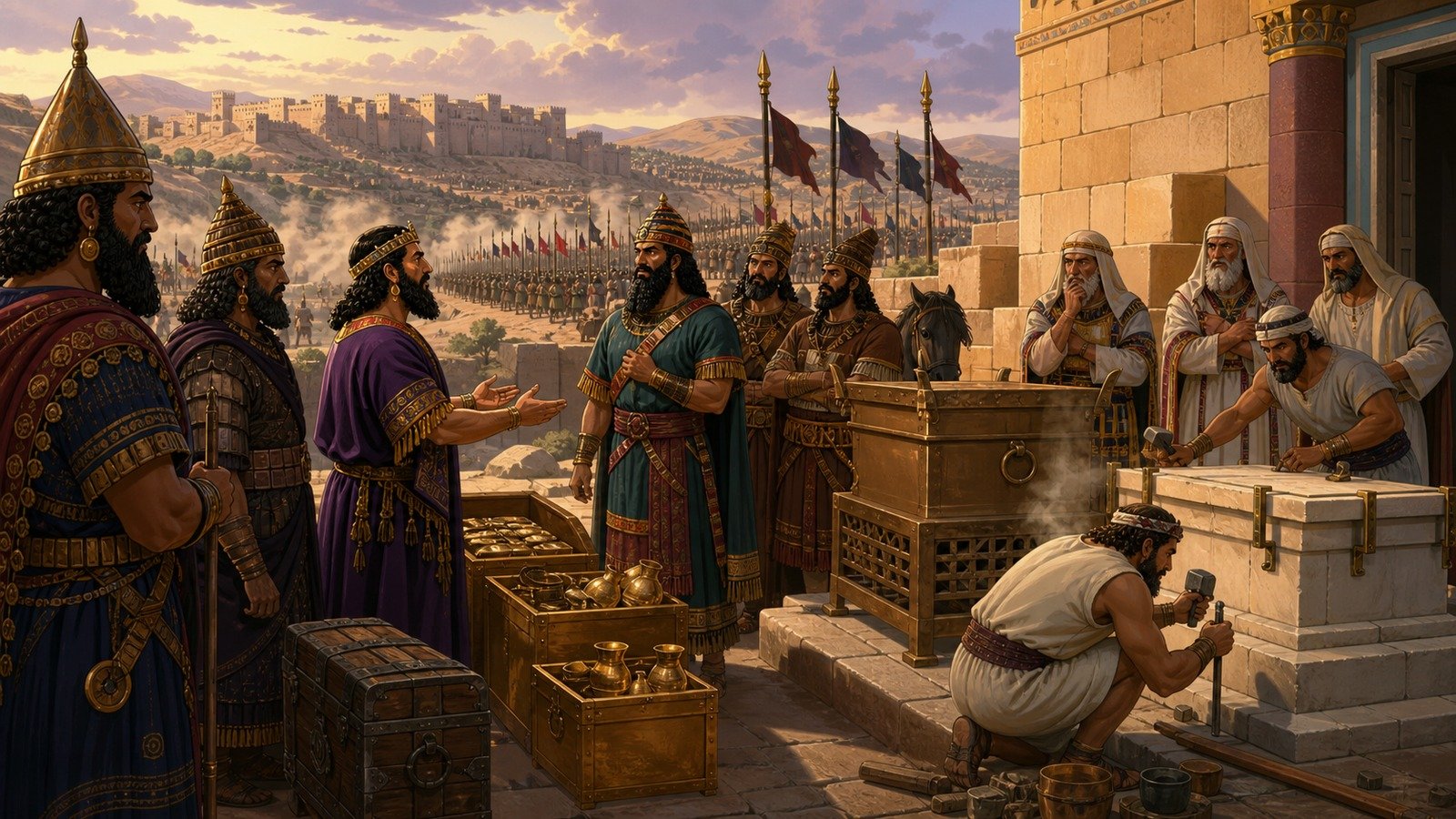
Facing invasion from Israel and Aram, Ahaz buys protection from Tiglath-Pileser III of Assyria at the cost of Temple treasures and lasting vassal status, and introduces a pagan altar modelled on one he saw in Damascus.
Further context
2 min readSixteen years, and the verdict is the worst given to any king of Judah so far: unlike David his father, he did not do what was right. He followed the ways of the kings of Israel and even sacrificed his son in the fire, engaging in the detestable practices of the nations the LORD had driven out before the Israelites.
Child sacrifice is the point at which the southern kingdom crosses a line it had not crossed before, and the practice is condemned in the strongest terms throughout Israelite law. Where it happened is identified elsewhere as the Valley of Ben Hinnom outside Jerusalem, a name that survives in Greek as Gehenna and becomes a standard word for hell.
The political crisis of his reign is the coalition of Aram and Israel trying to force him into an anti-Assyrian alliance and, when he refuses, marching on Jerusalem to replace him. Isaiah meets him at the aqueduct of the Upper Pool while he is inspecting the water supply, brings his own son along, and tells him to keep calm and not lose heart over these two smouldering stubs of firewood. He offers him a sign, any sign, as deep as the grave or as high as the heavens.
Ahaz refuses it, and the reason he gives is pious: I will not put the LORD to the test. Isaiah's reaction makes clear that the refusal is evasion rather than reverence, and the sign is given anyway: the virgin will conceive and give birth to a son, and will call him Immanuel, and before the boy knows enough to reject the wrong and choose the right, the land of the two kings you dread will be laid waste.
What he does instead is send messengers to Tiglath-Pileser III with a message that gives away the whole position: I am your servant and vassal. Come up and save me. He empties the temple and palace treasuries to pay for it.
The intervention works and destroys the region. Damascus falls, Israel loses three quarters of its territory, and Judah becomes an Assyrian vassal for the next century.
Then he goes to Damascus to meet his new overlord, sees an altar there, sends a detailed sketch and plans back to Uriah the priest in Jerusalem, and has a copy built. When he returns he offers on it himself and moves the bronze altar that had stood in front of the temple out of the way to the north side. He also dismantles the temple furnishings, removes the Sabbath canopy and the royal entryway, in deference to the king of Assyria.
The altar copied from Damascus is the detail that shows how the whole reign worked. He did not import a Syrian god. He imported a Syrian fitting, into the temple of his own God, because he had seen it at his overlord's capital and wanted one, and he moved the original out of the way to make room. Religion is being adjusted to match the furniture of the people who now run the country.
His son Hezekiah inherits a vassal state with a foreign altar in the temple courtyard.