

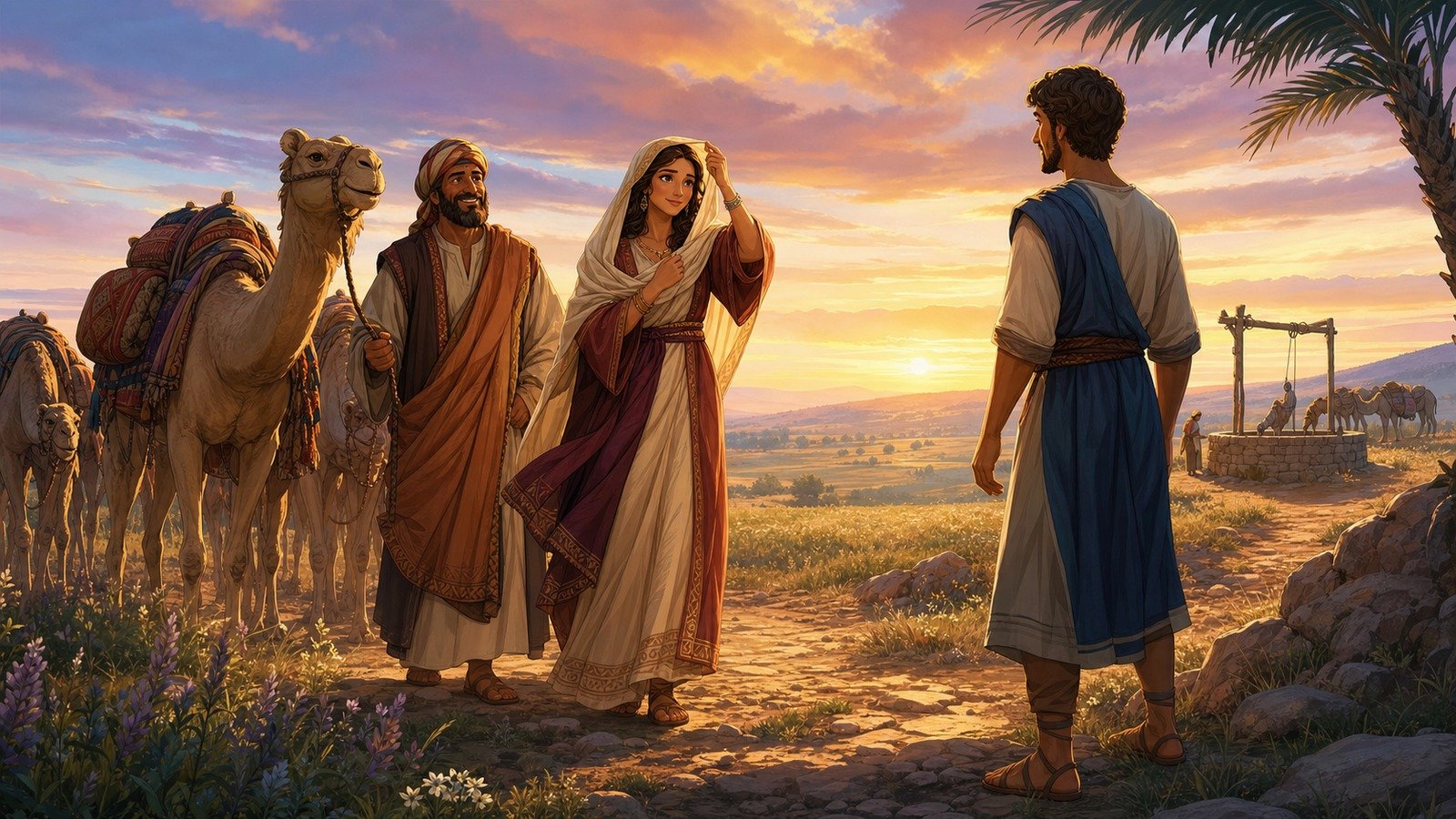
Abraham sends his servant back to Harran to find a wife for Isaac from among his own relatives rather than the Canaanites. The servant's prayer is answered by Rebekah at the well, and Isaac marries her, finding comfort after his mother's death.
Further context
3 min readSixty-seven verses are spent on the recruitment of a wife, more than on any other single episode in the patriarchal story, because the survival of the promise depends on it.
Abraham, now old, puts his senior servant under oath with an unusual gesture, asking him to place his hand under his thigh. The formula appears twice in these chapters and is generally understood as an oath sworn on the seat of procreation, which suits the subject. Two conditions are attached. Isaac is not to marry a Canaanite woman, and Isaac is on no account to be taken back east. The second is the more revealing: the family may look to Mesopotamia for a wife but will not retreat there to live.
The servant takes ten camels and travels to the town of Nahor in Aram Naharaim, and stops at the well outside the town towards evening, the hour when women came out to draw water. His prayer asks for a specific sign: the girl who, when he asks for a drink, offers to water his camels as well.
The size of that request is easy to miss. Ten camels after a long journey can take in a very large volume of water, and a jar carried up from a well holds a fraction of it. The sign asks a stranger to volunteer several hours of heavy physical work for a man she has never met. Rebekah does exactly that, quickly, and keeps going until they have finished drinking.
She turns out to be the daughter of Bethuel, son of Nahor and Milkah, which makes her Abraham's great-niece and inside the family the servant was sent to find. He gives her a gold nose ring weighing half a shekel and two gold bracelets weighing ten, and asks whether there is room in her father's house.
Her brother Laban appears next, and the way he is introduced matters for the twenty years of story still to come: Laban hurries out to the man at the spring after seeing the ring and the bracelets on his sister's arms. He is running towards the jewellery.
Terms are agreed quickly, and then the household proposes a delay of ten days. The servant refuses, and the question is put to Rebekah directly: will you go with this man? Her answer is two words in Hebrew. I will go. That she is asked at all, and that her consent settles it, is worth noticing in a period when marriages were arranged between men.
The length of the episode comes from a decision that looks like inefficiency and is not. Standing in Bethuel's house, the servant retells the whole thing from the beginning: the oath, the journey, the prayer at the well, the sign, and Rebekah's arrival. Roughly a quarter of the whole is that retelling. The effect is that the family hears the sequence as he understood it, framed throughout as a series of answered requests rather than a successful errand.
It ends at evening in a field in the Negev. Isaac has gone out to do something described by a Hebrew verb that occurs only here and whose meaning is uncertain. He is living near Beer Lahai Roi, the well where Hagar met the angel. She sees him, gets down from her camel and covers herself, and the closing line reports that he loved her and was comforted after his mother's death. He is forty years old.