

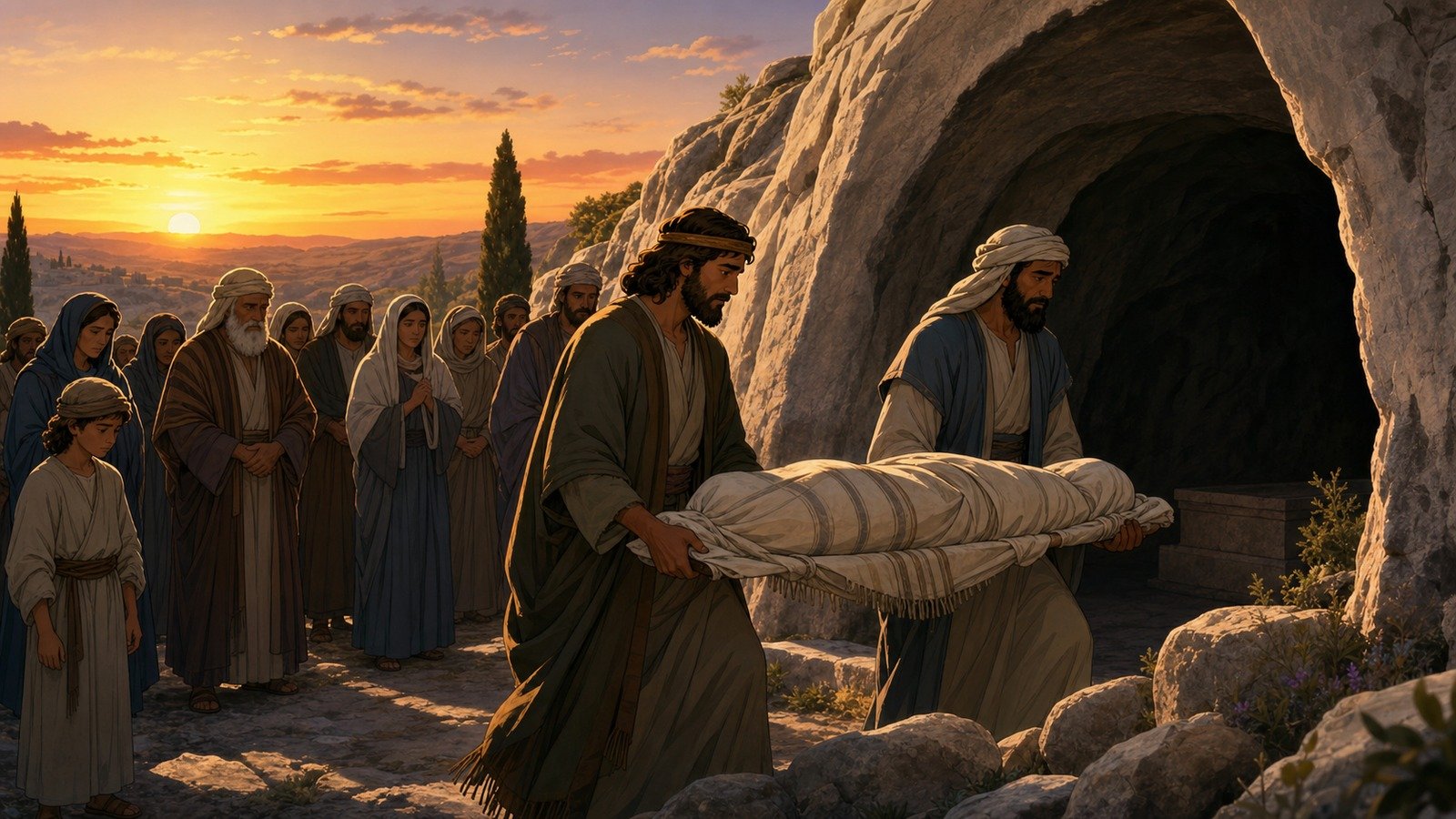
Abraham takes a further wife, Keturah, and fathers more children before dying at 175. Isaac and Ishmael together bury him beside Sarah in the cave of Machpelah.
Further context
2 min readAfter Sarah's death he took another wife, Keturah, and had six more sons. Zimran, Jokshan, Medan, Midian, Ishbak and Shuah are named, and several of them become peoples rather than individuals in what follows. Midian is the most significant: the Midianites recur repeatedly in the Hebrew scriptures, and Moses marries the daughter of a Midianite priest and spends forty years among them before the Exodus.
Keturah's status is described differently in different places. Here she is a wife; a later genealogy calls her a concubine, and the sons of Abraham's concubines are mentioned in the plural a few sentences on. The distinction concerned inheritance rights rather than affection, which is exactly what this passage is settling.
The disposal of the estate is stated with legal clarity. He left everything he owned to Isaac, and gave gifts to the sons of his concubines and sent them away eastward while he was still alive. Settling the other sons in his own lifetime, with property but away from the inheritance, prevents a succession dispute after his death. The same principle had already been applied to Ishmael, blessed and provided for and placed outside the covenant line. The eastward destination is equally practical: the territories associated with Midian, Sheba and Dedan lie along the caravan routes of northern Arabia.
He dies at a hundred and seventy-five, and the phrases used are worth unpacking. He breathed his last at a good old age, an old man and full of years, and he was gathered to his people. That last expression is applied to Abraham, Ishmael, Isaac, Jacob, Aaron and Moses, and always as something separate from the burial that follows it. The Hebrew scriptures say remarkably little about what happens after death, and this is one of the few indications that their writers thought of something beyond the grave, though it stops well short of a description.
The burial carries the most weight. His sons Isaac and Ishmael buried him in the cave of Machpelah. The two are named together, and the last time they appeared in the same scene one was being sent into the desert with a skin of water at the other's weaning feast. Some fifty-five years have passed. No reconciliation is described anywhere. They are simply both standing at the same graveside, and whatever happened between a boy of sixteen sent away with a loaf of bread and a man of ninety burying his father is left entirely to the reader.
The chronology here is not sequential, and noticing that changes how the following chapters read. Abraham was a hundred when Isaac was born, and Isaac was sixty when his twins were born, which puts Abraham at a hundred and sixty at their birth. He lived to a hundred and seventy-five. Jacob and Esau were therefore about fifteen when their grandfather died, and the events narrated after this in fact overlap with the end of his life.
The last line transfers the promise: after Abraham's death, God blessed his son Isaac, who then lived near Beer Lahai Roi. The well named by a runaway Egyptian slave is where the next generation makes its home.