

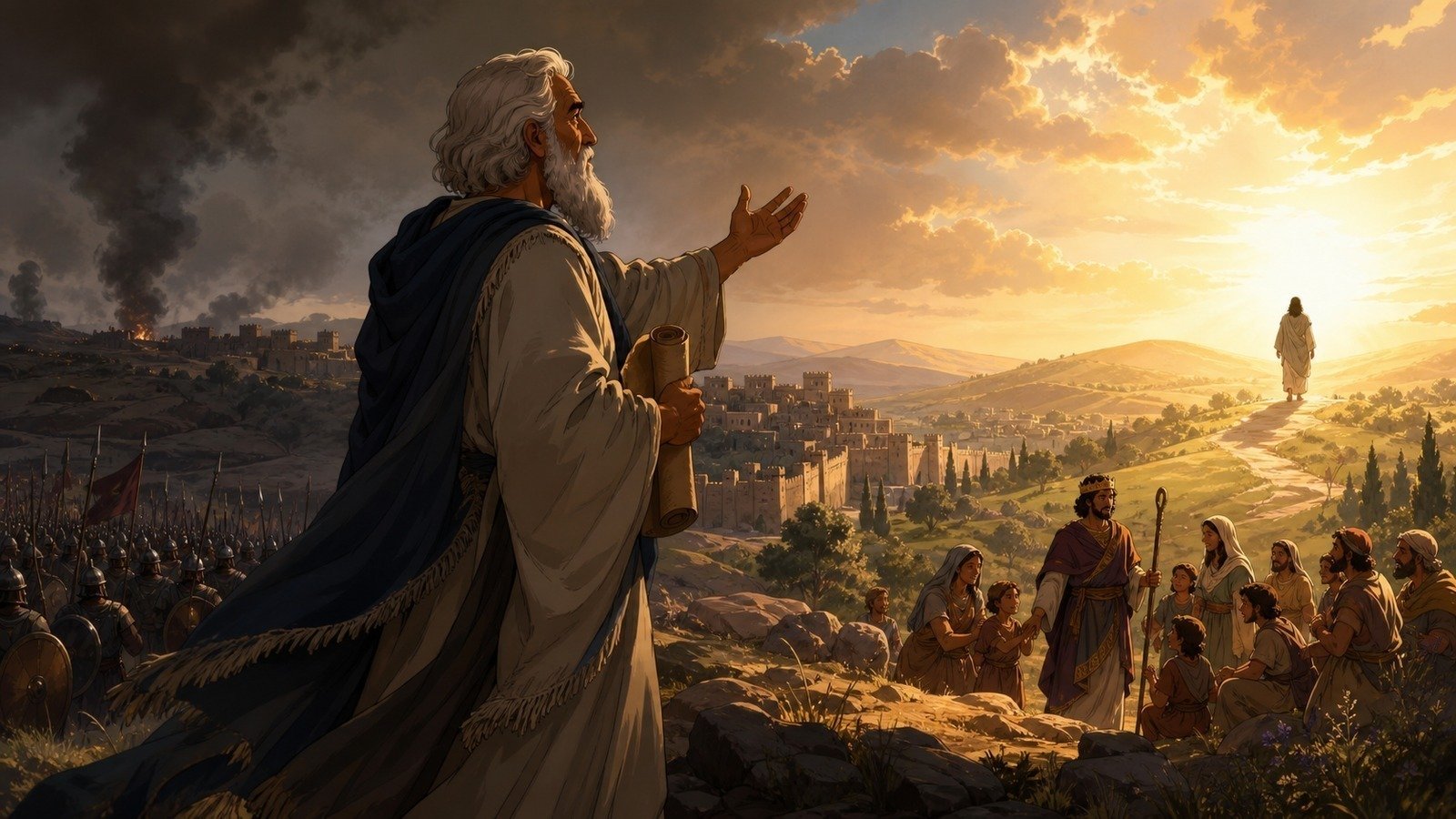
Across his ministry Isaiah oscillates between warning both kingdoms of judgement and promising a future king from David's line who will reign in justice, and a suffering servant who bears the sin of others; the New Testament writers repeatedly apply these texts to Jesus, a reading Christian tradition holds but which is itself a later theological interpretation of the Hebrew text.
Further context
3 min readThe material attributed to him runs to sixty-six chapters and covers about two centuries of subject matter, which is the reason for the longest-running argument in Old Testament scholarship.
The first thirty-nine chapters are set in the eighth century BC, name Assyria as the threat, and address kings who can be dated. From chapter forty onwards the setting has moved: Babylon is the power, the exile is already underway, and Cyrus of Persia is named twice, a man who was born roughly a hundred and fifty years after Isaiah's own lifetime. Positions on that range from a single prophet writing predictively, to two or three authors whose work was collected under one name, to a school of disciples continuing his tradition. Nothing in the debate is settled, and the arguments on each side are about how prophecy works rather than about the quality of the material.
Four passages from the collection have shaped Christian thought more than almost anything else in the Hebrew scriptures.
The sign given to Ahaz during the Aramean crisis: the virgin will conceive and give birth to a son, and will call him Immanuel, which means God with us. The Hebrew word means a young woman of marriageable age and does not by itself specify virginity; the Greek translation made three centuries earlier renders it with a word that does, and Matthew quotes that version.
The child born to us, in a passage addressed to a region devastated by Assyrian deportations: for to us a child is born, to us a son is given, and the government will be on his shoulders, and he will be called Wonderful Counsellor, Mighty God, Everlasting Father, Prince of Peace. Of the greatness of his government and peace there will be no end.
The shoot from the stump of Jesse, which assumes the royal line has been cut down to a stump, describing a ruler on whom the Spirit rests, who judges the needy with righteousness rather than by what he sees with his eyes, and a world in which the wolf lives with the lamb.
And the fourth of the servant songs, describing a figure despised and rejected, pierced for our transgressions, crushed for our iniquities, led like a lamb to the slaughter, who did not open his mouth, and who was assigned a grave with the wicked though he had done no violence. Who that servant is has been read as Israel, as a righteous remnant, as the prophet himself and as an individual to come, and the earliest Christian preaching applied it directly to Jesus.
A copy of the entire book, a scroll over seven metres long, was found at Qumran in 1947 and dates to around 125 BC, a thousand years older than any manuscript previously known, and it matches the received text closely.
The authorship question is the largest in Old Testament scholarship and it deserves stating fairly. From chapter forty onward the setting shifts: Jerusalem is already destroyed, the exile is under way, and Cyrus of Persia is named as the one who will send the people home, a century and a half after Isaiah's lifetime.
Those who hold to a single author take this as predictive prophecy of an unusually specific kind. Those who divide the book, which is the majority position in academic work, argue that the later chapters address a different audience in a different century and that the vocabulary and imagery change accordingly.
The four servant songs sit in that later material, and the fourth of them describes a figure despised and rejected, pierced for our transgressions, crushed for our iniquities, led like a lamb to the slaughter and silent before his shearers.
That poem is quoted or alluded to in every part of the New Testament.