

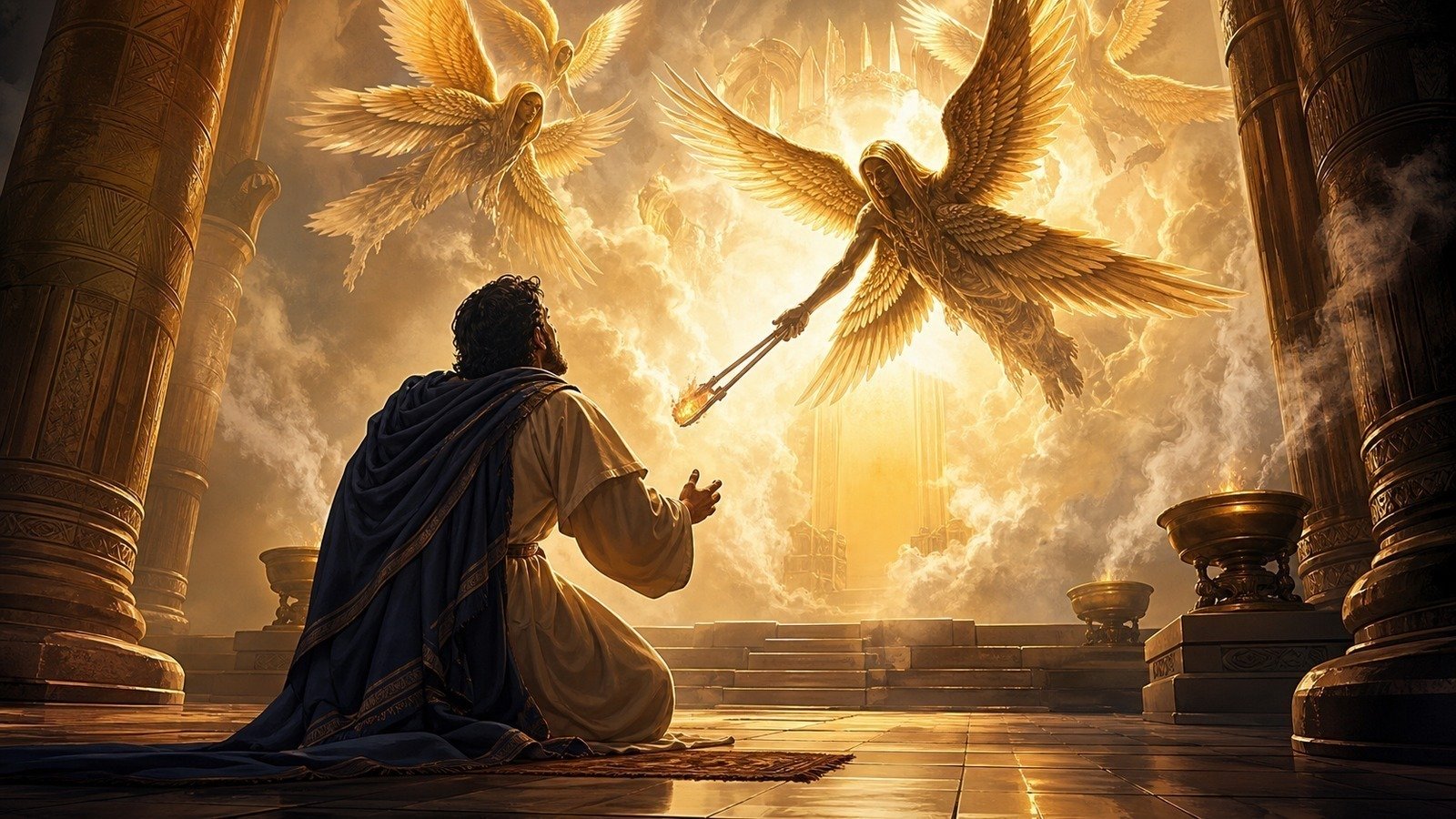
Isaiah receives a vision of God enthroned in the Temple "in the year King Uzziah died" and is commissioned as a prophet despite being warned the people will not listen; his ministry runs through the reigns of Jotham, Ahaz and Hezekiah.
Further context
3 min readIsaiah dates his call himself: in the year that King Uzziah died, which is around 740 BC, and the timing matters. Uzziah had reigned fifty-two years, longer than anyone living could remember, and had died excluded from the temple with a skin disease after trying to burn incense at the altar. In the year the throne emptied, a man sees a different throne.
The vision is set in the temple. He sees the Lord high and exalted, with the train of his robe filling the building, and above him seraphim, each with six wings, calling to one another: holy, holy, holy is the LORD Almighty; the whole earth is full of his glory. The doorposts and thresholds shake and the building fills with smoke.
His reaction is not awe but collapse. Woe to me! I am ruined! For I am a man of unclean lips, and I live among a people of unclean lips, and my eyes have seen the King, the LORD Almighty. A seraph takes a live coal from the altar with tongs and touches his mouth with it.
Then a question addressed to nobody in particular, which is what he answers: whom shall I send, and who will go for us? Here am I. Send me.
What he is sent to do is the hardest commission given to any of these figures, and it is stated in advance. Go and tell this people: be ever hearing, but never understanding; be ever seeing, but never perceiving. Make the heart of this people calloused; make their ears dull and close their eyes. He asks how long, and is told until the cities lie ruined and the land is utterly forsaken. A stump is left standing.
He works for about sixty years, through the reigns of four kings, at the centre of national politics rather than at the margins. He confronts Ahaz at the aqueduct during the Aramean crisis and is refused. He advises Hezekiah through the Assyrian siege and is heeded. He walks stripped and barefoot for three years as a sign against relying on Egypt. He names his own sons as walking messages, one meaning a remnant will return and the other meaning quick to the plunder, swift to the spoil.
The commission to make the heart of this people calloused has been read in two ways for a very long time. One takes it as a statement of intent. The other takes it as a description of the effect, expressed in Hebrew idiom as a purpose, on the grounds that a message repeatedly refused hardens the people refusing it. The same words are quoted in all four Gospels and in Acts, which indicates how sharply the difficulty was felt early on.
Later Jewish tradition holds that he was executed under Manasseh by being sawn in two, and a New Testament letter's list of what people suffered includes being sawn in two, which is generally taken as an allusion to it. That story appears in a Jewish work outside the Hebrew scriptures and not in the histories themselves.
The vision itself is set in the temple, and the details are physical: the hem of a robe filling the building, seraphim with six wings each, the doorposts and thresholds shaking, and the whole place filling with smoke.
Seraphim means burning ones, and the word is used elsewhere in the Hebrew Bible of venomous snakes, which is why the beings here are usually understood as serpentine rather than human in form.
Isaiah's reaction is not awe but panic: woe to me! I am ruined! For I am a man of unclean lips, and I live among a people of unclean lips. The cleansing that follows is done with a live coal taken from the altar with tongs and touched to his mouth.
The commission he then accepts is one nobody would want. He is told the message will not work: be ever hearing, but never understanding. How long, Lord? Until the cities lie ruined and without inhabitant.