

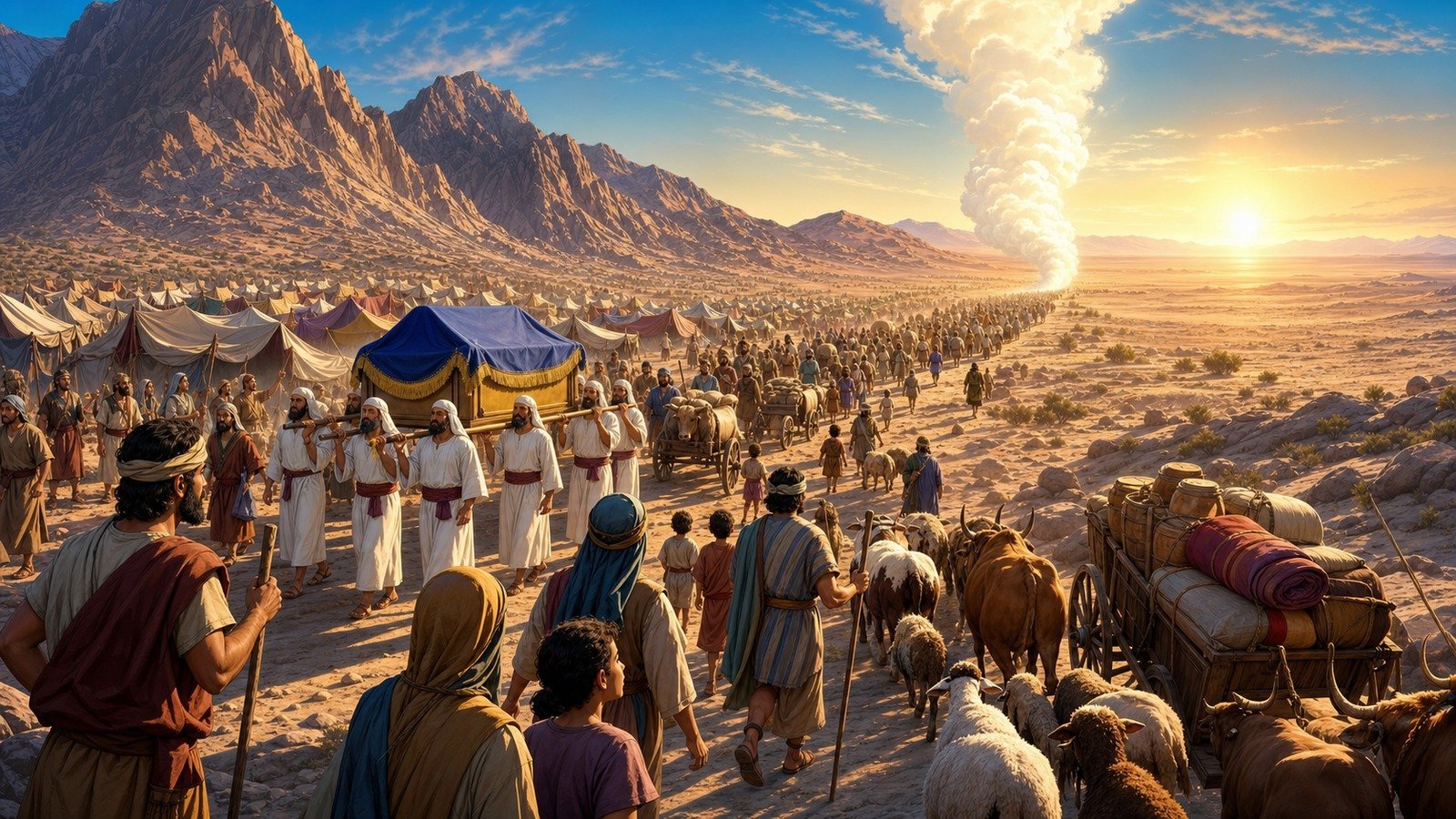
Almost a year after arriving, Israel breaks camp at Sinai and sets out for Canaan, guided by the cloud over the tabernacle and preceded by the ark.
Further context
2 min readIsrael has been at Mount Sinai for close to a year. They arrived three months after leaving Egypt, received the law, built a golden calf, were forgiven, built a sanctuary, were organised into a camp and counted, and on the twentieth day of the second month of the second year the cloud lifts and they set out for the first time as an ordered nation.
The march follows the pattern laid down beforehand. Judah's division goes first with its standard, the sanctuary is taken down and carried, and the other divisions follow in their appointed order. Two silver trumpets, made to specification, are used to signal assembly and departure, with different calls for summoning the whole community and for summoning the leaders alone.
Inside the departure is a short exchange with more weight than its length suggests. Moses asks his father-in-law's relative Hobab, a Midianite, to come with them, and Hobab says he will go back to his own land and his own people. Moses presses him with an argument that is entirely practical: please do not leave us, since you know where we should camp in the wilderness and can be our eyes. The community has a pillar of cloud and its leader still wants a guide who knows the country. What Hobab decided is unknown, and the descendants of Moses' father-in-law turn up living among the Israelites in the later histories, which suggests he came.
Two lines of poetry close the section, and they were evidently spoken every time the ark moved and every time it stopped. When it set out: rise up, LORD, may your enemies be scattered, may your foes flee before you. When it came to rest: return, LORD, to the countless thousands of Israel. In Hebrew manuscripts those two sentences are marked off with inverted letters, a scribal device found nowhere else in the first five books, and what it was for is unknown.
What follows is a sequence of failures, and putting those lines immediately before them is deliberate. The next episode is a complaint about hardship, and by the time the column reaches Kadesh Barnea this generation has forfeited the destination it set out for.
The two silver trumpets deserve a note. They were made to a specified pattern, hammered from single pieces, and only priests were permitted to blow them. Different signals meant different things: one trumpet summoned the leaders, both summoned the whole community, and a particular blast meant strike camp. A nation of that size moving in formation needed a signalling system, and this is one, described in the detail of a technical manual.
The distance is not great. Eleven days by the mountain road, according to a later summary, and Kadesh, usually identified with the springs at Ain el-Qudeirat in the north-eastern Sinai, sits on the southern approach to Canaan. The generation that left Egypt then spends about thirty-eight further years within reach of a border it will not cross.
Nothing about the departure suggests any of that. A disciplined column moves off in formation behind a standard, with trumpets, with a guide being recruited, and with a war cry that assumes the campaign is already won.