

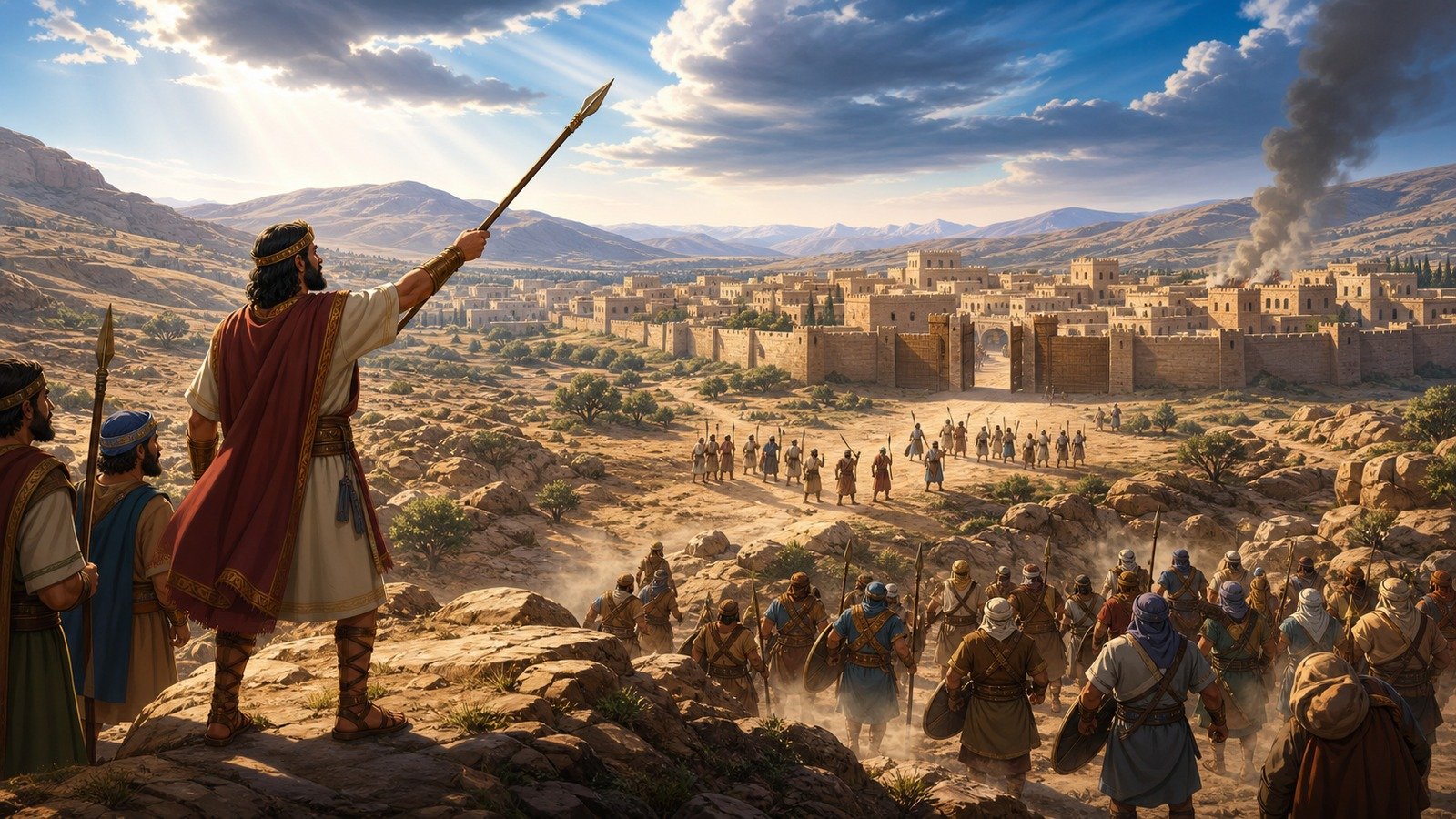
With Achan's sin dealt with, Israel returns to Ai and takes the city using an ambush strategy, reversing the earlier defeat.
Further context
2 min readThe second attempt on Ai is a professional operation and it is described in enough detail to follow on a map. Thirty thousand men are sent out by night to lie in ambush behind the town on its western side. Joshua takes the rest and approaches openly from the north, camping in the valley in full view.
The king of Ai sees them and comes out at dawn, and the main force turns and runs as though beaten, drawing the defenders away from the town in pursuit. Not a man is left in Ai, and the gate is left open. Joshua holds out his javelin towards the town, the ambush force rises and takes it and sets it on fire, and the pursuing army turns round to see smoke going up behind them and finds the retreating Israelites now coming back at them.
Twelve thousand die that day, the king is captured and hanged, and this time the plunder is kept, because permission to keep it was given in advance.
The contrast with Jericho is deliberate at every point. Jericho was taken by walking and shouting and nothing was kept. Ai is taken by a feigned retreat and a double envelopment and everything is kept. Both are described as the LORD giving the town into their hands, and the two together make a point about method that the conquest narratives keep returning to: nothing here is a formula, and doing the previous thing again is not the plan.
The ceremony at Ebal is also where a copy of the law is written on stones coated with plaster, which is a documented Near Eastern practice: monumental inscriptions on plastered stone are known from the region, including the Balaam text at Deir Alla. What is being set up is a public legal record, in the open, at the geographical centre of the country, at the point where an army in the field would normally be consolidating its gains.
The site is a difficulty and it should be stated. Ai in Hebrew means the ruin. Et-Tell, the traditional identification, was excavated in the 1930s and again in the 1960s and shows a large Early Bronze city destroyed around 2400 BC and then abandoned for roughly a thousand years, with a small unwalled Iron Age village on top. On that identification there was no fortified town there to capture at any plausible date for the conquest. Proposals in response include a different site nearby, notably Khirbet el-Maqatir which has produced Late Bronze fortification remains, and the suggestion that the name attached to a garrison outpost of Bethel rather than to a city. None commands agreement, and the problem is real rather than manufactured.
What follows the battle is the strangest thing in the sequence. The whole nation, including women, children and the foreigners living among them, goes twenty-five miles north to Mount Ebal and Mount Gerizim, builds an altar of uncut stones, and holds a ceremony in which half the tribes stand on one mountain and half on the other and the blessings and curses of the law are read aloud between them. In the middle of an active campaign, an army stops and spends several days on a reading.