

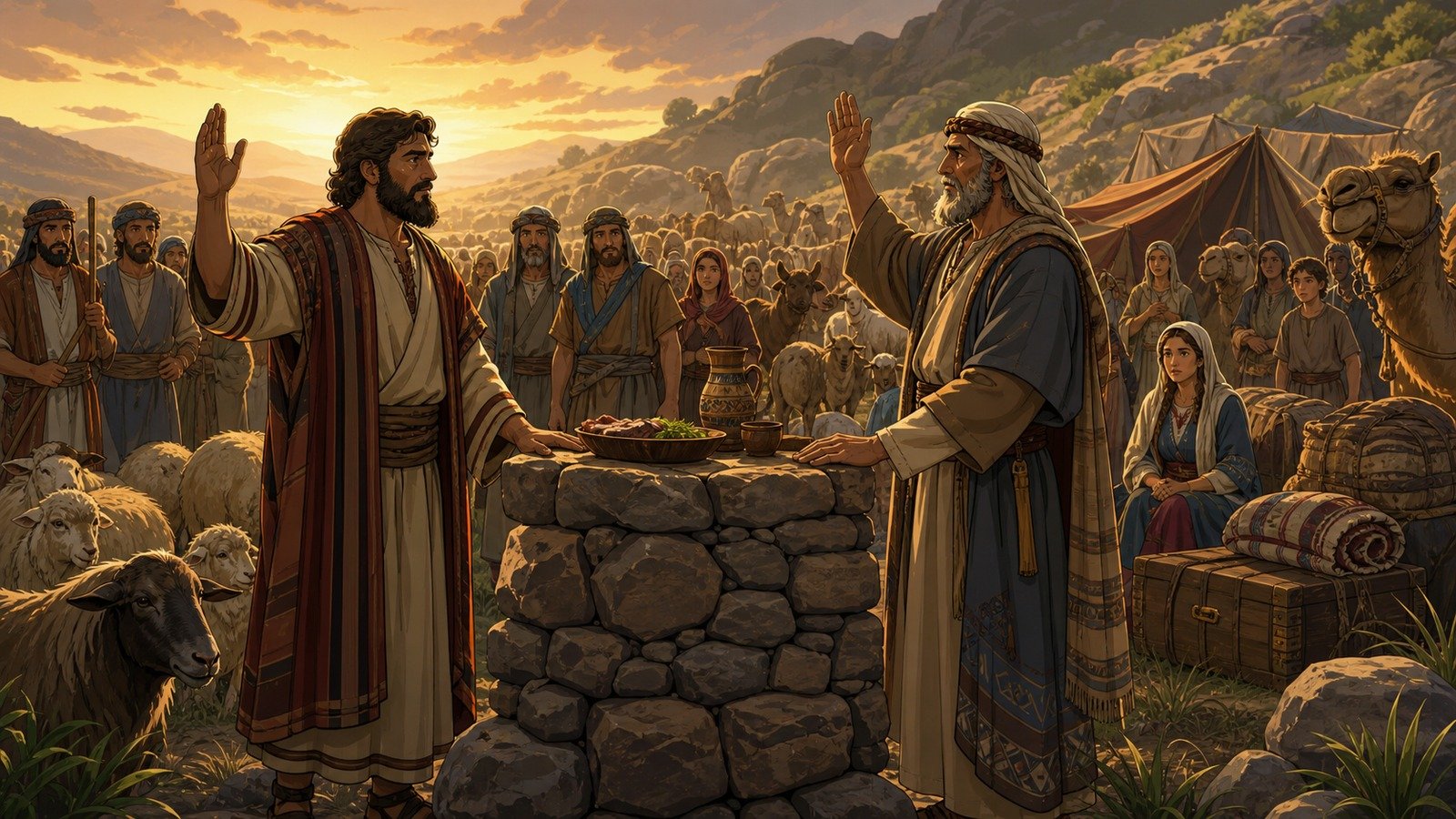
Jacob leaves Laban secretly with his family and flocks; Laban pursues him but the two part on terms of a covenant at Galeed, after Rachel's theft of her father's household idols goes undiscovered.
Further context
2 min readLaban's sons are complaining that Jacob has taken everything their father owned, and Laban's attitude has visibly changed. That is the atmosphere when the instruction comes to go back to the land of his fathers.
He calls Leah and Rachel out to the fields, away from the household, and puts the case to them. Their reply is not what anyone expects from two daughters. Do we still have any share in the inheritance of our father's estate? Does he not regard us as foreigners? He sold us, and what was paid for us has been used up. Fourteen years of their husband's labour was their bride price, and their father consumed it rather than settling it on them, which under the customs of the region was a real grievance rather than a complaint about affection.
They leave while Laban is away shearing, and Rachel steals her father's household gods. These small figurines have been argued over for decades. Tablets from Nuzi in northern Iraq were once widely cited as showing that possession of such images carried inheritance rights, which would make the theft a legal manoeuvre rather than a religious one. That interpretation has been challenged since, on the grounds that the Nuzi texts do not say quite what was claimed. What can be said safely is that the images mattered a great deal to Laban, and why they mattered to Rachel is unknown.
He pursues for seven days and catches them in the hill country of Gilead. God warns him in a dream not to say anything to Jacob, either good or bad, which is a legal idiom for not pressing a case. His complaint when he arrives is about the manner of the departure and about the gods, and Jacob, who does not know what Rachel has done, declares that whoever is found with them will not live. Laban searches every tent and finds nothing, because she has put the images in her camel's saddle and is sitting on it, telling her father she cannot stand up because she is having her period.
Jacob's speech in reply is the longest he makes anywhere and it is a statement of account. Twenty years: fourteen for the two daughters and six for the flocks, with wages changed ten times. He bore the loss of animals killed by wild beasts himself rather than bringing the carcass as evidence, which the law of the region entitled him to do. Heat consumed him by day and cold by night, and sleep fled from his eyes.
They settle it by treaty, heaping up stones and eating a meal beside them. Laban names the heap in Aramaic and Jacob in Hebrew, the only Aramaic phrase in the whole book, and both names mean heap of witness. The pillar is also called Mizpah, watchpost, and the words spoken over it have become a blessing used between people parting in affection: may the LORD keep watch between you and me when we are away from each other. In context it is nothing of the kind. It is a boundary clause between two men who do not trust one another, calling God in as the enforcer against whichever of them crosses the line to do harm.