

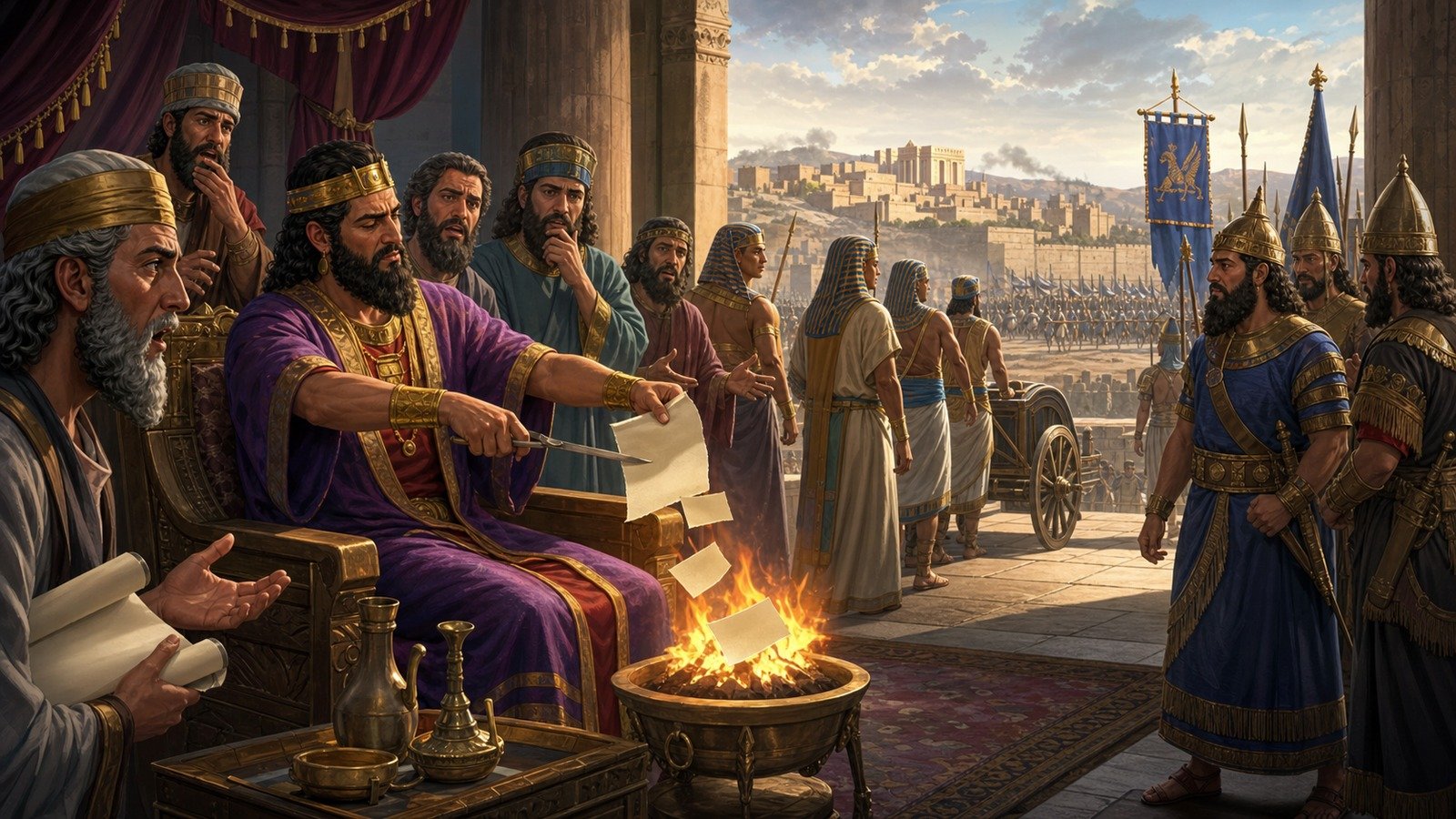
Jehoiakim rules first as an Egyptian and then, after Nebuchadnezzar's victory at Carchemish in 605 BC, as a Babylonian vassal; he burns a scroll of Jeremiah's prophecies in defiance and later rebels against Babylon, dying shortly before Jerusalem's first major siege.
Further context
3 min readJehoiakim reigns eleven years, installed by Egypt and renamed by an Egyptian king, and the verdict is that he did evil in the eyes of the LORD.
He pays the fine by taxing the country, exacting the silver and gold from the people of the land according to their assessments, which is the first time a Judaean king is described raising a levy to pay a foreign power.
Then the geopolitics change under him. Nebuchadnezzar defeats Egypt at Carchemish in 605 BC, a battle recorded in the Babylonian Chronicle, and the whole Levant passes from Egyptian to Babylonian control. Jehoiakim becomes Nebuchadnezzar's vassal for three years and then rebels, which is the decision that ends the kingdom. Raiders from Babylon, Aram, Moab and Ammon are sent against Judah, and the deportations begin.
What he is remembered for is a scroll. Jeremiah, banned from the temple, dictates everything he has said over twenty-three years to his secretary Baruch, who reads it publicly on a fast day. Officials hear it, take it to the king and read it to him while he is sitting in his winter apartment with a fire burning in a brazier in front of him. As each three or four columns are read, he cuts them off with a scribe's knife and throws them into the fire, until the entire scroll is burned. Three officials urge him not to and are ignored, and neither he nor his attendants show any fear or tear their clothes.
The winter apartment and the brazier are the kind of detail that fixes a scene. Jerusalem in the ninth month is cold and wet, the palace had separate summer and winter quarters, and a king sitting by a charcoal fire cutting a scroll into strips with a penknife as it is read to him is one of the sharpest images anywhere in these histories.
A second scroll is dictated with many similar words added to it, which is one of the few descriptions anywhere of how a prophetic book came to be compiled.
Jeremiah's assessment of him is personal and specific. He is accused of building a palace by unrighteousness and forced labour, making his own people work for nothing and not paying them for their labour, and of having eyes and heart set only on dishonest gain, on shedding innocent blood and on oppression and extortion. The predicted end is a burial like a donkey's, dragged away and thrown outside the gates of Jerusalem.
How he actually died is unclear. One account says he rested with his ancestors, another that he was bound in bronze shackles to be taken to Babylon. His son succeeds him and reigns three months.
Eleven years, and Jeremiah worked through all of them, which is why more is known about the political atmosphere of this reign than of almost any other.
The best-documented episode is the burning of the scroll. Jeremiah dictated his messages to Baruch, who read them in the temple; they were read again to the officials, who were alarmed and told the two men to hide; and then read to the king, who was sitting in his winter apartment with a fire burning in a brazier in front of him. As each three or four columns were read, he cut them off with a scribe's knife and threw them into the fire, until the entire scroll was burned.
Neither the king nor his attendants showed any fear, and none of them tore their clothes.
Jeremiah dictated it again, and many similar words were added to it.