

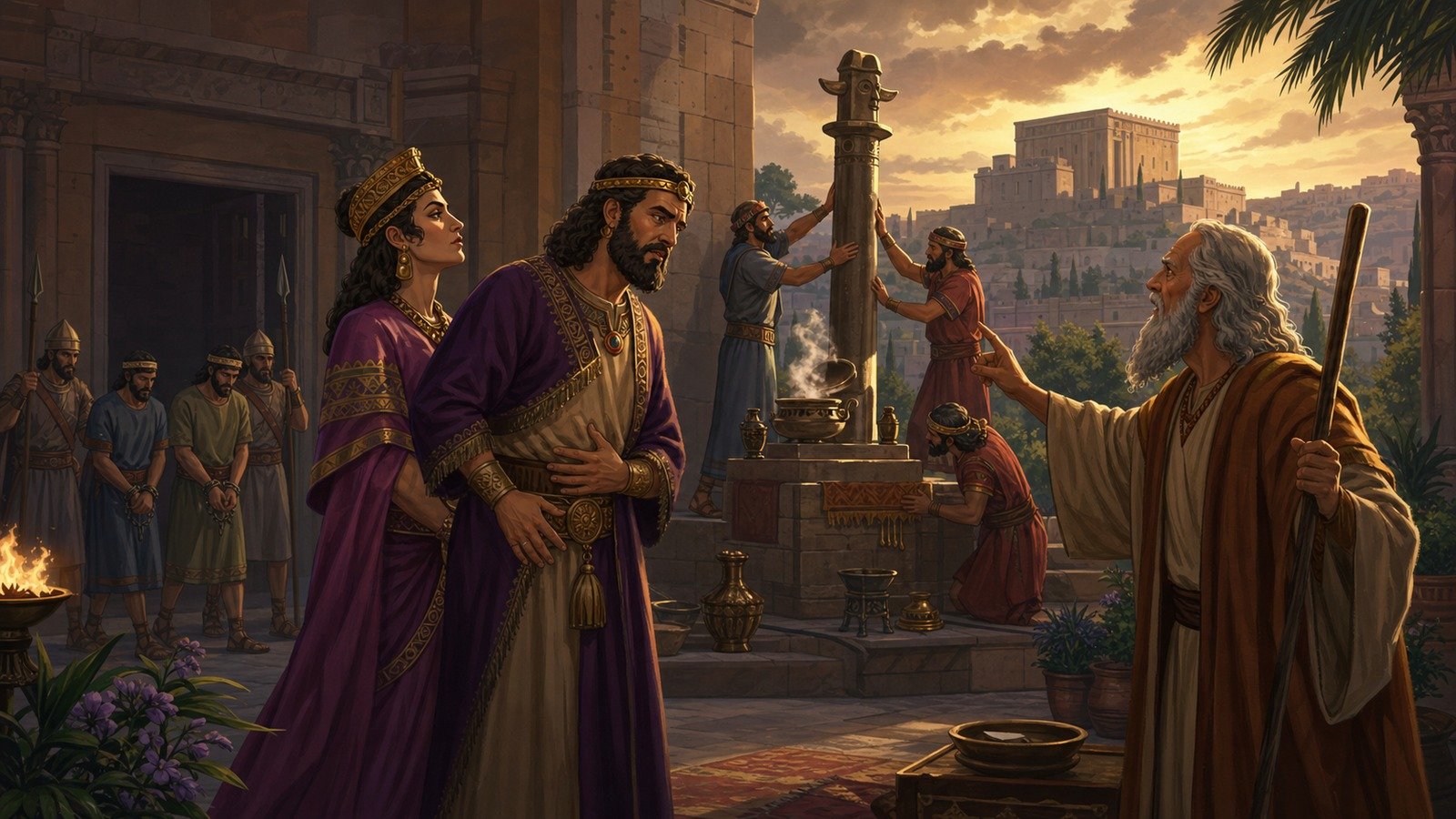
Jehoshaphat's son Jehoram marries Ahab's daughter Athaliah and murders his own brothers to secure the throne, importing Baal worship into Judah for the first time; Chronicles records he dies of a painful intestinal disease as a specific prophetic judgement.
Further context
3 min readJehoram of Judah is Jehoshaphat's son, and the marriage alliance his father arranged now delivers its bill. He is married to Athaliah, a daughter of the house of Ahab, and the verdict is that he walked in the ways of the kings of Israel, as the house of Ahab had done, because he married a daughter of Ahab. He did evil in the eyes of the LORD.
His first act on securing the throne is to kill all six of his own brothers with the sword, along with some of the officials of Israel. Their father had given them substantial gifts of silver and gold and fortified cities, and had given the kingdom to Jehoram because he was the firstborn, so the killings are not a succession dispute. They are a precaution.
He builds high places in the hill country of Judah and causes the people of Jerusalem to prostitute themselves, which is the standard vocabulary for religious defection.
The reign goes wrong quickly. Edom revolts and sets up its own king, and a night attack by Jehoram breaks out of an encirclement but achieves nothing, and Edom stays independent. Libnah revolts at the same time. Philistines and Arabs raid Judah and carry off everything found in the royal palace, together with his sons and his wives, leaving him only his youngest son.
A letter then arrives from Elijah, which is the only recorded contact between that prophet and the southern kingdom, and it is short and entirely about the murders and the shrines. It ends with a specific prediction of a lingering disease of the bowels.
The letter from Elijah is the only recorded contact between the northern prophet and the southern court, and its timing has been questioned since antiquity, since Elijah is generally taken to have been removed before this reign. Proposals include a letter written before his departure and delivered later, a chronological overlap larger than usually assumed, and a document transmitted by his successors. None is decisive.
He is struck with an incurable disease and dies after two years of it in great pain. The closing note is one of the bleakest epitaphs anywhere: he passed away, to no one's regret, and was buried in the City of David, but not in the tombs of the kings.
One detail is preserved about how the reign was regarded at the time and it is more damning than any verdict. His people made no funeral fire in his honour, as they had for his predecessors. Burning spices at a royal funeral was the ordinary mark of respect for a king of Judah, and it was pointedly omitted.
Two generations after Jehoshaphat set up a national system of judges and sent teachers round the towns with the law, his son has murdered his own brothers, lost Edom permanently, imported Baal worship into Jerusalem and died unmourned, and the marriage that produced it was arranged as foreign policy by a man everyone regarded as good.
Eight years, and his reign opens with a massacre: when he had established himself firmly, he put all his brothers to the sword along with some of the officials of Israel.
Killing potential claimants on accession was ordinary practice in the ancient Near East and it is recorded of several dynasties. What makes it worth stating here is that his father had given those sons fortified cities and substantial gifts, and had made Jehoram king because he was the firstborn.
Edom revolted during his reign and won its independence, which cost Judah the trade routes to the Gulf of Aqaba and the copper of the Arabah permanently.
A letter from Elijah is recorded arriving during his reign, which is the only written prophetic message in these books, and it predicts a lingering disease of the bowels. He dies of one, to no one's regret, and is buried in the city but not in the tombs of the kings.