

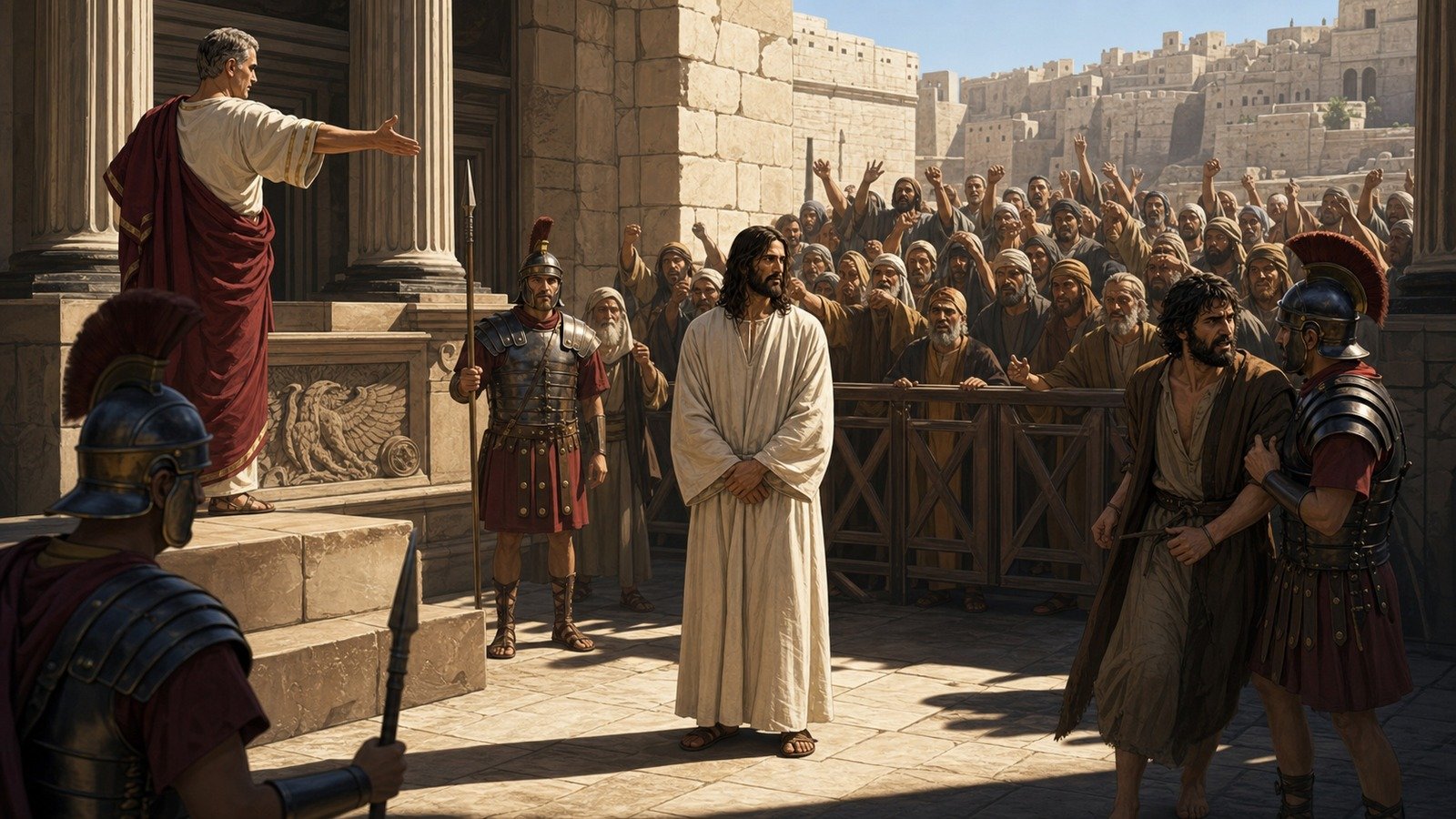
Pilate sends Jesus briefly to Herod Antipas, who mocks him and sends him back; despite his own reluctance, Pilate eventually yields to the crowd's demand and releases the insurrectionist Barabbas instead, sentencing Jesus to crucifixion.
Further context
2 min readLearning that the prisoner is a Galilean, Pilate sends him to Herod Antipas, who ruled Galilee and was in Jerusalem for the festival.
The move is jurisdictional and convenient. Roman practice allowed a case to be referred to the authority of the accused's home district, and Pilate had every reason to want this one off his desk.
Antipas is the man who had executed John the Baptist and had later said that John had been raised from the dead. He is described as pleased, because he had wanted to see Jesus for a long time and hoped to see him perform some sign. He questions him at length, and gets nothing: he gave him no answer.
The chief priests and teachers of the law stand there vehemently accusing him. Then Herod and his soldiers ridicule and mock him, dress him in an elegant robe and send him back.
A small note is added about the effect on the two officials: that day Herod and Pilate became friends, for before this they had been enemies. Two men who had been at odds discover a shared position over a prisoner neither wants.
Back before Pilate, the crowd is in front of the residence and the morning turns on a custom: the release of one prisoner at the festival. No Roman source outside the Gospels describes this practice in Judea, and its historicity is questioned; provincial governors did have discretionary powers of pardon, and instances of prisoners released to please a crowd are attested elsewhere in the empire.
The alternative offered is Barabbas, described as an insurrectionist who had committed murder in an uprising. The choice is therefore between two men accused of the same category of crime, one of whom had actually done it.
The chief priests stir up the crowd, and the shout comes back for Barabbas. What shall I do, then, with the one you call the king of the Jews? Crucify him.
Why? What crime has he committed?
They shout all the louder.
Pilate takes water and washes his hands in front of the crowd, saying he is innocent of this man's blood. Then he releases Barabbas, has Jesus flogged, and hands him over to be crucified.
Antipas had ruled Galilee since his father's death and would rule it for another six years, until he went to Rome to ask for the title of king and was exiled to Gaul instead. He is the only one of the three authorities that morning whose words nobody preserved.
The elegant robe he sends the prisoner back in is a piece of theatre with a purpose: dressing a supposed king in fine clothes and returning him to the governor is a way of saying, in public, that the case is a joke and not his.
Barabbas means son of the father, and a handful of early manuscripts give his personal name as Jesus, which would make the choice offered to the crowd a choice between two men called Jesus. Origen knew that reading in the third century and was uncomfortable with it.