

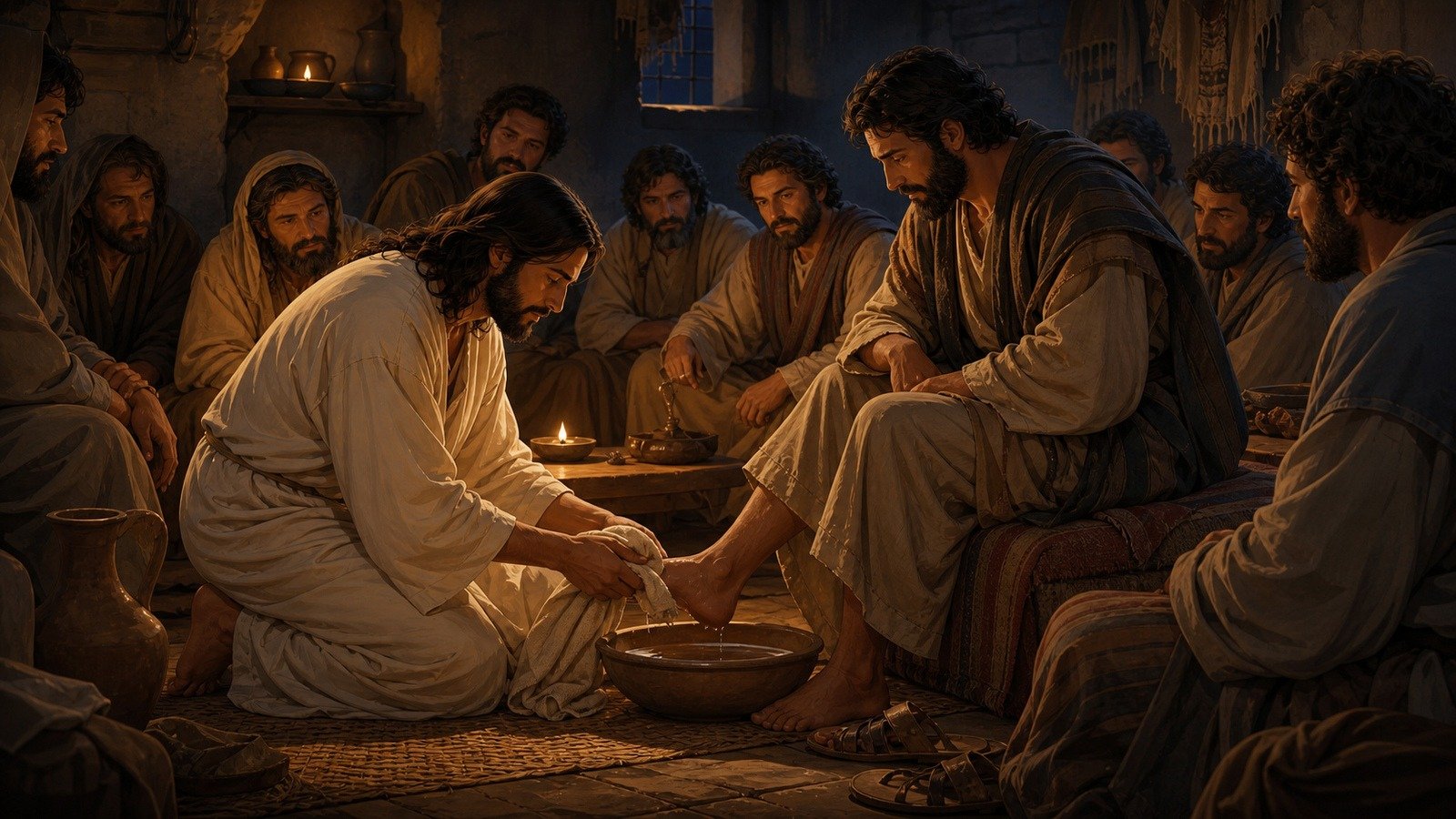
Before the meal, Jesus takes a servant's role and washes each disciple's feet, including Judas', over Peter's initial protest, establishing humble service as the model for how his followers are to treat one another.
Further context
2 min readDuring the meal Jesus gets up, takes off his outer clothing, wraps a towel round his waist, pours water into a basin and begins to wash his disciples' feet, drying them with the towel.
Every part of that describes a slave. Roads were dust or mud, footwear was sandals, and washing a guest's feet on arrival was standard hospitality performed by the lowest-ranking servant in a household. Jewish sources of the period discuss which duties a Hebrew slave could be required to perform, and washing feet appears among those considered too degrading to impose on one, being left to Gentile slaves. Removing the outer garment and tying on a towel is the costume of the job.
The room had no servant, and none of the Twelve had volunteered, which is easier to understand given that they had been arguing about rank on the way.
Peter's reaction is the one everybody remembers, and it goes through two stages within a few seconds. Lord, are you going to wash my feet? Then, no, you shall never wash my feet. Then, when told that unless he is washed he has no part with him, the reverse: Lord, not just my feet but my hands and my head as well.
The answer he gets makes a distinction: those who have had a bath need only to wash their feet. A guest bathed at home and arrived clean apart from the walk.
And you are clean, though not every one of you. Judas was in the room, and his feet were washed with the rest.
When he finishes he puts his clothes back on, returns to his place and asks whether they understand what he has done. You call me teacher and Lord, and rightly so, for that is what I am. Now that I, your Lord and Teacher, have washed your feet, you also should wash one another's feet.
Some churches have taken that as an instruction to be performed literally, and foot-washing services are still held on the Thursday of Holy Week in several traditions, including by the Bishop of Rome. Others take it as an illustration of a principle. The instruction itself does not settle which.
No servant is greater than his master, nor is a messenger greater than the one who sent him. Now that you know these things, you will be blessed if you do them.
Where in the meal this happened has been discussed since the early church, because feet were normally washed on arrival rather than partway through. Getting up during the meal to do it makes the act deliberate rather than customary: the moment for it had passed, nobody had done it, and he does it anyway.
The room itself was a borrowed upper storey, reached by an outside stair, of the kind ordinary houses in Jerusalem had. It held thirteen men reclining, a table, water and a basin, and no servant.
Peter's objection is also, in its way, correct. The order of the room was being inverted, and he was the only one who said so out loud.