

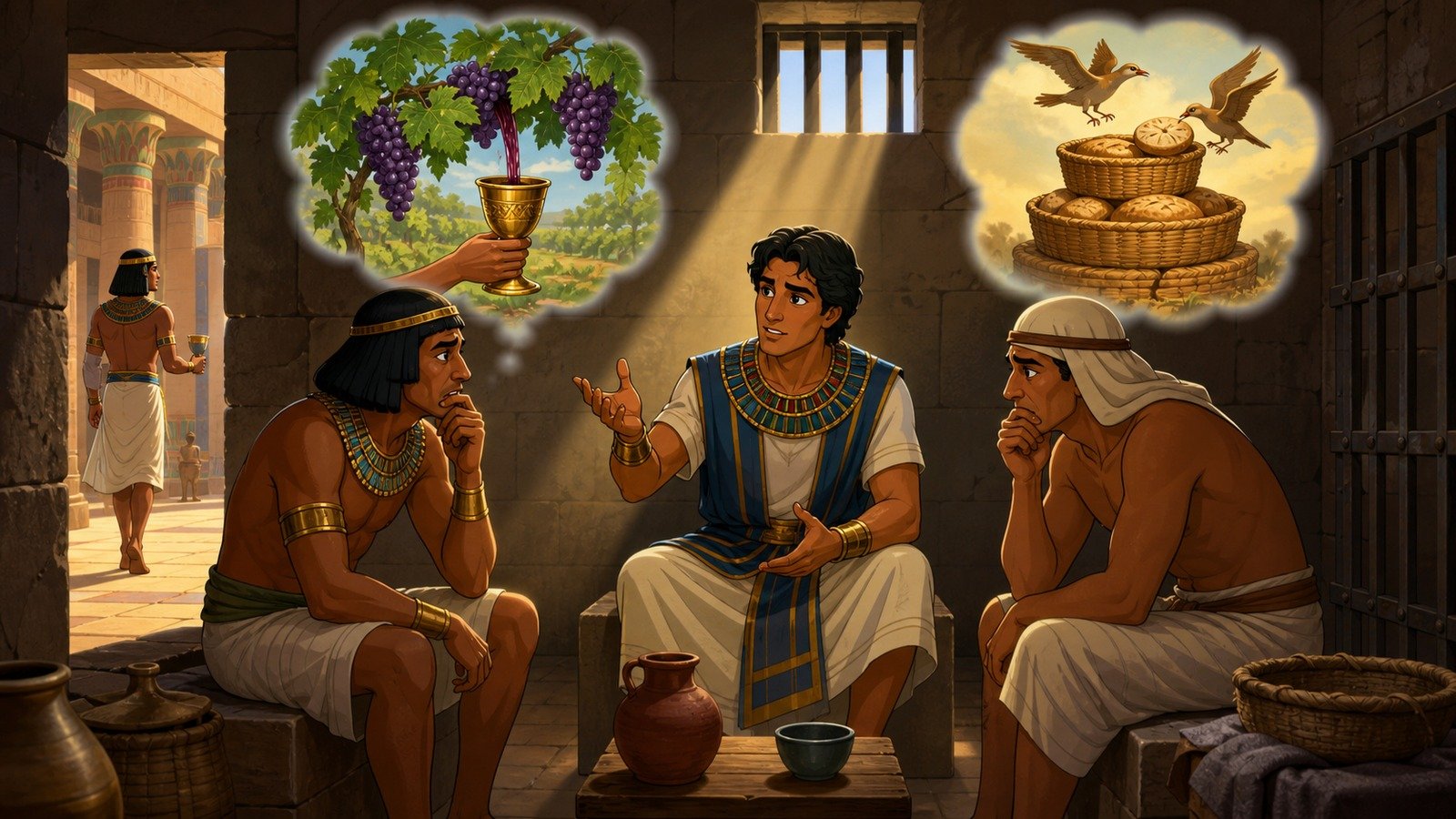
In prison, Joseph correctly interprets dreams for Pharaoh's cupbearer and baker, predicting restoration for one and execution for the other. The cupbearer, restored as predicted, forgets Joseph for two full years.
Further context
3 min readTwo of Pharaoh's officials offend him and are put in custody in the house of the captain of the guard, which is where Joseph is being held. Their titles are chief cupbearer and chief baker, and both were positions of real standing at an Egyptian court rather than kitchen work. The cupbearer served the king's wine and tasted it, which meant constant access to the monarch and a role in guarding him against poison; men holding such posts appear in Egyptian records as trusted advisers.
Joseph is assigned to attend them, and one morning he notices that both look dejected. That question is the sort only somebody paying attention asks, and he is a prisoner asking it of men well above him. They tell him they have each had a dream and there is nobody to interpret it.
His reply sets the terms for everything that follows in his life: do not interpretations belong to God? Tell me your dreams. Dream interpretation was a recognised professional skill in Egypt, with manuals compiled listing dreams and their meanings, and he is declining the professional framing while offering to do the work.
The cupbearer's dream is a vine with three branches that buds, blossoms and ripens into grapes, which he squeezes into Pharaoh's cup and puts into his hand. Three branches are three days, after which Pharaoh will lift up his head and restore him to his position. Joseph then asks a favour: remember me when it goes well with you, and mention me to Pharaoh. He states his case in two sentences, that he was carried off from the land of the Hebrews and has done nothing to deserve a dungeon, and makes no larger claim than that.
The baker, encouraged by a favourable reading, describes three baskets of bread on his head with birds eating from the top one. The interpretation comes without softening. Three days, and Pharaoh will lift off your head and impale your body on a pole, and the birds will eat away your flesh. The phrase about lifting the head is used of both men and means opposite things in each case, which is grim wordplay in the Hebrew.
The third day is Pharaoh's birthday. He gives a feast for all his officials, restores the cupbearer and hangs the baker, exactly as Joseph said.
The last line is what matters for everything after: the chief cupbearer did not remember Joseph; he forgot him. Two verbs saying the same thing, and the repetition is the point.
The two dreams are constructed as a matched pair, which is what makes the interpretations demonstrable rather than plausible. Both involve the number three and both turn on the same idiom about the head being lifted. One man is restored and the other is executed, on the same day, exactly as stated, in front of an entire court. When the cupbearer eventually remembers, what he can testify to is not that a prisoner said something interesting but that two predictions came true to the day, one of them fatal.
Two full years pass before anything changes. Joseph accurately predicted the future for a man with direct access to the king, asked one favour in return, and spent another two years in a cell because the man forgot. Nothing is made of that, and no complaint from him is recorded during it.