

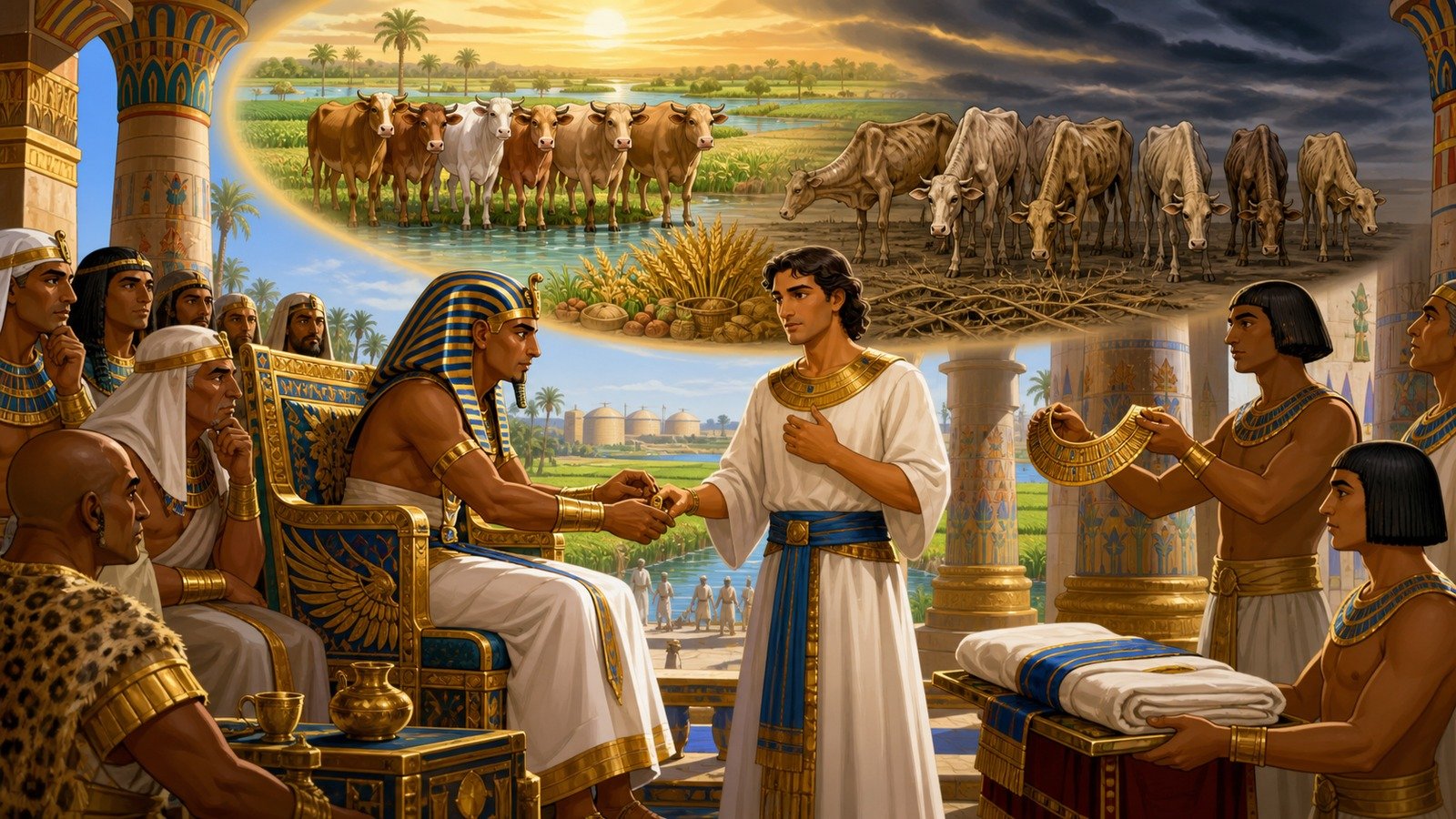
Joseph interprets Pharaoh's dreams of seven fat and seven lean cows as seven years of plenty followed by seven of famine, and is appointed second-in-command over all Egypt at the age of 30 to oversee the coming crisis.
Further context
2 min readPharaoh dreams twice in one night. Seven sleek, fat cows come up out of the Nile and are eaten by seven ugly, gaunt ones that stay as thin as before. Seven full heads of grain on one stalk are swallowed by seven thin heads scorched by the east wind.
Both images are Egyptian rather than generic. Cattle coming up out of the river fit a country whose herds grazed the flooded margins of the Nile, and the east wind is the khamsin, the desert wind that dries and shrivels standing crops. The magicians and wise men of Egypt are consulted first and can make nothing of either, and only then does the cupbearer remember the prisoner.
Joseph is brought up from the dungeon, and he shaves and changes his clothes before going in. Egyptians were clean-shaven and regarded facial hair as foreign, so that detail is a small piece of accurate observation about what a court expected.
His opening words disclaim the skill he has been summoned for: I cannot do it, but God will give Pharaoh the answer he desires. He then reads both dreams as one. Seven years of great abundance followed by seven years of famine so severe that the abundance will be forgotten. The reason for the doubling is supplied as well: the matter has been firmly decided by God and will happen soon.
Then he offers advice nobody asked him for. Appoint a discerning and wise man over the land, put commissioners in charge, and take a fifth of the harvest during the seven good years so the country has a reserve. A fifth is a heavy rate and not an unheard-of one; Egyptian taxation on agricultural produce ran at comparable levels.
The appointment that follows is described in the vocabulary of Egyptian court procedure. Pharaoh gives him his signet ring, which conveyed authority to seal documents in the king's name, dresses him in robes of fine linen, puts a gold chain around his neck and has him ride in a chariot as second in command. He is given an Egyptian name, Zaphenath-Paneah, and a wife, Asenath, daughter of the priest of On, which is Heliopolis, the centre of the sun cult. A Hebrew slave marries into the Egyptian priesthood.
He is thirty years old, which means thirteen years have passed since he was sold at seventeen.
Two sons are born during the years of plenty, and their names record what he had been carrying. Manasseh, because God has made him forget all his trouble and all his father's household. Ephraim, because God has made him fruitful in the land of his suffering.
No Egyptian record names him and none would be expected to. The Second Intermediate Period, when rulers of Semitic origin governed the Delta from Avaris in the seventeenth and sixteenth centuries BC, is often proposed as the setting in which a foreigner could reach that position, and that is a plausible context rather than evidence. A famine inscription on Sehel Island describing seven lean years was carved in the Ptolemaic period and cannot corroborate anything.