

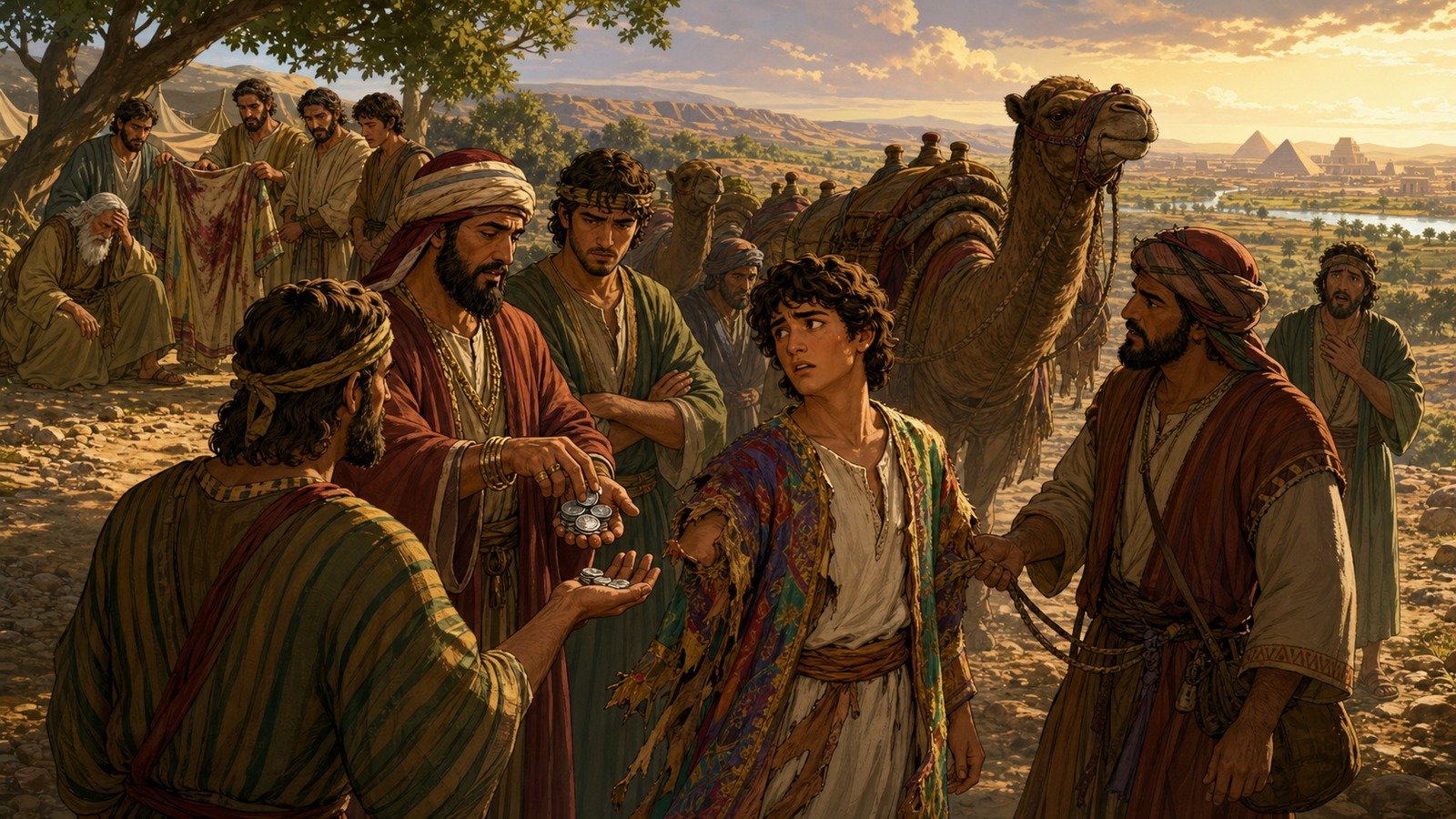
The brothers seize Joseph, consider killing him, then sell him to Midianite traders for twenty pieces of silver; he is taken to Egypt while his brothers deceive Jacob into believing he was killed by a wild animal.
Further context
3 min readJacob sends him from Hebron to check on his brothers, who are grazing the flocks near Shechem. That is a journey of some eighty kilometres north, into the district where two of those brothers had recently massacred a town, and when he arrives a man finds him wandering in the fields and redirects him another twenty kilometres to Dothan.
They see him coming from a distance and there is time to plan. Here comes that dreamer, they say to each other. Let us kill him and throw him into one of these cisterns, and we will see what comes of his dreams.
Reuben intervenes, and his motive is spelled out: he intended to rescue him later and take him back to his father. His proposal is to shed no blood but to throw him into a cistern in the wilderness, and it is accepted.
They strip him of the robe and throw him in. The cistern was empty, with no water in it, and the next thing reported, without transition, is that they sat down to eat their meal. Cisterns in that country were bottle-shaped pits cut into limestone to catch winter runoff, narrow at the neck and impossible to climb out of.
A caravan appears, carrying spices, balm and myrrh from Gilead down to Egypt. Judah makes the case for selling him: what will we gain if we kill our brother and cover up his blood? The price is twenty shekels of silver.
That figure fits the period precisely. Israelite law later values a male between five and twenty at exactly that amount, and Old Babylonian and Nuzi documents record slave prices in the same range for the early second millennium BC, with the going rate rising to thirty shekels by the time of the Exodus laws and higher still in the first millennium. Someone inventing the detail later would more probably have used a figure current in his own day.
The traders are called Ishmaelites in some sentences and Midianites in others, which source critics take as evidence of two traditions joined together. The alternative is that the terms overlapped, and a passage in Judges uses both of the same people in a single verse.
The deception at home is built out of a goat and a garment. They slaughter a goat, dip the robe in its blood, send it to their father and ask him to examine it. Jacob deceived his own blind father using goatskins and his brother's clothing; his sons now deceive him with the blood of a goat and his son's coat. Nothing points this out, and nothing needs to.
Reuben's absence at the moment of the sale is easy to miss and it matters for what happens later. He is not there when the caravan arrives; he comes back to the cistern afterwards, finds it empty and tears his clothes, asking where he can turn now. As the eldest he was responsible for the boy, and he loses that responsibility twice over, once by failing to prevent the killing plan outright and once by being elsewhere at the decisive moment. Twenty years later, when he offers his own two sons as a guarantee for Benjamin, his father does not take him seriously.
He tears his clothes, puts on sackcloth and refuses to be comforted, saying he will go down to the grave mourning. The last line supplies information the family will not have for twenty-two years: the traders sold Joseph in Egypt to Potiphar, one of Pharaoh's officials, the captain of the guard.