

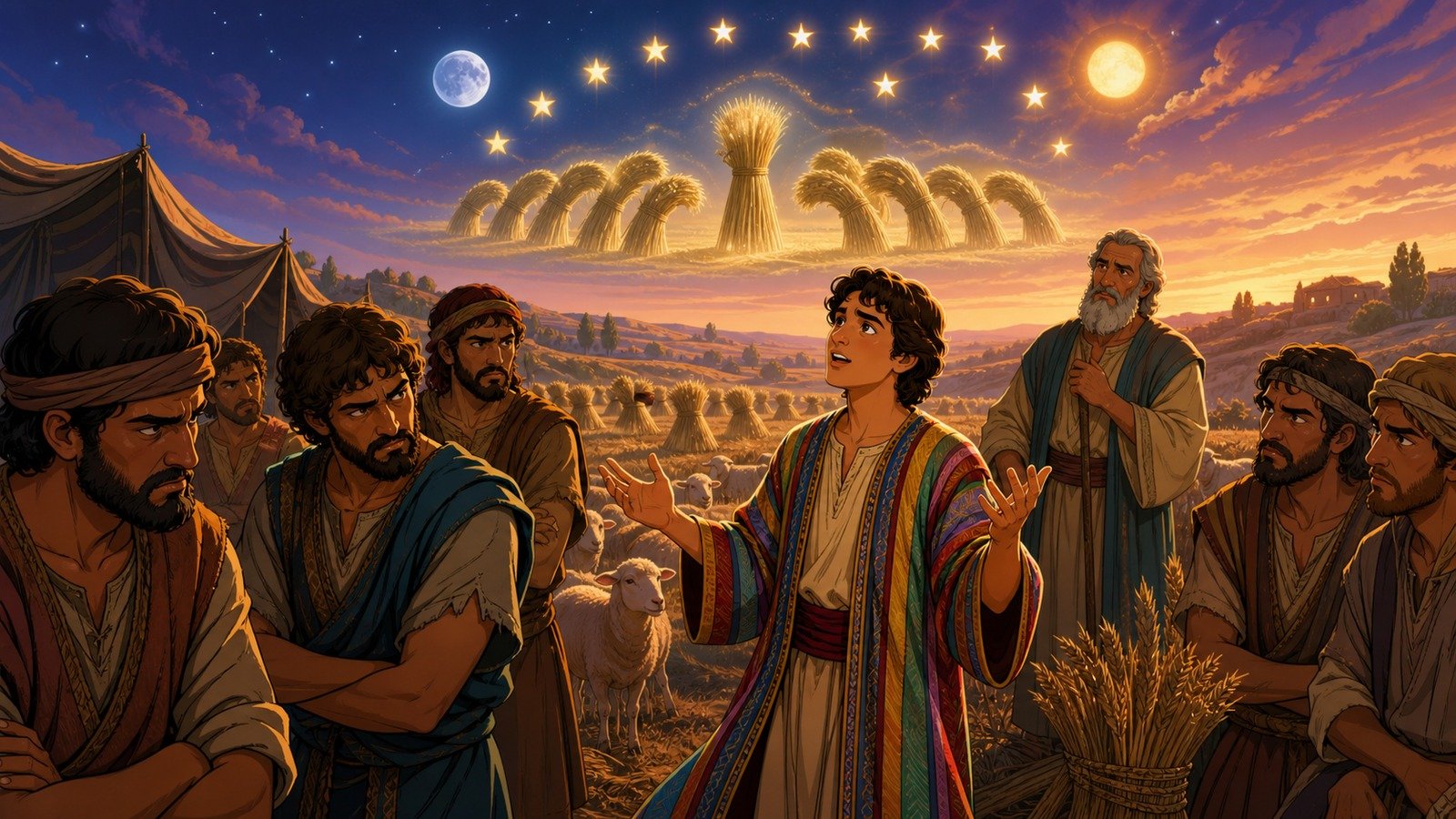
Jacob's evident favouritism toward Joseph, marked by an ornate robe, and Joseph's own dreams of his family bowing to him, provoke deep resentment among his older brothers.
Further context
2 min readJoseph is seventeen, working with the flocks alongside the sons of Bilhah and Zilpah, the two servant wives. The first thing recorded of him is that he brought his father a bad report about them.
The second is the robe. Israel loved Joseph more than any of his other sons because he had been born to him in his old age, and he made him an ornate robe. The Hebrew phrase (ketonet passim) is uncertain, and the familiar coat of many colours comes from the Greek and Latin translations rather than from the Hebrew. The only other place the phrase turns up describes the garment worn by a king's unmarried daughters, which suggests something long-sleeved and reaching to the ankles. Whatever it looked like, it was not work clothing. A garment that cannot be worn while herding, given to one of twelve sons, announces a decision about who is not expected to do the herding.
The result needs no interpretation: when his brothers saw that their father loved him more than any of them, they hated him and could not speak a kind word to him.
The dreams make it worse, and he tells them. In the first, the brothers are binding sheaves in a field, his sheaf stands upright and theirs gather round and bow down to it. The imagery is agricultural, which is faintly odd for a herding family, and it points forward to grain in Egypt. Their reply is a question with an edge: do you intend to reign over us?
In the second, the sun, the moon and eleven stars bow down to him. This time he tells his father as well, and Jacob rebukes him, asking whether his mother and brothers will actually come and bow to the ground before him. There is a difficulty embedded in that objection which readers have long noticed: Rachel is already dead, so the moon cannot be his mother in any straightforward sense. Some take the imagery as conventional rather than exact, others as pointing to Leah, who is functioning as the mother of the household.
The two dreams form a pair and the escalation between them is deliberate. The first is on the ground, among work the family actually does, and the ones bowing are his brothers. The second moves to the sky, takes in the whole household, and uses imagery associated with rule. Doubled dreams occur twice more in his life, with two prisoners and with a king, and he explains the significance of the doubling himself when he finally stands in front of Pharaoh: it means the matter has been firmly decided.
Jacob's response is recorded in two halves. He rebuked him, and he kept the matter in mind.
Nothing here presents Joseph sympathetically. He reports on his brothers, wears the robe, and repeats a second dream after the first has already provoked them. What is being built is a character who will spend the next thirteen years having every advantage stripped away from him, and care is taken to show what he was like before that happened.