

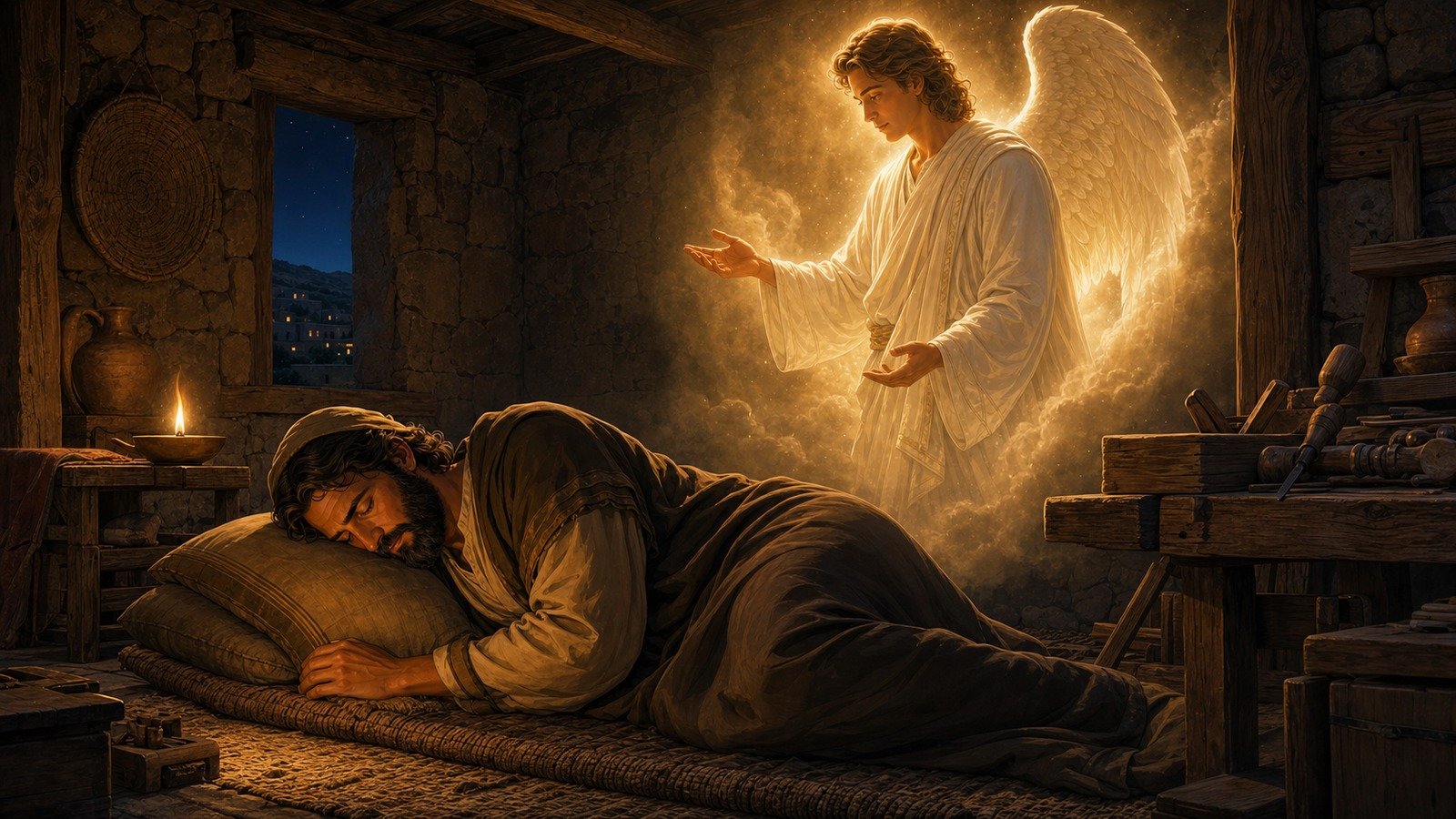
Discovering Mary pregnant before their marriage is completed, Joseph plans to quietly end the betrothal until an angel explains the child's origin in a dream and instructs him to name the boy Jesus, "because he will save his people from their sins."
Further context
3 min readBetrothal in that society was legally binding. The contract was made, the couple were referred to as husband and wife, and only a formal divorce could end it, though they did not yet live together. Within that arrangement, Mary is found to be pregnant.
Joseph is described as faithful to the law, and the two words used of his intention pull against each other in a way that defines him. He does not want to expose her to public disgrace, so he plans to divorce her quietly. The law permitted a public accusation with witnesses, which would have been ruinous and worse. He chooses the quiet certificate, which protects her as far as anything could while ending the marriage.
That is the situation when he has the dream. An angel addresses him as Joseph son of David, which is the only reason any of the genealogy matters, and tells him not to be afraid to take Mary home as his wife, because what is conceived in her is from the Holy Spirit. She will give birth to a son, and he is to give him the name Jesus, because he will save his people from their sins.
Jesus is the Greek form of Joshua, meaning the LORD saves, and it was an extremely common name. The instruction to name the child is what makes Joseph the legal father: naming was the act by which a man acknowledged a son as his own, and it is how the child enters the line of David.
When he wakes he does what he was told, takes her home as his wife, and does not consummate the marriage until after the birth.
That is almost all he does in the entire New Testament. He is given four dreams and obeys each one, moves his family twice on instruction, and is never recorded saying a single word. He appears once more when the boy is twelve and then vanishes from the narrative altogether, which is generally taken to mean he died before the public ministry began.
The point Matthew makes of the whole episode is a quotation: the virgin will conceive and give birth to a son, and they will call him Immanuel, which means God with us. Those words had been spoken to a frightened king seven centuries earlier, during an invasion crisis, as a sign about a child who would be born before that crisis passed.
The genealogy that precedes this reaches back through David to Abraham, and the four women named in it are Tamar, Rahab, Ruth and the wife of Uriah, which is a list of a woman who disguised herself as a prostitute, a Canaanite prostitute, a Moabite widow and a woman taken by a king who murdered her husband.
Joseph's problem is legal. Betrothal was binding, an unfaithful betrothed woman was liable to the penalty for adultery, and his options were a public trial or a quiet divorce before two witnesses.
He is described as faithful to the law, and yet he did not want to expose her to public disgrace, so he had in mind to divorce her quietly. Both halves of that sentence are held together without any suggestion that they conflict.
The instruction he receives in the dream reverses it: do not be afraid to take Mary home as your wife, because what is conceived in her is from the Holy Spirit.
Naming the child is the legal act of acknowledging him as a son, and Joseph is told to do it: you are to give him the name Jesus, which is the Greek form of Joshua and means the LORD saves.
He wakes up and does what he is told, and nothing he says is recorded anywhere in the New Testament.