

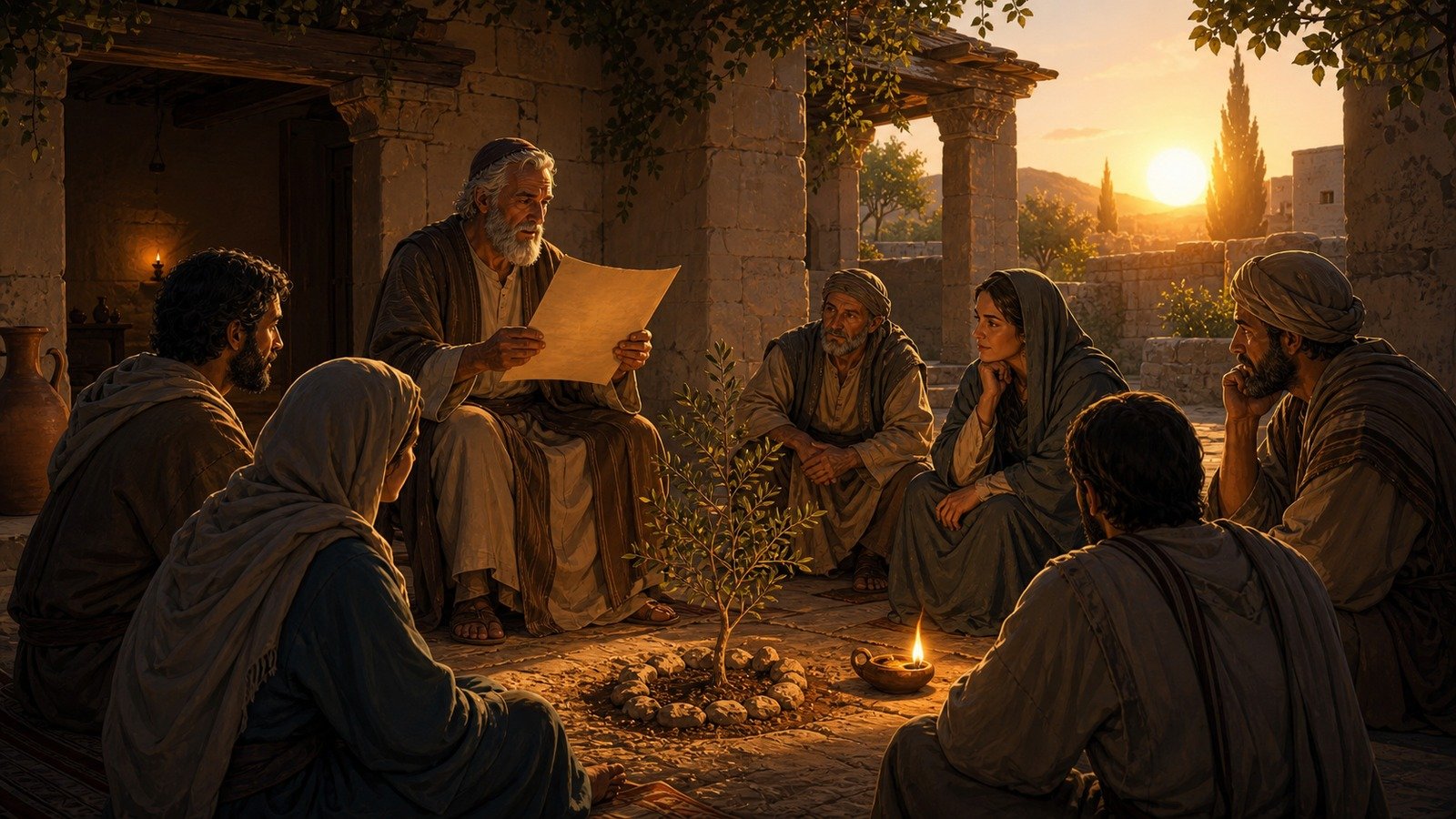
Christ commends the Ephesian church's perseverance and doctrinal discernment but warns that it has "forsaken the love you had at first," calling it to repentance with the promise of the tree of life for those who overcome.
Further context
2 min readThe seven messages follow a common pattern: a description of the speaker drawn from the opening vision, an assessment beginning I know your deeds, a commendation, a criticism, an instruction and a promise to the one who is victorious.
The seven cities also lie on a circular road running north from Ephesus up the coast, inland to Pergamum, and back down through Thyatira, Sardis, Philadelphia and Laodicea. A courier carrying the book would have visited them in exactly that order.
Ephesus is first because it was the largest and the natural point of arrival.
What the church there is commended for is substantial. I know your deeds, your hard work and your perseverance. I know that you cannot tolerate wicked people, that you have tested those who claim to be apostles but are not, and have found them false. You have persevered and have endured hardships for my name, and have not grown weary.
That is a congregation with stamina and discernment, which had done exactly what Paul had warned the Ephesian elders to do at Miletus decades earlier when he told them savage wolves would come in among them.
Then the criticism, and it is a single sentence: yet I hold this against you, that you have forsaken the love you had at first.
What that means has been read in two ways, and the Greek does not settle it. Love for God, or love for one another. The instruction that follows suggests something practical: consider how far you have fallen. Repent and do the things you did at first.
The threat attached is not a general warning about judgement but a specific one about the congregation's existence: if you do not repent, I will come to you and remove your lampstand from its place.
That is what happened, though not quickly. The church at Ephesus hosted a general council in 431. The harbour silted up, as it had been doing for centuries despite repeated dredging, the sea retreated several kilometres, and the city was gradually abandoned. The site today is ruins in a field.
The promise is to eat from the tree of life, which is in the paradise of God.
Paul, Timothy, Apollos, Priscilla, Aquila and, by tradition, John all worked in Ephesus. No other city outside Jerusalem has that concentration of names attached to it.
The message to it is the only one of the seven that quotes the congregation's own history back at it, since the warning about false apostles picks up a warning delivered in that city decades earlier.
The seven churches are all in a hundred-and-fifty-kilometre arc in western Asia Minor, and none of the great centres of the movement is among them. There is nothing to Jerusalem, Antioch, Corinth or Rome.
Why those seven is unexplained. The likeliest reason is that they were the postal centres of the region, from which copies could be distributed to the congregations around them, and seven is the number the book uses for completeness anyway.
The lampstand image is explained in the opening vision: the seven lampstands are the seven churches, so removing one is not a threat about punishment but about existence.