

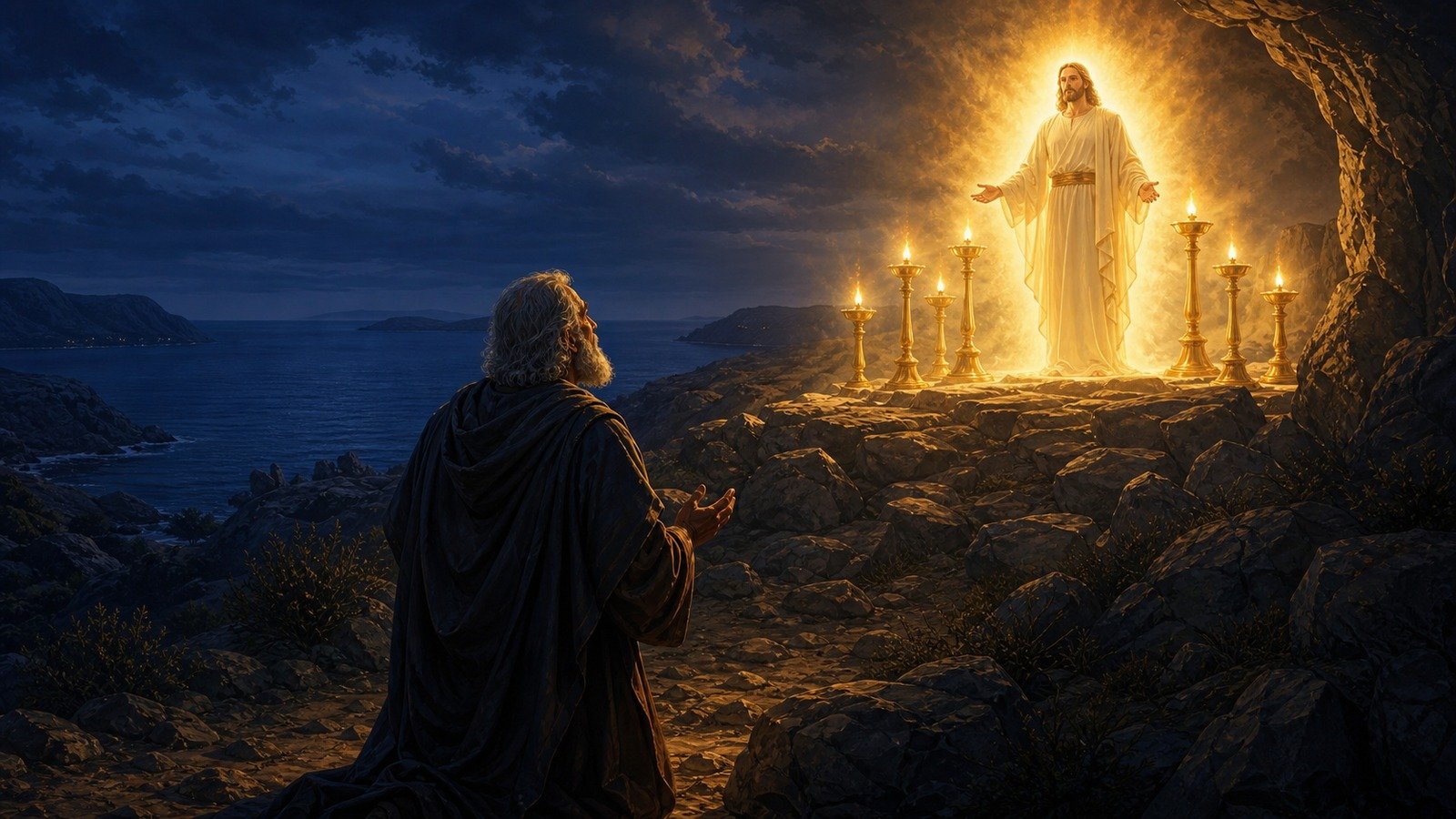
Exiled to the small island of Patmos "because of the word of God," a writer identifying himself as John receives a vision of the risen Christ walking among seven golden lampstands and is commanded to write what he sees to seven churches in the province of Asia.
Further context
2 min readThe writer names himself John and says he was on the island of Patmos because of the word of God and the testimony of Jesus.
Patmos is a small rocky island in the Aegean, about seventy kilometres off the coast of Asia Minor, roughly thirty-four square kilometres, with a good harbour. Roman authorities used islands for relegation, a form of banishment short of exile proper, and it was a normal sentence for people considered a nuisance rather than a danger.
The date is disputed between two options. Irenaeus, writing in the second century, says the vision was seen towards the end of the reign of Domitian, which puts it around AD 95, and that is the majority view. A minority argue for the late 60s, under Nero, mainly on internal grounds involving the state of the temple and the numbering of emperors.
Who John was is a separate question. He identifies himself simply as a servant and brother, without claiming apostleship, and his Greek is rough in a way that is quite unlike the fourth Gospel. Some early writers accepted him as the apostle; Dionysius of Alexandria, in the third century, argued carefully on stylistic grounds that he was a different John, and the eastern church was slow to accept the book at all.
On the Lord's Day he is in the Spirit and hears a loud voice like a trumpet behind him, telling him to write what he sees and send it to seven churches.
Turning round, he sees seven golden lampstands, and among them someone like a son of man, dressed in a robe reaching down to his feet and with a golden sash round his chest. His head and hair are white like wool, his eyes like blazing fire, his feet like bronze glowing in a furnace, his voice like the sound of rushing waters. In his right hand he holds seven stars, and out of his mouth comes a sharp, double-edged sword.
Almost every element of that description is assembled from the older prophets, particularly Daniel and Ezekiel, and the book continues that way throughout: several hundred allusions to the Hebrew Scriptures and not one direct quotation.
John falls at his feet as though dead. A hand is placed on him: do not be afraid. I am the First and the Last. I am the Living One; I was dead, and now look, I am alive for ever and ever.
Relegation to an island was a standard Roman penalty and did not usually involve hard labour, despite the tradition of Patmos as a penal colony with mines, for which there is no evidence.
The island now holds a monastery of St John, founded in 1088, and a cave identified since the medieval period as the place of the vision. The monastery library is one of the oldest continuously operating in the world.
The book calls itself an unveiling, a apokalypsis, and it belongs to a whole genre of Jewish writing of that kind produced between about 200 BC and AD 100, of which Daniel is the one inside the Bible.