

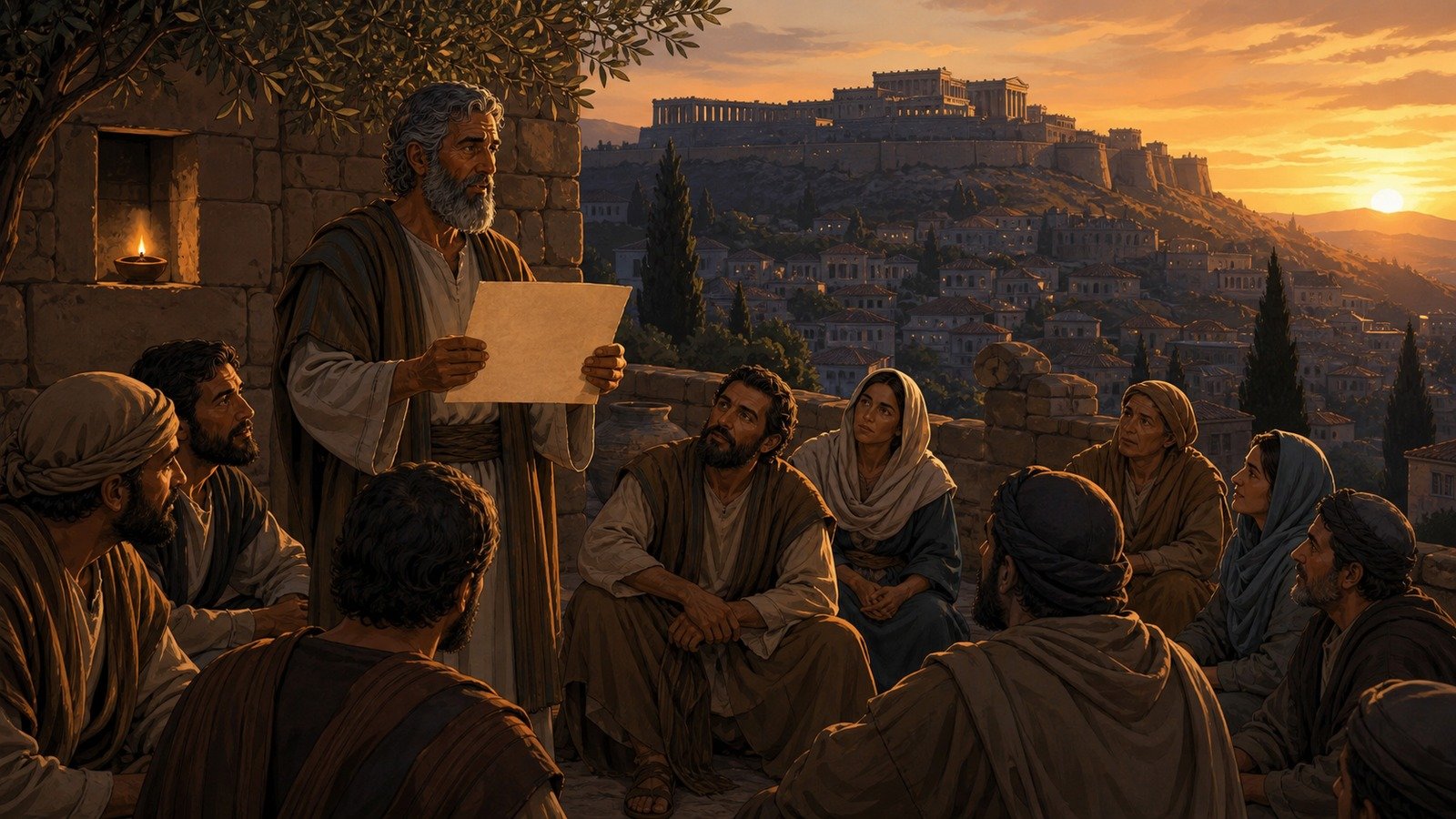
Christ commends the Pergamene church for remaining faithful "where Satan has his throne," but rebukes it for tolerating teaching associated with Balaam and the Nicolaitans, calling for repentance.
Further context
2 min readPergamum sat on a steep hill about twenty-five kilometres inland, and it had been the capital of an independent kingdom before its last king bequeathed it to Rome in 133 BC. Its library was second only to Alexandria's, and when Egypt cut off the papyrus supply the city developed treated animal skin instead, which is why parchment carries its name.
The phrase used of it is the arresting one: I know where you live, where Satan has his throne.
What that refers to has been argued for centuries and there are four serious candidates, all on the same hill. The great altar of Zeus, a colossal structure on a terrace with a frieze of gods fighting giants, now reassembled in Berlin. The temple of Augustus and Roma, the first in the province and the centre of the imperial cult. The sanctuary of Asclepius, the healing god whose symbol was a serpent and whose shrine drew visitors from across the empire. Or simply the city's position as the seat of the Roman governor, which gave it the power of capital punishment.
Any of them would do, and the first readers presumably knew which.
The commendation follows from it: you remain true to my name. You did not renounce your faith in me, not even in the days of Antipas, my faithful witness, who was put to death in your city.
Antipas is named and nothing else about him is known. The word used of him, martys, means witness and is the word that became martyr.
The criticism concerns tolerating two things. Some there hold to the teaching of Balaam, who taught Balak to entice the Israelites to sin by eating food sacrificed to idols and by sexual immorality. And some hold to the teaching of the Nicolaitans.
Balaam is the prophet hired to curse Israel who could not, and who is later blamed for advising the Moabites to seduce them instead. The Nicolaitans are mentioned twice and never explained, and second-century writers connect them to one of the seven appointed at Jerusalem, on no evidence anyone can check.
The practical issue behind both is the same one Paul had dealt with at Corinth: whether a believer could eat meat from a temple, which in a Greek city meant whether he could attend the dinners at which business and civic life were conducted.
The great altar was excavated by German archaeologists in the 1870s and shipped to Berlin, where it was reassembled in a purpose-built museum. Anyone wanting to see what the first readers may have had in mind can walk up its steps.
Parchment made the codex possible, and the codex is the form in which Christian writings circulated from very early on, while Jewish and pagan works stayed on scrolls for centuries longer.
The promise given to Pergamum includes a white stone with a new name known only to the one who receives it, and white stones were used in the ancient world for acquittal in court, for admission tickets and as tokens of victory.