

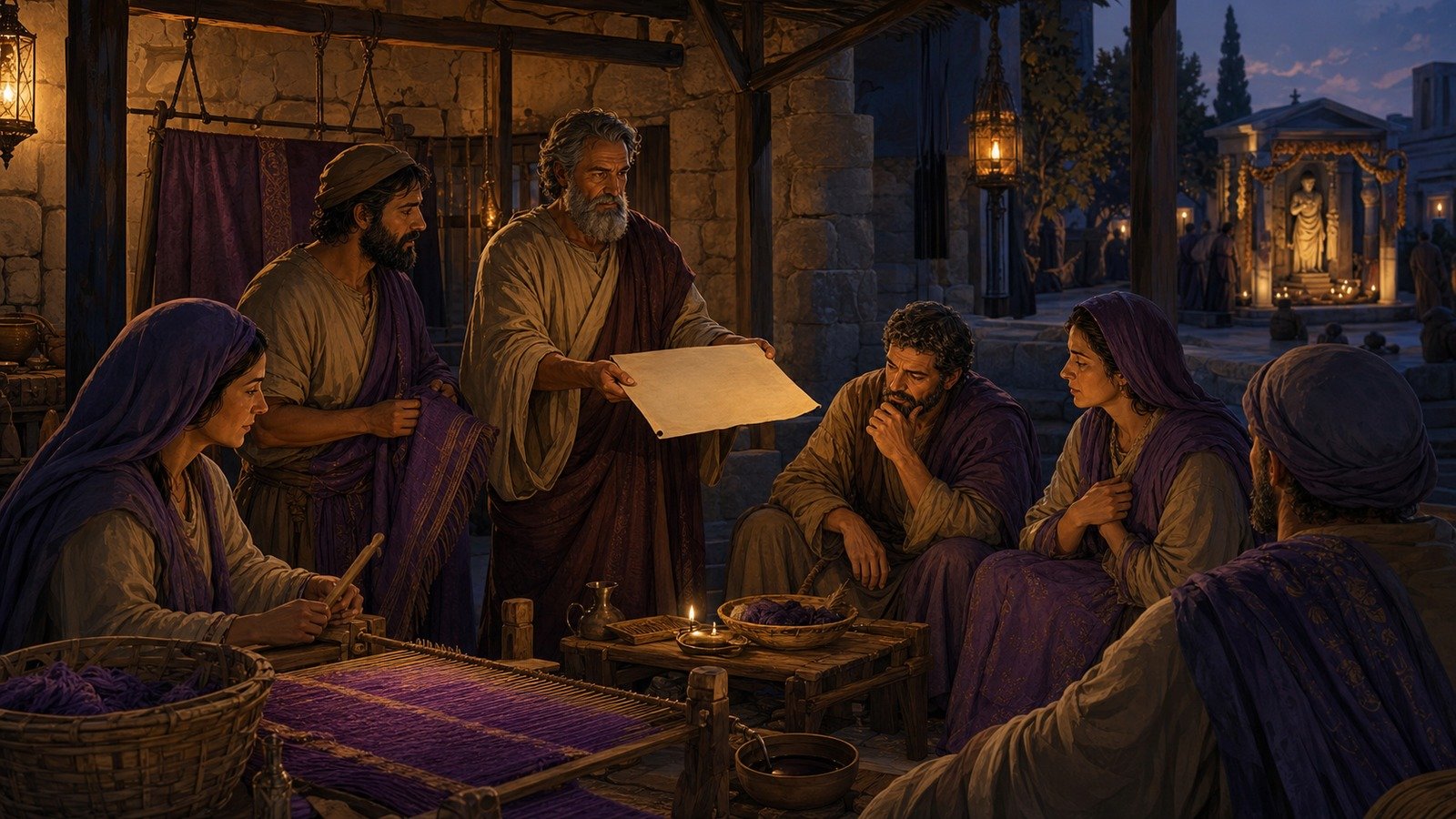
Christ praises the Thyatiran church's growing love, faith and service, but sharply condemns its tolerance of a prophetess he calls "Jezebel," who is leading believers into sexual immorality and idolatry.
Further context
2 min readThyatira was the least distinguished of the seven cities, a manufacturing town on a plain with no natural defences and no great temple, and it receives the longest of the seven messages.
What it was known for was trade guilds, and the inscriptions found there list more of them than at any other city in Asia: wool workers, linen workers, leather workers, tanners, potters, bakers, slave dealers and dyers. Lydia, the first convert at Philippi, was a dealer in purple cloth from Thyatira.
Those guilds are the whole problem. Membership was effectively compulsory for anyone in a trade, and each guild had a patron deity, held its meetings and common meals in a temple precinct, and opened them with a libation. A believer who would not take part could not work.
The commendation is warm and it is about growth: I know your deeds, your love and faith, your service and perseverance, and that you are now doing more than you did at first.
Then the criticism, and it is the sharpest of the seven. You tolerate that woman Jezebel, who calls herself a prophet. By her teaching she misleads my servants into sexual immorality and the eating of food sacrificed to idols.
Jezebel is not her name. It is the name of the Phoenician queen who married Ahab and promoted the worship of Baal in Israel, and using it is a judgement rather than an identification. Who she actually was is unknown; a woman with standing in the congregation, teaching, and evidently persuasive.
What she was teaching can be inferred from the setting. If eating food offered to idols was permissible, the guild dinners were open, and a Christian craftsman could keep his livelihood. That is not a frivolous position, and Paul had argued something close to it at Corinth before qualifying it heavily.
The response is uncompromising and its language is violent: I have given her time to repent of her immorality, but she is unwilling. So I will cast her on a bed of suffering, and I will make those who commit adultery with her suffer intensely, unless they repent of her ways.
Then something added for the rest: I will not impose any other burden on you, except to hold on to what you have until I come.
The promise to the one who is victorious includes authority over the nations, quoted from a psalm about ruling with an iron sceptre.
Thyatira's message contains the only direct claim in the book that the speaker searches hearts and minds, and it is made to the least significant of the seven cities.
The promise attached, the morning star, is picked up at the very end of the book, where the speaker identifies himself as the bright morning star.
Thyatira's message is the longest of the seven and the city is the smallest, which is the pattern of the whole book: the least significant place gets the most attention.
Whether the woman called Jezebel held any recognised position is unclear. She is described as calling herself a prophet, which suggests the congregation had not appointed her and had not stopped her either.