

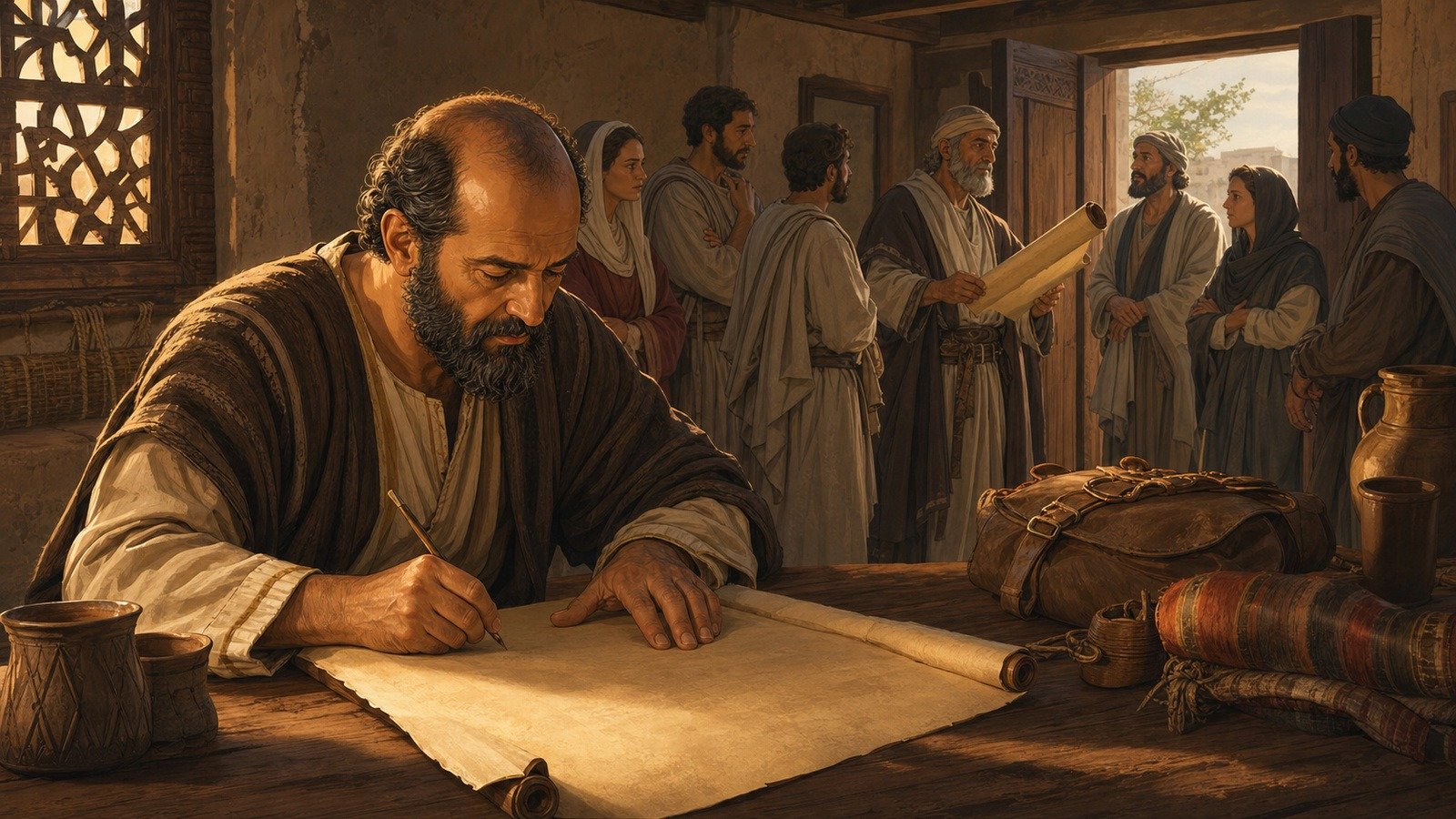
Paul writes urgently to churches in Galatia who are being persuaded to adopt Jewish law-keeping alongside faith in Christ, defending his apostolic authority and arguing that justification comes through faith rather than through observing the Law.
Further context
2 min readPaul writes to churches in Galatia because teachers have arrived after he left and are telling the Gentile converts that faith in Christ is not enough: they must also be circumcised and keep the law of Moses.
It is the angriest thing he wrote. Every other letter of his opens with thanksgiving for the recipients. This one opens with astonishment: I am astonished that you are so quickly deserting the one who called you to live in the grace of Christ and are turning to a different gospel.
Of the men teaching it he says: as for those agitators, I wish they would go the whole way and emasculate themselves. That sentence is normally softened in polite discussion and there is nothing polite about it.
The argument runs in three movements.
First his own authority. He insists the message did not come to him from any human source, and gives an itinerary to prove how little contact he had with Jerusalem, including the fifteen days with Peter and a meeting years later at which the leaders added nothing to his message. He also describes opposing Peter to his face at Antioch over withdrawing from Gentile tables, which is the only recorded quarrel between two apostles.
Then Scripture. Abraham believed God, and it was credited to him as righteousness, and that happened four hundred and thirty years before the law was given. If righteousness came through the law, then Christ died for nothing.
Then the consequence. There is neither Jew nor Gentile, neither slave nor free, nor is there male and female, for you are all one in Christ Jesus.
The letter closes with a description of what life produced by the Spirit looks like, which is one of the most quoted lists in Christian writing: love, joy, peace, forbearance, kindness, goodness, faithfulness, gentleness and self-control.
Its date depends on which Galatia is meant. On the southern reading it is addressed to the churches of the first journey and may be the earliest of Paul's letters, written before the Jerusalem council; on the northern reading it is later. The question is unresolved and it matters, because the letter and the council are dealing with the same dispute.
Sixteen centuries later Luther lectured on it, and what he said started the Reformation in Germany.
Which Galatia is meant determines the date, and the two options are quite different. Galatia was originally the territory of Celtic tribes who had migrated into central Asia Minor in the third century BC, and it later became a Roman province stretching much further south to include Antioch, Iconium, Lystra and Derbe.
On the southern reading Paul is writing to the churches of his first journey, and the letter may predate the Jerusalem council, which would explain why he never cites its ruling in an argument where it would have settled everything.
He also mentions writing in large letters with his own hand, which readers have taken as evidence of poor eyesight and as an old man's signature written deliberately large.