

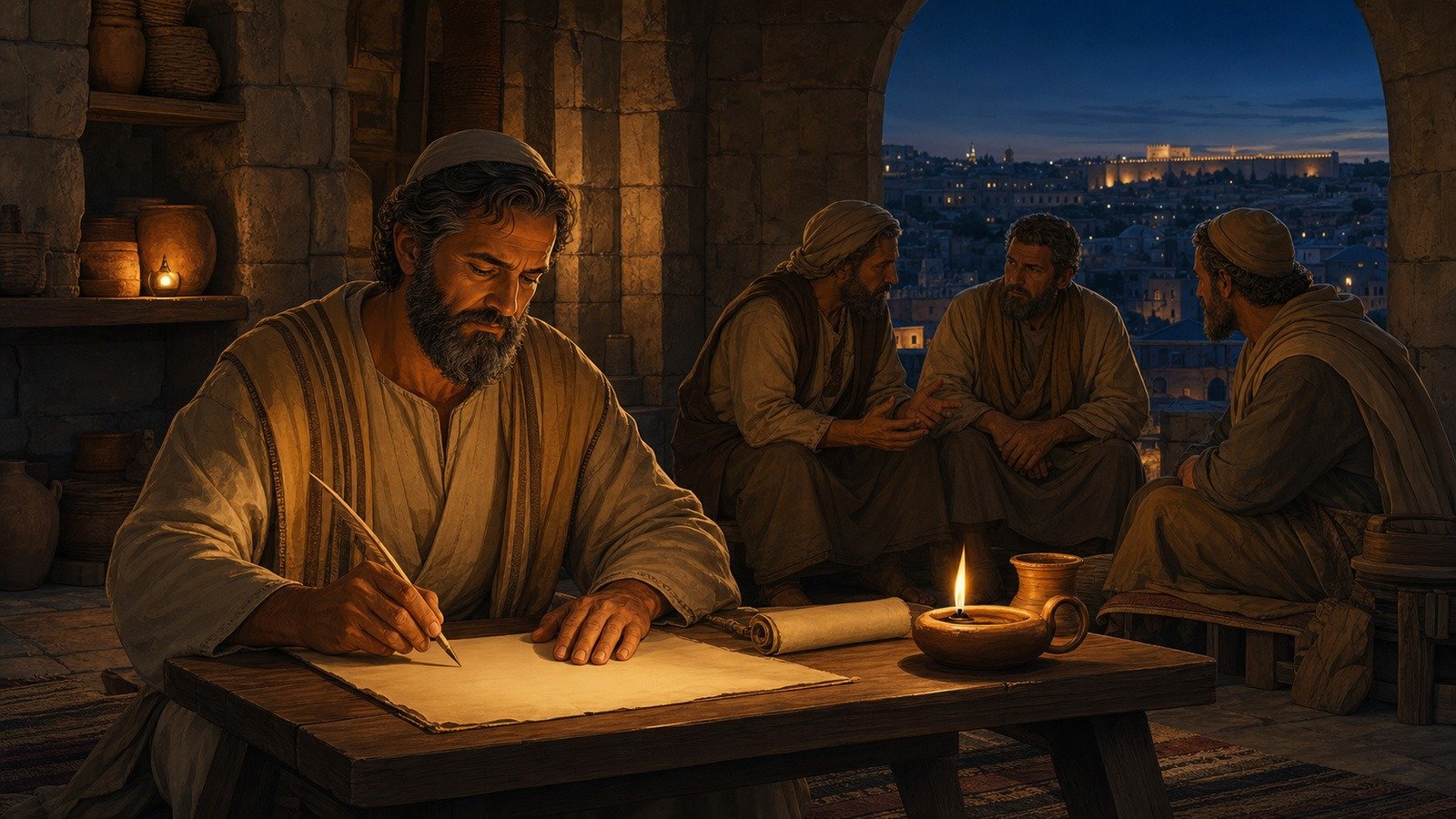
Traditionally attributed to James, the brother of Jesus and leader of the Jerusalem church, this practical letter on faith and works is dated by many scholars earlier than any other New Testament document, though its precise date and even its authorship are debated.
Further context
2 min readThe writer identifies himself only as James, a servant of God and of the Lord Jesus Christ, and writes to the twelve tribes scattered among the nations.
Four men named James appear in the New Testament, and the traditional identification is with the brother of Jesus, who led the Jerusalem church and was executed in AD 62. The absence of any explanation of who he is points that way; a man who needed no introduction was either an apostle or that James.
What he writes is unlike anything else in the New Testament. There is almost no theology of the cross, no discussion of the resurrection, and no mention of Gentiles. What there is instead is a sequence of short, hard practical instructions in a style close to the Hebrew wisdom writings and close, in places, to the Sermon on the Mount without ever quoting it.
The best-known passage is about faith and works. What good is it if someone claims to have faith but has no deeds? Suppose a brother or sister is without clothes and daily food. If one of you says to them, go in peace, keep warm and well fed, but does nothing about their physical needs, what good is it? Faith by itself, if it is not accompanied by action, is dead.
Luther found this so difficult to reconcile with Paul that he called it an epistle of straw and relegated it in his German Bible, and the tension has been discussed ever since.
The usual resolution is that the two men are answering different questions with the same vocabulary. Paul is arguing against people who thought keeping the law earned standing before God; James is arguing against people who thought professing belief required nothing of them. Paul says a man is justified by faith and not by works of the law; James says faith without works is dead. Both quote Abraham.
The letter is also fierce about wealth in a way that has few parallels. Now listen, you rich people, weep and wail because of the misery that is coming on you. Look! The wages you failed to pay the workers who mowed your fields are crying out against you.
And it contains the most sustained treatment anywhere of the tongue: a small part of the body that makes great boasts, a spark that sets a forest on fire.
The dating is disputed. If it is the brother of Jesus, it must be before AD 62, and many place it in the 40s, which would make it the earliest Christian document in existence.
The letter contains more allusions to the teaching of Jesus than any other in the New Testament, and quotes none of it directly, which is what would be expected from someone who had heard it at home rather than read it in a book.
It is also the only New Testament letter that never mentions the resurrection, which is one of the reasons for dating it early, before the standard formulations had settled.