

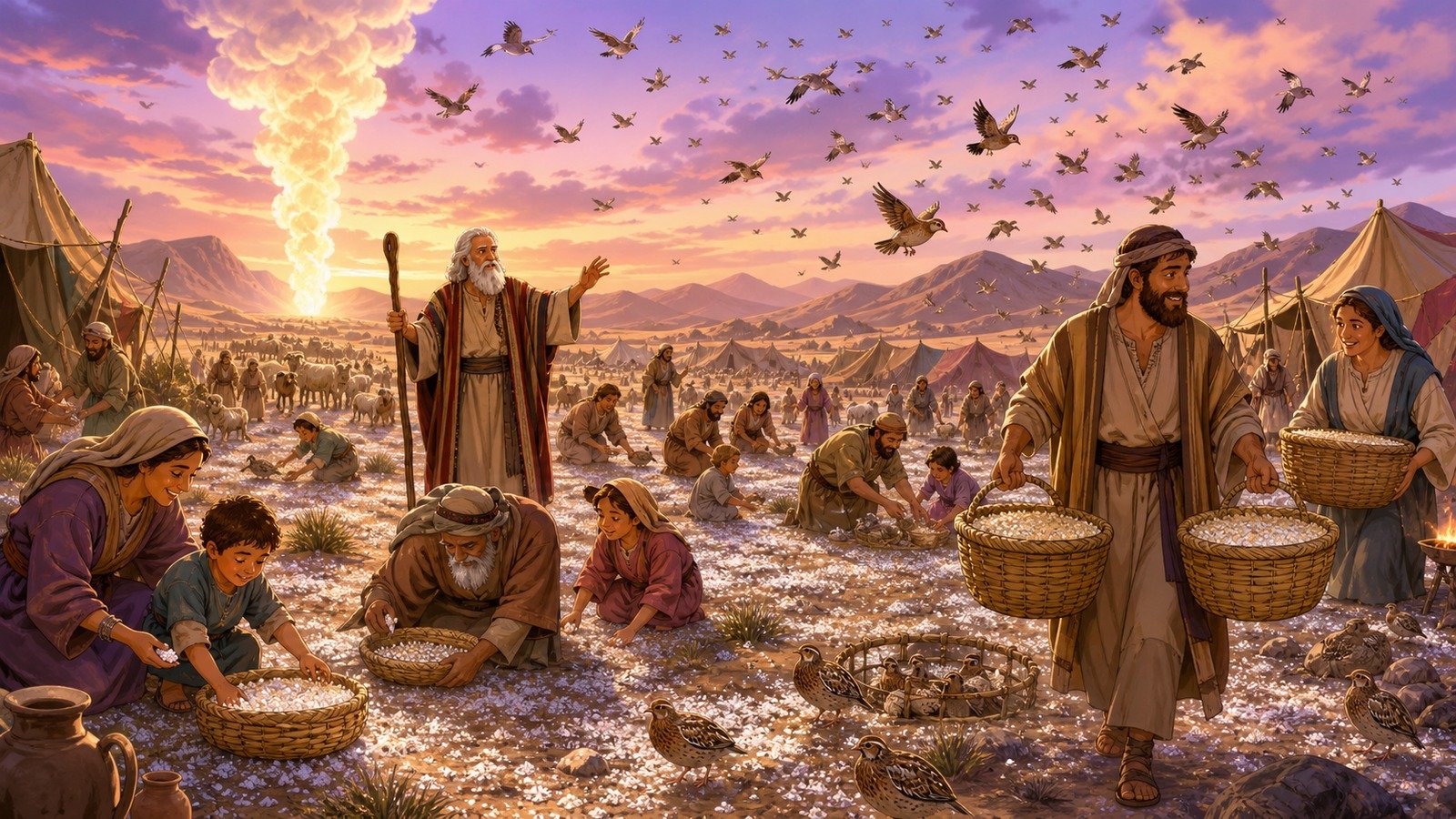
Facing hunger within six weeks of leaving Egypt, Israel complains bitterly for food; God provides quail and daily manna, with a double portion on the sixth day so the Sabbath can be kept without gathering.
Further context
3 min readOne month out of Egypt, on the fifteenth day of the second month, the food runs out. What the people say is worth quoting, because memory is doing something strange in it. If only we had died by the LORD's hand in Egypt! There we sat around pots of meat and ate all the food we wanted, but you have brought us out into this desert to starve this entire assembly to death.
They were slaves, and they are describing Egypt as a place of abundance. That recollection recurs through the whole wilderness period and gets warmer every time.
The provision comes in two forms. Quail cover the camp in the evening, and a migratory explanation fits well: quail cross the Sinai in large numbers in spring and arrive exhausted enough to be caught by hand. In the morning a layer of dew leaves thin flakes like frost on the ground.
The people ask each other what it is, and the Hebrew phrase (man hu) gives the substance its name. It is described as white like coriander seed, tasting like wafers made with honey, and elsewhere as tasting of something made with olive oil, and it is ground in a hand mill or crushed in a mortar, cooked in a pot and made into loaves.
The instructions matter as much as the food. Each person gathers about two litres, and when it is measured the one who gathered much has nothing left over and the one who gathered little has no shortage. Anyone who keeps it overnight finds it full of maggots by morning. On the sixth day they gather twice as much and that portion does not spoil, because the seventh day is a day of rest. Some go out to look on the seventh day anyway and find nothing.
This is the first appearance of the Sabbath as a practice, and it comes before Sinai and before the commandment that formalises it. The people learn to rest through a fortnight of finding nothing on the ground rather than through a law.
The economics are as unusual as the food. Nobody can accumulate, since anything held back rots. Nobody can go short, since the one who gathered little has enough. Effort and outcome are deliberately uncoupled, and a community that has just left a system where their labour built other people's cities is put on a footing where a day's work produces exactly a day's food for everyone. Paul quotes the line about no one having too much or too little when arguing for a collection between churches four centuries later.
The commonest naturalistic proposal is that manna is the honeydew secreted by scale insects feeding on tamarisk in parts of the Sinai, which crystallises into sweet white granules and is still gathered locally. That accounts for the appearance and the taste. It does not account for the quantity required, the forty years, the daily spoiling, the exception on the sixth day, or the absence on the seventh.
They ate it for forty years, until they reached the border of Canaan, and a jar of it was kept as a memorial. Much later a crowd cited this to Jesus and was corrected on two points: it was not Moses who gave them the bread from heaven, and the true bread is the one who comes down from heaven and gives life to the world.