

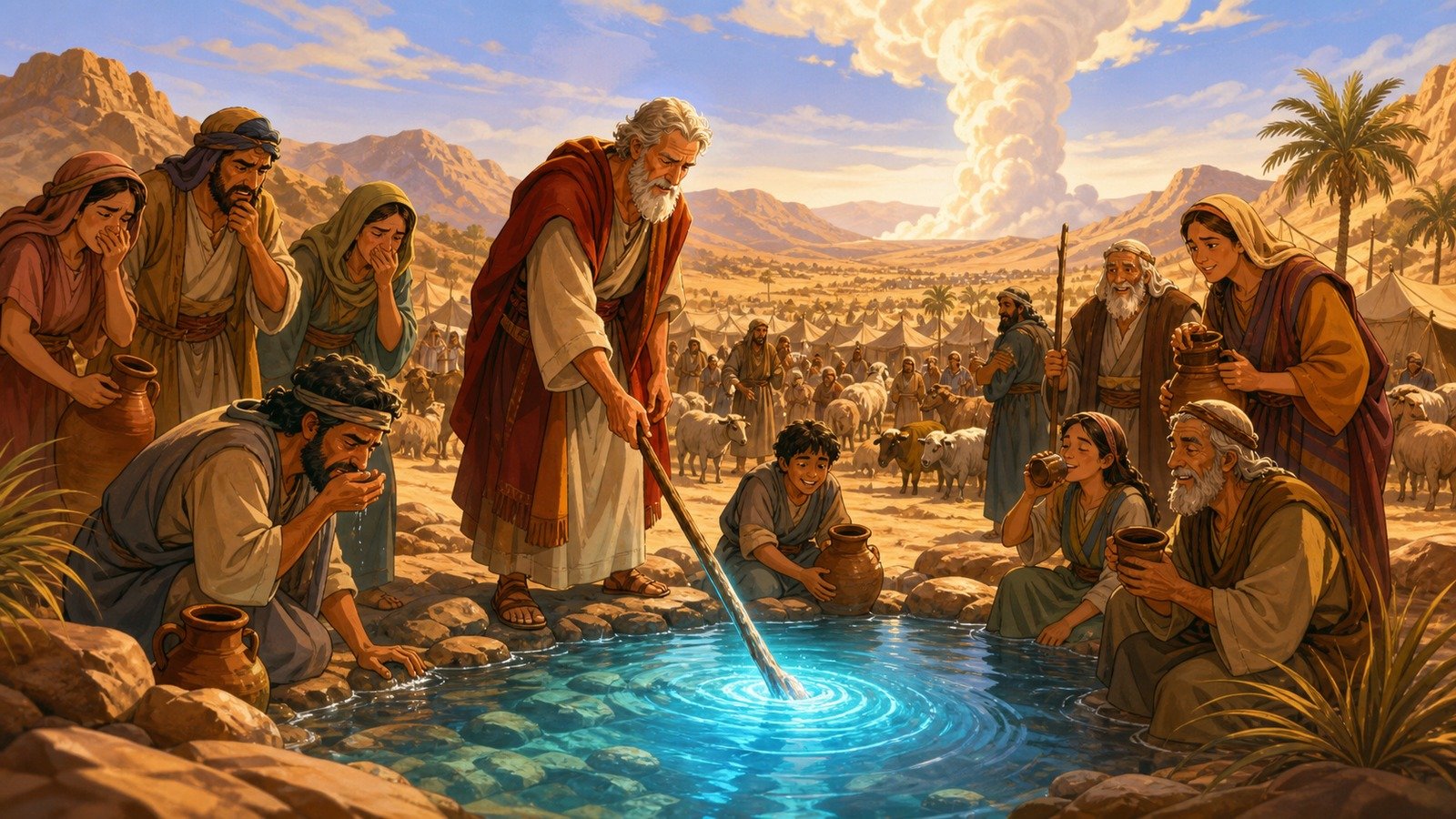
Three days after the crossing, Israel finds only bitter water at Marah; God shows Moses a piece of wood that sweetens it when thrown in, and gives Israel a statute promising freedom from Egypt's diseases if they obey him.
Further context
3 min readThree days. That is the interval between the singing at the sea and the first complaint. Israel travels into the Desert of Shur and for three days finds no water at all.
When they reach Marah they cannot drink what is there, because it is bitter, and the place is named for it. Brackish water is the ordinary condition of wells in that region, where evaporation concentrates mineral salts, and travellers' accounts of the Sinai routinely describe springs that are undrinkable.
The verb used for the people's response is the one that will define this generation: they grumbled against Moses. It recurs constantly over the following forty years and eventually becomes the charge that keeps them out of the land.
Moses cries out and is shown a piece of wood, which he throws into the water, and the water becomes fit to drink. Whether the wood works chemically or the act is simply the form the instruction took is never addressed, and attempts to identify a Sinai shrub with water-purifying properties are speculative.
What follows the miracle is more substantial than the miracle. A ruling and an instruction are issued there, and there they are tested. What is offered is conditional: if you listen carefully to the LORD your God and do what is right in his eyes, if you pay attention to his commands and keep all his decrees, I will not bring on you any of the diseases I brought on the Egyptians, for I am the LORD who heals you.
That last phrase is one of a series of compound names attached to particular moments, alongside the LORD Will Provide on Moriah and the LORD is my Banner a few weeks later. Each fixes a claim about God to the place where it was demonstrated. This one is medical, and it is made in an episode about water that makes people ill.
What is promised is not immunity in general but exemption from the diseases they have just watched fall on somebody else. The condition attached is attention and obedience, and the test mentioned is the shortage itself rather than a separate examination.
They end up at Elim, where there are twelve springs and seventy palm trees, and they camp there beside the water. The numbers correspond to the twelve tribes and to the seventy who went down into Egypt, and whether that is coincidence or the reason the detail was preserved, both figures are given.
The pattern established in these few sentences runs through everything that follows: a shortage, a complaint, an intervention, and a condition attached. They have been out of Egypt for less than a week.
The speed of the collapse is the thing to hold on to. Three days earlier they were singing about a God unlike any other, majestic in holiness, who had just destroyed the strongest army in the region. Three days later they cannot drink and the singing has become grumbling. Nothing is said about the inconsistency, and no rebuke is issued. What happens instead is that water is provided and terms are offered, which is the shape almost every episode in the wilderness will take.
Where Marah was is unknown. Sites along the eastern shore of the Gulf of Suez have been proposed on the strength of their brackish springs, and none can be confirmed.