

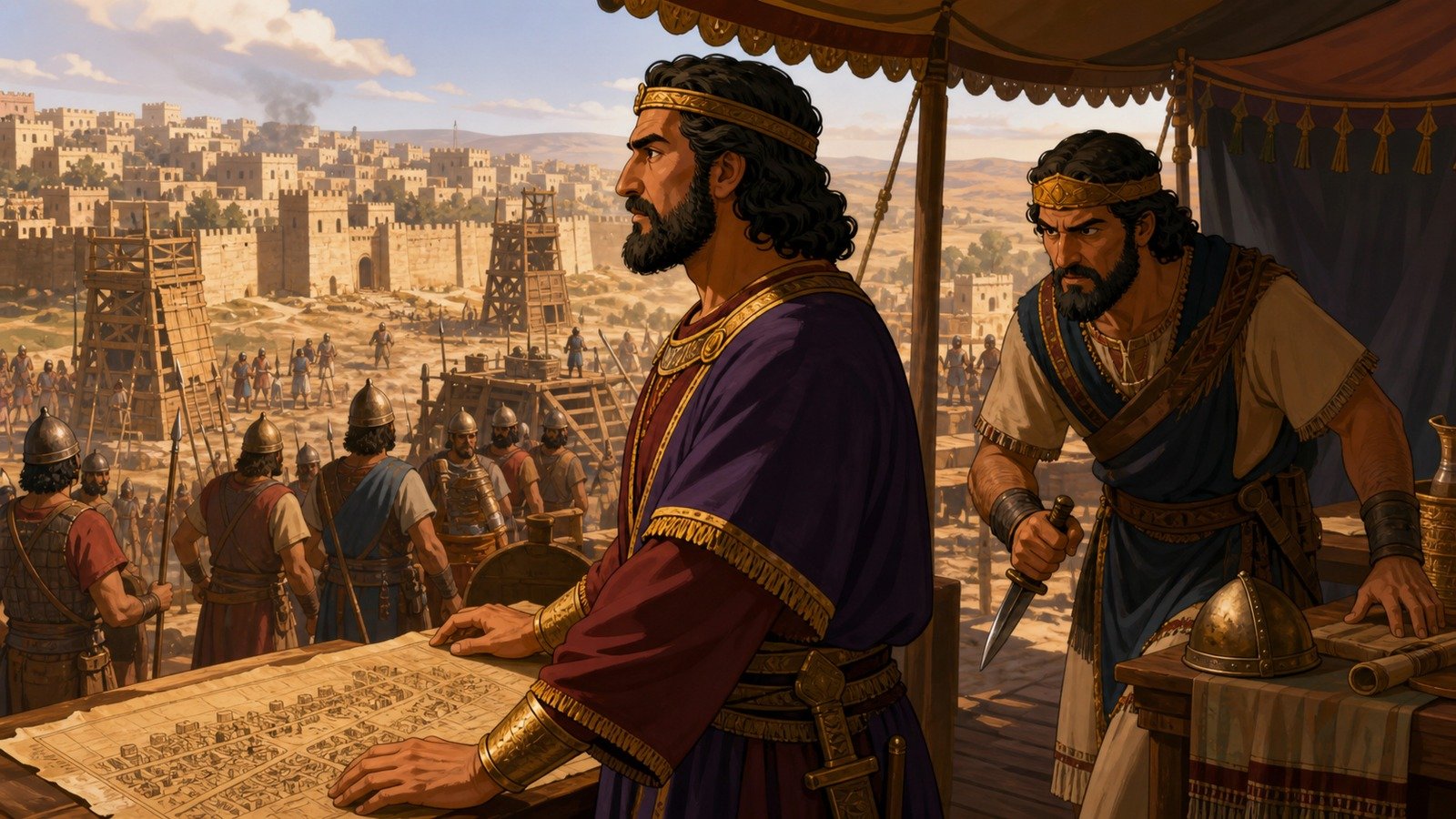
Jeroboam's son Nadab reigns barely two years before Baasha assassinates him during a siege and wipes out the rest of Jeroboam's family, fulfilling an earlier prophecy against Jeroboam's house.
Further context
3 min readJeroboam's son lasts two years. He is besieging the Philistine town of Gibbethon when Baasha son of Ahijah, of the tribe of Issachar, kills him and takes the throne, and then kills every member of Jeroboam's family, not sparing anyone that breathed.
That is the first dynastic extermination in the northern kingdom and it establishes the pattern for everything that follows. Over the two centuries of its existence the north runs through nine separate dynasties and at least seven of its kings are assassinated. The south, over the same period, has one family on the throne from beginning to end.
The reason for that difference is structural rather than moral. Judah had a covenant attached to the house of David and a capital city that belonged to that house, and the succession was never seriously in question even when a king was murdered. The north had a kingship founded on a prophetic word given to a labour foreman, with no dynastic principle behind it, so anyone with an army and an opportunity had a claim as good as the incumbent's. Jeroboam himself came to power that way, and the argument works equally well for the man who kills his son.
The killing is also presented as the fulfilment of something announced in advance. When Jeroboam's own son fell ill, his wife had gone in disguise to the prophet Ahijah, who was old and blind, and he had identified her before she reached the door and sent her home with a message that every male of the house of Jeroboam would be cut off and that the boy would die as she stepped back into the town. Both happened.
Nadab's assessment is the standard northern formula, applied here for the first time to a successor: he did evil in the eyes of the LORD, following the ways of his father and committing the same sin his father had caused Israel to commit. That sentence, with the names changed, is repeated over almost every king of the north for the next two hundred years, and it always refers to the two golden calves.
The war with Judah continues throughout, which is why an Israelite king is at Gibbethon in the first place: the Philistine towns on the coastal plain are contested ground, and the northern kingdom is fighting on two fronts.
The prophet Ahijah, who identified Baasha's victim's family as doomed, is the same man who had torn his cloak into twelve pieces and handed ten of them to Jeroboam outside Jerusalem a generation earlier. He installed the dynasty and he announced its destruction, and he was blind by the time he did the second.
Gibbethon appears again a generation later, when another Israelite king is killed during a siege of the same town, so this small Philistine settlement is besieged twice, decades apart, and produces two coups.
Nadab is the son of Jeroboam, and his death two years into his reign fulfils exactly what a prophet had told his father: the whole house would be swept away. Baasha kills every member of it.
That pattern repeats through the northern kingdom with a regularity that is the point of the way these reigns are recorded. Nine dynasties in two hundred years, most of them ended by assassination, against one continuous line in Judah for over three centuries.
Gibbethon was a Philistine town on the coastal plain, and the fact that Israel was besieging it tells you the northern kingdom was fighting on its western frontier while its kings were being murdered in the field.