

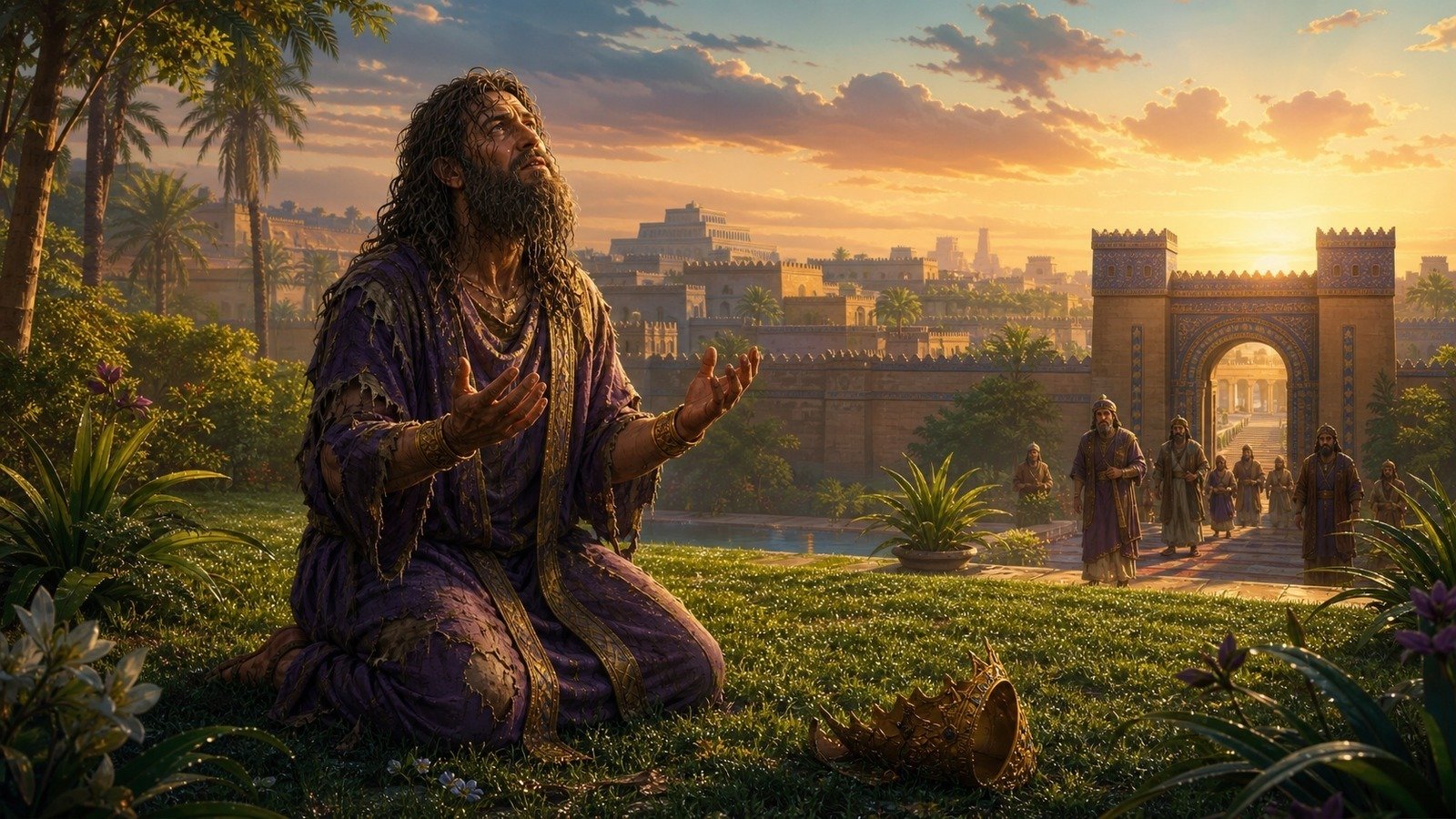
After a dream warning him of coming humiliation for his pride, Nebuchadnezzar is driven from human society for a period, living like an animal, until his sanity and throne are restored when he acknowledges "that the Most High is sovereign."
Further context
3 min readThe episode is written in the first person, framed as a public proclamation from Nebuchadnezzar himself to all peoples, nations and men of every language throughout the world, which is an unusual literary form and is either an authentic royal document or a very deliberate imitation of one.
He describes a dream of an enormous tree at the centre of the earth, visible to the ends of it, with beautiful leaves and abundant fruit, sheltering the animals and birds. Then a messenger from heaven orders it cut down, its branches trimmed and its fruit scattered, but the stump and roots are to be left, bound with iron and bronze, and drenched with dew, and the sentence turns from a tree to a person: let him live with the animals among the plants of the earth, let his mind be changed from that of a man and let him be given the mind of an animal, till seven times pass by for him.
Daniel is disturbed for a while before answering and says he wishes the dream applied to the king's enemies. Then he gives it straight and adds advice that is the most striking thing in the chapter: renounce your sins by doing what is right, and your wickedness by being kind to the oppressed. It may be that then your prosperity will continue. A court official telling an absolute monarch that his prospects depend on his treatment of the poor.
Twelve months later, walking on the roof of the royal palace, he says: is not this the great Babylon I have built as the royal residence by my mighty power and for the glory of my majesty? The words are still on his lips when it happens.
He is driven from people, eats grass like cattle, is drenched with the dew of heaven, and his hair grows like the feathers of an eagle and his nails like the claws of a bird.
At the end of the period he raises his eyes towards heaven and his sanity is restored, and the kingdom with it, and he ends the proclamation praising the one who is able to humble those who walk in pride.
No Babylonian record of any of this has been identified, which is unsurprising for an event of that kind. Nebuchadnezzar's own inscriptions are building accounts and there is a documented gap in the record during his later years. A separate document found at Qumran, the Prayer of Nabonidus, describes a Babylonian king afflicted for seven years and healed after a Jewish exile told him to give glory to God, and Nabonidus is known to have spent about ten years away from Babylon at the oasis of Tayma for reasons that remain debated. Whether that text preserves an older form of the same tradition, or borrowed from it, is argued in both directions.
What is described medically matches a recognised condition. Boanthropy, a rare delusion in which a person believes they are an ox and behaves accordingly, is documented in the psychiatric literature, and the description here is precise: driven away from people, eating grass like the ox, hair growing like the feathers of an eagle and nails like the claws of a bird.
The tree in the dream is the standard ancient image for a monarch, and the sentence pronounced on it is stated as a purpose: so that the living may know that the Most High is sovereign over all kingdoms on earth and gives them to anyone he wishes.
Daniel's advice before it happens is unexpectedly practical and is the one piece of moral counsel he gives a king: renounce your sins by doing what is right, and your wickedness by being kind to the oppressed.
Twelve months later, walking on the roof of his palace, the king says: is not this the great Babylon I have built?