

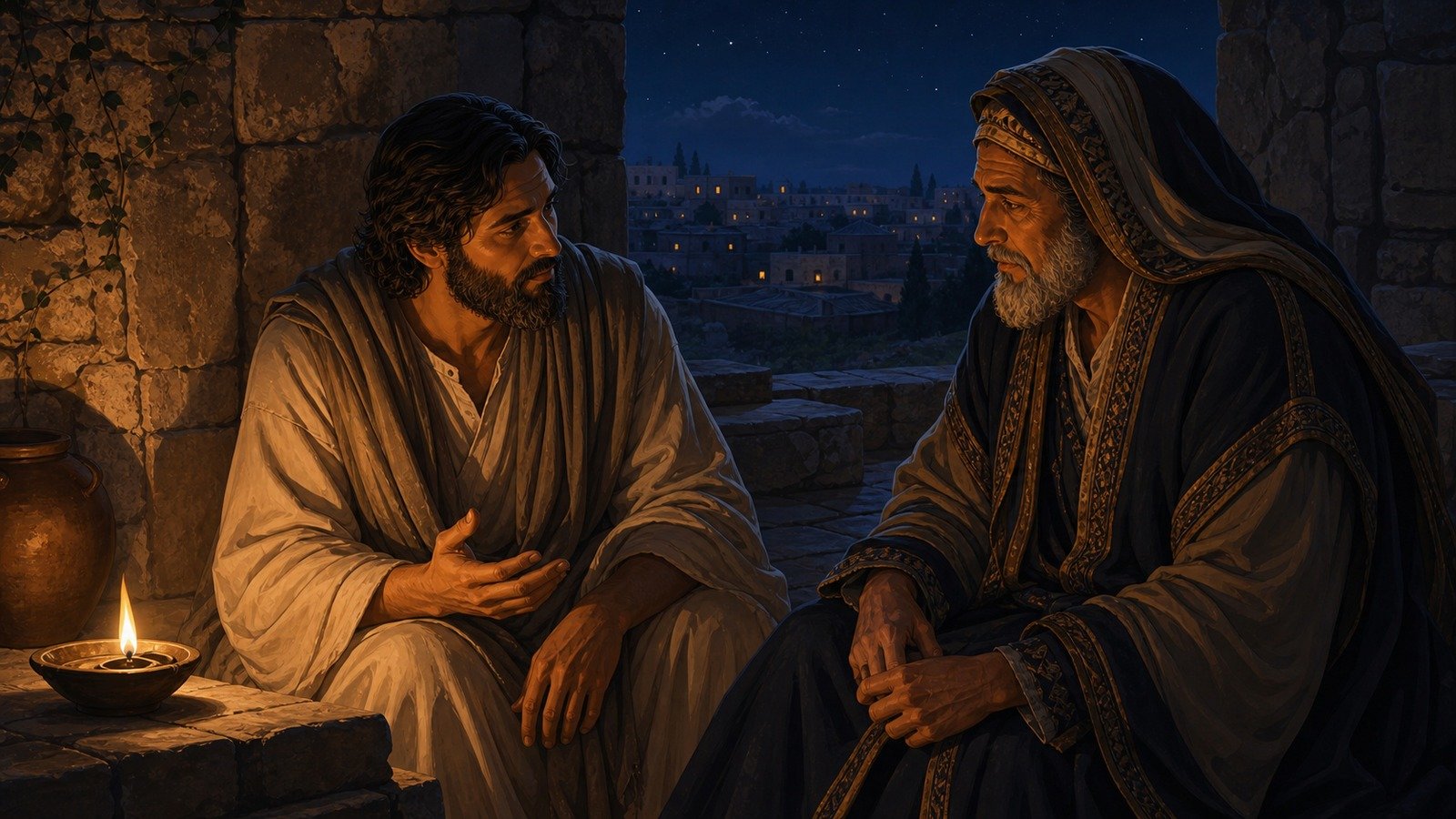
A Pharisee and member of the Jewish ruling council, Nicodemus, comes to Jesus privately by night; Jesus tells him no one can see the kingdom of God without being "born again," and the conversation contains John 3:16, among the most widely known verses in the New Testament.
Further context
3 min readNicodemus is a Pharisee and a member of the Jewish ruling council, which is the seventy-one member body that governed Jewish affairs under Roman oversight, and he is described later as a teacher of Israel. He comes at night, and every reader since has drawn the obvious inference about a senior man not wanting to be seen.
His opening is courteous and careful and commits him to nothing: Rabbi, we know that you are a teacher who has come from God, for no one could perform the signs you are doing if God were not with him.
The reply ignores the compliment entirely and states a condition: no one can see the kingdom of God unless they are born again. The Greek word carries two meanings at once, again and from above, and the ambiguity is deliberate and is what the conversation runs on.
Nicodemus takes the first meaning and produces the objection that has kept the scene alive: how can someone be born when they are old? Surely they cannot enter a second time into their mother's womb to be born.
What follows distinguishes two births, one of flesh and one of the Spirit, and uses a piece of wordplay that works in Greek and Hebrew and not in English. The same word means wind and spirit, and the sentence turns on it: the wind blows wherever it pleases; you hear its sound, but you cannot tell where it comes from or where it is going. So it is with everyone born of the Spirit.
The gentle rebuke that follows is aimed at his profession: you are Israel's teacher, and do you not understand these things?
Then the image is changed to something from the wilderness. Just as Moses lifted up the snake in the desert, so the Son of Man must be lifted up, that everyone who believes may have eternal life in him. A bronze snake on a pole, made at God's instruction, that people bitten and dying had to look at.
And then the sentence that has been printed on more objects than any other in the New Testament: for God so loved the world that he gave his one and only Son, that whoever believes in him shall not perish but have eternal life.
He appears twice more, and the trajectory is worth following. He speaks up in the council when they want to act against Jesus without a hearing, asking whether their law condemns anyone without first hearing him, and is dismissed with a sneer about Galilee. And he turns up at the burial, in daylight, carrying about thirty-four kilograms of myrrh and aloes, which is a quantity fit for a king.
Coming at night is usually read as caution, and it may equally be practical, since the evening was when serious study and discussion took place.
His opening is a careful, formal acknowledgement: Rabbi, we know that you are a teacher who has come from God, for no one could perform the signs you are doing if God were not with him. The we is worth noticing; he speaks for others.
The reply cuts straight across it: no one can see the kingdom of God unless they are born again. The Greek word can mean again or from above, and the ambiguity is deliberate, which is why the confusion that follows is not stupidity.
How can someone be born when they are old? Surely they cannot enter a second time into their mother's womb!
Out of that conversation comes the most quoted sentence in the Bible, and it is delivered at night to one man who came to check him out.