

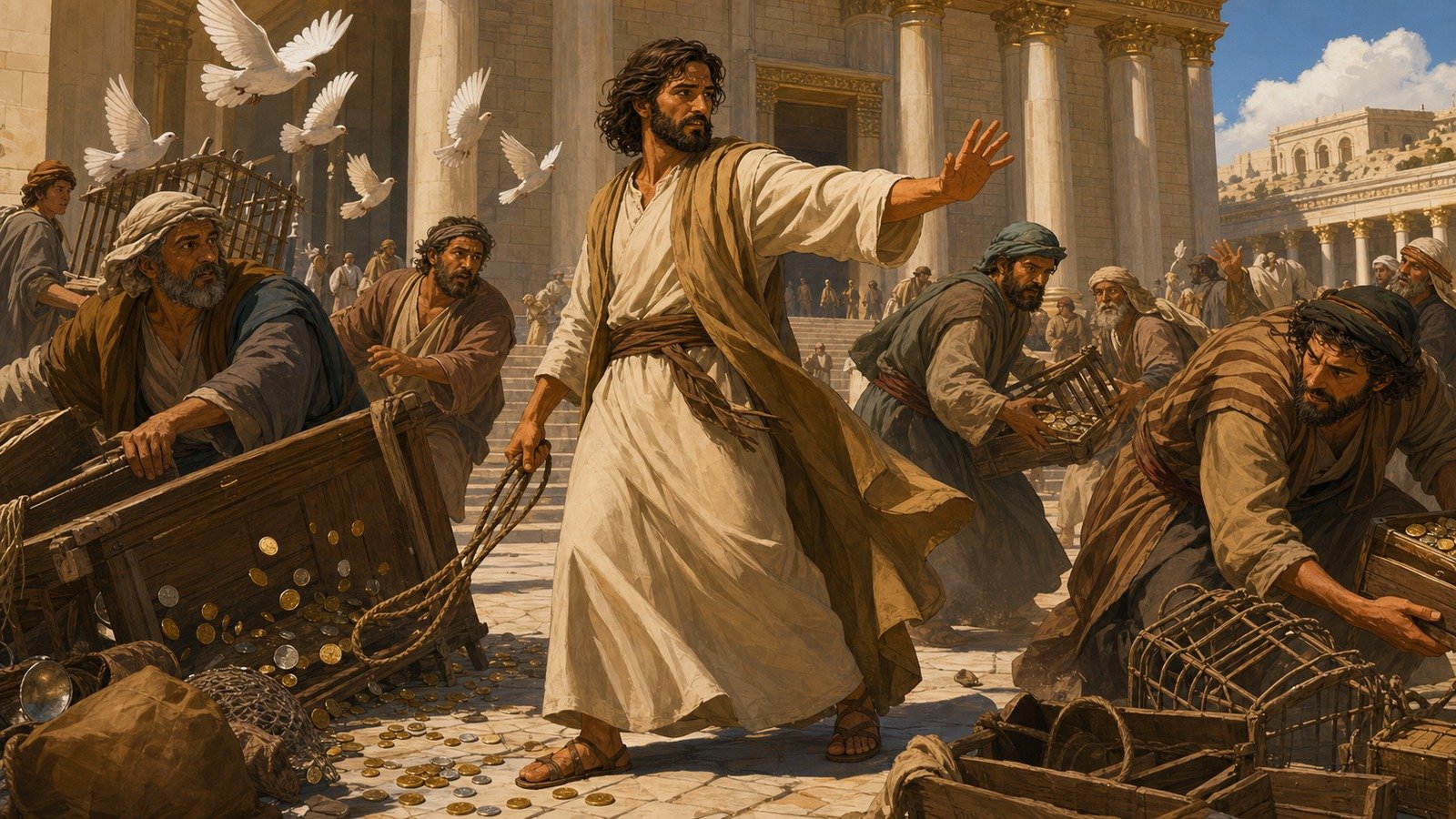
Jesus drives out money changers and animal sellers from the Temple courts, accusing them of turning "my Father's house into a market," and cryptically speaks of destroying and rebuilding "this temple" in three days, a saying his disciples only understand after the resurrection.
Further context
3 min readPassover fills Jerusalem, and the trade Jesus disrupts exists because the system requires it.
Every adult Jewish male owed an annual half-shekel to the temple, and it had to be paid in Tyrian coinage, whose silver content was reliable in a way provincial issues were not. Pilgrims arriving with Roman or Egyptian money had to change it, at a commission. Sellers of cattle, sheep and doves supplied animals for sacrifice, which was a genuine convenience for people who had travelled hundreds of kilometres, and the doves in particular were the offering prescribed for those who could not afford a lamb.
All of it takes place in the outer courtyard, which is the only part of the complex a non-Jewish visitor was permitted to enter.
He makes a whip out of cords, drives out the animals, scatters the coins of the money changers and overturns their tables, and tells those selling doves to get these out of here. The detail about the whip and about not tipping over the dove sellers' cages, only ordering them removed, appears in John alone.
What he says is a charge of theft dressed as a property claim: stop turning my Father's house into a market. The phrase my Father's house is the same one he had used at twelve.
The response from the authorities is a demand for credentials: what sign can you show us to prove your authority to do all this? His answer is deliberately opaque. Destroy this temple, and I will raise it again in three days. They take it literally and point out that it has taken forty-six years to build and is not finished, which is a useful chronological marker placing the exchange around AD 27 or 28.
The number forty-six is worth converting. Work on the temple platform began around 20 or 19 BC, which puts this exchange around AD 27 or 28 and makes it one of the few chronological anchors in the whole ministry. It also means the building was still a construction site throughout, with scaffolding, quarried stone arriving and craftsmen at work, which is not the serene picture the word temple usually produces.
The explanation is supplied afterwards: the temple he had spoken of was his body, and his disciples remembered it after the resurrection. The saying resurfaces at his trial in a garbled form given by witnesses who cannot agree, and again as a taunt at the cross.
Whether this is the same episode as the one recorded in the final week by the other three Gospels is a long-standing question. Some readers hold that there were two cleansings, three years apart. Others hold that John, who arranges his material by theme rather than strictly by sequence, moved a single event to the front in order to state early what the others state late. The differences in detail are real, and neither reconstruction can be demonstrated.
The trade existed because the system required it. Pilgrims came from across the empire and could not bring animals with them, and the annual temple tax had to be paid in Tyrian shekels because the coin was reliably pure silver, which meant Roman and provincial currency had to be exchanged.
Both services were necessary and both were licensed by the priesthood, which took a share.
What is described is a whip made of cords, sheep and cattle driven out, the coins of the money changers scattered and their tables overturned, and to those selling doves an instruction rather than a physical act: get these out of here! Stop turning my Father's house into a market!
Doves were the offering of the poor, which may be why the handling differs.
The demand for a sign produces the answer about destroying this temple and raising it in three days, which the audience takes literally and points out that the building has been under construction for forty-six years.